
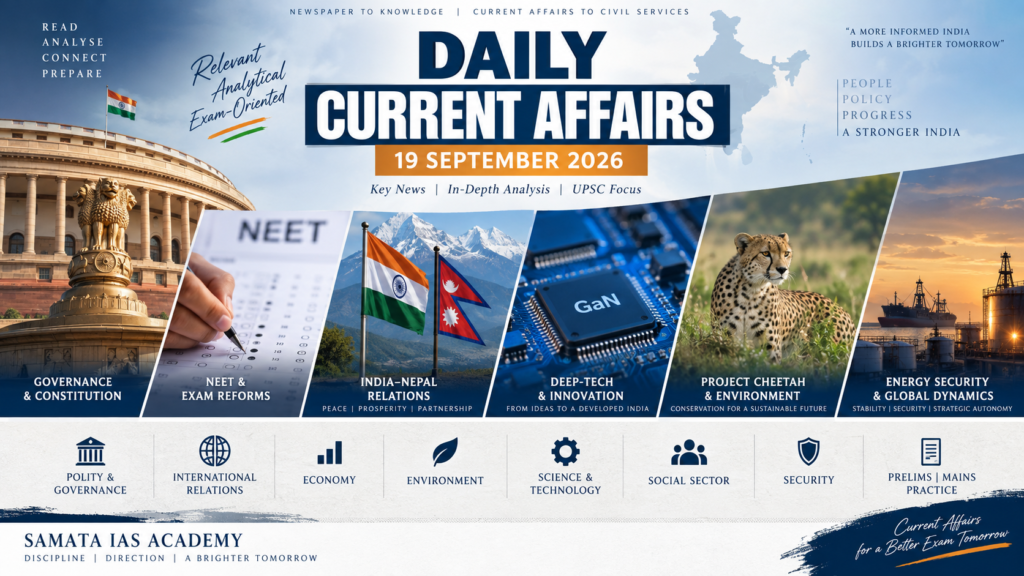
Important News Analysis for UPSC Civil Services Examination
Source: The Hindu, Delhi City Edition, Saturday, 19 September 2026.
This compilation covers the important UPSC-relevant developments from the newspaper. Routine political statements, crime reports, sports and purely local events have been excluded unless they have a significant constitutional, governance, economic, international, environmental or scientific dimension.
🔴 NATIONAL & GOVERNANCE
1. NEET-UG 2027: Shift to Computer-Based Testing Under Consideration
Why in News?
The Union government informed the Supreme Court that shifting NEET-UG 2027 from the conventional pen-and-paper format to Computer-Based Testing (CBT) remains under active consideration.
A task force headed by Nandan Nilekani has been constituted to recommend technological and institutional reforms for the National Testing Agency (NTA). Its report is expected by the end of September.
The Supreme Court has also questioned when the proposed reforms would actually be implemented.
Key Issues
The debate goes beyond merely changing the examination medium.
Major concerns include:
- Question-paper leaks
- Examination-centre security
- Digital infrastructure
- Identity authentication
- Server capacity
- Data security
- Transparency in examination processes
- Grievance redressal
- Institutional capacity of the NTA
NTA Reform
The Supreme Court has stressed the need for structural stability within the NTA, including:
- permanent offices;
- adequate permanent personnel;
- institutional expertise;
- robust technological infrastructure.
UPSC Perspective
GS-II – Governance | Education | Institutional Reform
Keywords: NTA, NEET-UG, CBT, examination reforms, digital governance, transparency, accountability.
Mains Link
How can technology improve the integrity of India’s large-scale public examinations without creating new forms of exclusion and vulnerability?
2. Electoral Roll Revision in West Bengal: Over 37 Lakh Appeals Pending
Why in News?
The Election Commission of India (ECI) has informed the Supreme Court that more than 37 lakh appeals arising from the Special Intensive Revision (SIR) of electoral rolls in West Bengal remain pending before appellate tribunals.
According to the report:
- 38,20,683 appeals were submitted;
- only 1,02,231 had been disposed of;
- approximately 37 lakh appeals remained pending;
- the appeals concern both inclusion and exclusion of names from electoral rolls.
The matter has acquired significance because the Supreme Court had sought greater transparency regarding the pendency and disposal of appeals.
Constitutional Dimension
The issue brings together:
Article 324 → Election Commission
Electoral Roll → Representation of the People Acts
Right to Vote → Statutory Right
Judicial Review → Electoral Integrity
Why Important for UPSC?
Electoral-roll revision raises questions concerning:
- inclusion of eligible voters;
- exclusion of genuine voters;
- documentation;
- migrant and displaced populations;
- transparency;
- due process;
- accessibility of electoral remedies.
The newspaper also reports a related case in Delhi where residents of a Yamuna floodplain settlement whose names were removed from the draft electoral roll are seeking restoration through Form 6 applications.
Mains Question
Electoral rolls constitute the foundation of representative democracy. Discuss the challenges involved in ensuring accuracy while preventing wrongful exclusion of eligible voters.
3. Anti-Defection Law: Telangana High Court Disqualifies MLA
Why in News?
The Telangana High Court has disqualified BRS MLA Danam Nagender on grounds of defection after he joined the Congress.
The High Court held that he stood disqualified under Paragraph 2(1)(a) of the Tenth Schedule read with Article 191(2) of the Constitution.
The case arose after Mr. Nagender, elected as a BRS MLA, contested the 2024 Lok Sabha election as a Congress candidate.
Tenth Schedule
The anti-defection provisions were inserted through the 52nd Constitutional Amendment Act, 1985.
A legislator may be disqualified if:
- He/she voluntarily gives up membership of a political party; or
- Votes or abstains from voting contrary to the party direction, subject to the provisions of the Schedule.
Important Exception
The merger provision permits protection where at least two-thirds of the members of a legislature party agree to merge with another political party.
UPSC Concept
Tenth Schedule → Anti-defection → Presiding Officer → Judicial Review → Legislative Accountability
Core Debate
The anti-defection law seeks to balance:
- political stability;
- party discipline;
- individual legislative freedom;
- representative accountability.
4. FCRA Amendment Bill: Debate Over Asset-Takeover Provision
Why in News?
Members of the Joint Parliamentary Committee (JPC) examining amendments to the Foreign Contribution (Regulation) Act have raised concerns regarding provisions relating to the takeover of assets.
FCRA: Basic Purpose
The Foreign Contribution (Regulation) Act regulates the acceptance and utilisation of foreign contributions by:
- associations;
- NGOs;
- organisations;
- individuals covered by the law.
Its broad objective is to ensure that foreign funding does not adversely affect:
- national security;
- public interest;
- political processes;
- sovereignty and integrity.
Constitutional Dimension
The debate over asset-related provisions raises questions concerning Article 300A, under which:
No person shall be deprived of his property save by authority of law.
UPSC Perspective
This is a useful intersection of:
Civil Society + National Security + Fundamental Rights + Property Rights + Parliamentary Oversight
🟠 INTERNATIONAL RELATIONS
5. India–Nepal Relations: Post-Flood Reconstruction and Diplomatic Reset
Why in News?
India and Nepal have discussed post-flood reconstruction and strengthening bilateral relations, particularly in the areas of:
- economy;
- energy;
- connectivity;
- trade;
- investment;
- people-to-people relations.
External Affairs Minister S. Jaishankar met Nepal’s Finance Minister Swarnim Wagle in New Delhi.
The discussions come ahead of a proposed visit by Nepal’s Prime Minister to New Delhi.
The newspaper reports that the August floods caused extensive damage, with reconstruction requirements estimated at more than $5 billion.
India–Nepal Relations: Major Pillars
| Area | Significance |
|---|---|
| Geography | Open border and deep social linkages |
| Energy | Hydropower cooperation |
| Connectivity | Roads, railways and air links |
| Trade | Nepal’s significant dependence on Indian transit routes |
| Security | Open border and cross-border security |
| Disaster management | Himalayan floods, landslides and earthquakes |
| People-to-people ties | Historical, cultural and familial connections |
Neighbourhood First
The development fits within India’s Neighbourhood First approach, which seeks stronger economic, developmental and security cooperation with neighbouring countries.
Challenges
- Boundary disagreements
- Trade and transit issues
- Hydropower-related concerns
- Political instability in Nepal
- Perceptions regarding Indian influence
- Chinese infrastructure engagement in Nepal
- Cross-border environmental issues
Way Forward
India–Nepal relations can be strengthened through:
Connectivity + Energy + Trade + Disaster Resilience + People-to-People Relations
6. India’s Oil Diplomacy: Russian Crude, U.S. Pressure and Energy Security
Why in News?
The newspaper examines changes in India’s crude-oil imports from Russia, Iran and Venezuela amid U.S. sanctions and tariff measures.
India has maintained that its energy sourcing decisions are guided by national interest and diversification of supply.
The report highlights significant fluctuations in Russia’s share of India’s oil imports in response to changing external restrictions.
Why Does India Import Oil from Multiple Sources?
India is heavily dependent on imported crude oil.
Therefore, diversification helps India manage:
- geopolitical disruptions;
- price volatility;
- sanctions;
- shipping risks;
- supply shortages.
Strategic Autonomy
The issue illustrates an important principle of Indian foreign policy:
Foreign-policy decisions increasingly involve the simultaneous management of strategic, economic and energy interests.
UPSC Dimensions
GS-II
- India–U.S. relations
- India–Russia relations
- strategic autonomy
- sanctions
GS-III
- energy security
- crude-oil prices
- inflation
- current account
- import dependence
Key Concept
Energy Security = Availability + Affordability + Accessibility + Sustainability
7. Russia’s Wartime Parliamentary Election
Russia has begun voting in a parliamentary election described by international reporting as the country’s first wartime parliamentary election since the full-scale invasion of Ukraine.
The election involves the 450-member State Duma.
Structure of the Duma Election
- 225 seats: party-list system
- 225 seats: single-member constituencies
The election is significant for understanding:
- electoral competition;
- wartime politics;
- political participation;
- electronic voting;
- parliamentary systems.
UPSC Relevance
GS-II – International Institutions & Comparative Politics
Students should distinguish between:
formal electoral institutions and actual political competitiveness.
8. China–Philippines Maritime Tensions in the South China Sea
A Chinese Coast Guard vessel and a Philippine fisheries vessel were involved in a collision near a contested area of the Spratly Islands.
The incident highlights continuing tensions over maritime claims in the South China Sea.
Why is the South China Sea Important?
It is strategically significant because of:
- major shipping routes;
- fisheries;
- offshore hydrocarbons;
- competing territorial claims;
- China’s maritime expansion;
- U.S. strategic presence.
India Connection
For India, developments in the South China Sea matter because:
- India supports freedom of navigation;
- India has growing economic and strategic engagement with Southeast Asia;
- the region is linked to the Indo-Pacific;
- maritime security affects global trade.
9. Strait of Hormuz: Shipping Security and Energy Markets
The newspaper reports an incident involving an oil tanker in the Strait of Hormuz, with Iran’s Revolutionary Guards saying that they had struck the tanker.
The United Kingdom Maritime Trade Operations agency also reported a vessel being hit by an unidentified projectile.
Why is Hormuz Important for India?
The Strait of Hormuz is one of the world’s most strategically important maritime chokepoints.
Disruption can affect:
Oil supply → Crude prices → Inflation → Current Account → Rupee → Economic growth
UPSC Concept
Chokepoint vulnerability is an important element of India’s energy-security strategy.
🟡 SCIENCE & TECHNOLOGY
10. India’s Homegrown Deep-Tech Ecosystem
An important editorial examines the emergence of a homegrown innovation ecosystem in India.
The article identifies three interconnected pillars:
Public Research
↓
Corporate R&D
↓
Deep-Tech Entrepreneurship
The newspaper highlights developments in:
- Gallium Nitride (GaN)
- semiconductors;
- radar;
- space technology;
- 5G/6G;
- biotechnology;
- CAR-T therapy;
- private space technology.
Patent filings have also increased substantially, with domestic applicants accounting for a large share of filings.
Gallium Nitride
GaN-based semiconductor technology is important for:
- advanced radar;
- defence systems;
- communications;
- electric vehicles;
- renewable-energy systems;
- 5G/6G infrastructure.
Indian Deep-Tech Examples
The article discusses developments involving:
- Skyroot Aerospace
- Agnikul Cosmos
- Pixxel
- ImmunoACT
- Remidio
UPSC Perspective
India’s technological transformation requires a transition:
Technology Consumer → Technology Developer → Technology Exporter
Challenges
- low private R&D expenditure;
- technology commercialisation;
- university–industry linkages;
- patient capital;
- intellectual-property utilisation;
- skilled manpower;
- scaling startups.
11. Deep-Sea Exploration and Environmental Responsibility
The editorial section also examines the tension between deep-sea mineral exploration and ecological conservation.
India’s Interest
India is undertaking seabed exploration under its agreements with the International Seabed Authority (ISA).
The resources of interest include polymetallic nodules, containing minerals such as:
- manganese;
- nickel;
- cobalt;
- copper.
Deep Ocean Mission
India’s Deep Ocean Mission seeks to develop capabilities for:
- deep-sea exploration;
- marine biodiversity studies;
- underwater technology;
- resource assessment;
- deep-sea mining technology.
The Central Dilemma
The deep ocean remains one of the least understood ecosystems on Earth.
Therefore:
Critical Minerals
versus
Ecological Protection
must be assessed through scientific evidence.
Important Environmental Principles
Precautionary Principle
Sustainable Development
Intergenerational Equity
Polluter Pays Principle
UPSC Link
Should technological capability automatically lead to resource exploitation?
The answer requires assessment of:
- ecological risk;
- scientific certainty;
- economic necessity;
- technological safeguards;
- international law.
12. Project Cheetah: Four New Cubs at Kuno
An Indian-born cheetah has given birth to four cubs at Kuno National Park in Madhya Pradesh.
The latest litter takes the reported cheetah population at Kuno to 56.
Project Cheetah
The programme seeks to establish a viable cheetah population in India through reintroduction.
Ecological Significance
The programme raises important questions concerning:
- predator reintroduction;
- habitat availability;
- prey base;
- carrying capacity;
- genetic diversity;
- disease management;
- human–wildlife interaction.
UPSC Concept
Species Reintroduction ≠ Merely Releasing Animals
A successful reintroduction requires:
Habitat + Prey + Genetic Diversity + Disease Control + Monitoring + Community Participation
🟢 HEALTH & SOCIAL SECTOR
13. Counterfeit Drugs: A Threat to Patient Safety
A detailed Ground Zero investigation examines an alleged counterfeit-drug repackaging and relabelling network originating from a farmhouse in Karnataka.
The investigation reportedly connected the operation to an inter-State supply chain supplying medicines to hospitals and clinics.
The alleged counterfeit products included medicines used in:
- antibiotics;
- critical care;
- cancer treatment.
Why is Counterfeit Medicine Dangerous?
A counterfeit or substandard drug may contain:
- incorrect dosage;
- inactive ingredients;
- contaminants;
- incorrect active pharmaceutical ingredients;
- expired substances.
Consequences
Counterfeit medicine
↓
Treatment failure
↓
Disease progression
↓
Drug resistance / complications
↓
Potential death
Regulatory Framework
Important institutions include:
- Central Drugs Standard Control Organisation (CDSCO)
- State drug-control authorities
- Drug inspectors
- FSSAI for food-related regulation
- Ministry of Health and Family Welfare
UPSC Perspective
The issue reflects the intersection of:
Public Health + Regulation + Pharmaceutical Industry + Criminal Networks + Consumer Protection
14. Maternal Health: Deaths Following Caesarean Sections in Rajasthan
Two additional women who underwent C-sections at a government hospital in Bundi died after being shifted to hospitals in Kota.
The operating theatre was temporarily sealed and an investigation initiated.
The newspaper notes that this follows a series of maternal-health incidents in Rajasthan and reports 19 maternal deaths between May and July-end in the broader context discussed.
Broader Governance Questions
The issue raises questions concerning:
- quality of public healthcare;
- infection control;
- surgical protocols;
- availability of specialists;
- referral systems;
- emergency care;
- maternal mortality;
- accountability.
SDG Link
SDG 3 – Good Health and Well-being
Particularly:
Reduction of preventable maternal mortality.
15. Tulu to Receive Additional Official Language Status in Coastal Karnataka
The Karnataka government has decided to accord additional official-language status to Tulu in the coastal districts of Dakshina Kannada and Udupi.
Constitutional Context
India has:
- 22 languages in the Eighth Schedule;
- Hindi and English used extensively for Union-level official purposes;
- States possessing considerable flexibility in determining their official languages.
UPSC Link
Language policy intersects with:
Federalism + Cultural Identity + Administration + Linguistic Diversity
The issue also provides a useful comparison with debates surrounding Tamil Nadu’s two-language policy.
🟣 ECONOMY
16. Tata Sons, RBI Regulation and Corporate Governance
The Reserve Bank of India has rejected Tata Sons’ application to surrender its registration and directed the company towards necessary compliance.
The development has revived discussion about:
- Tata Sons’ regulatory status;
- NBFC regulation;
- corporate governance;
- listing;
- ownership structure;
- accountability.
Why Important?
Tata Sons is the principal holding company of the Tata group.
The regulatory issue illustrates the relationship between:
Corporate Structure → Financial Regulation → Public Accountability
UPSC Concept
The case is useful for understanding the regulatory framework governing systemically significant financial entities and upper-layer NBFCs.
17. RBI Monetary Policy: Possible Rate Hikes
Analysts cited in the newspaper expect the Reserve Bank of India could raise the repo rate by 25 basis points in October and another 25 basis points in December 2026, potentially taking the rate to 5.75%.
The expectation is linked to:
- inflation concerns;
- elevated crude-oil prices;
- excess liquidity;
- global monetary tightening.
How Does a Repo Rate Hike Work?
Repo rate ↑
↓
Cost of bank borrowing from RBI ↑
↓
Bank lending rates may rise
↓
Credit demand ↓
↓
Aggregate demand ↓
↓
Inflationary pressure may moderate
But…
Higher interest rates may also:
- reduce investment;
- reduce consumption;
- increase borrowing costs;
- slow economic activity.
Hence monetary policy involves a balance between:
Price Stability ↔ Economic Growth
18. Merchant Discount Rate and UPI
The RBI has discussed concerns surrounding the introduction of Merchant Discount Rate (MDR) in digital payments.
What is MDR?
MDR is the charge associated with processing a digital transaction, generally distributed among entities involved in the payment ecosystem.
Why Important for UPI?
India’s UPI ecosystem has expanded rapidly, but the question of:
Who bears the cost of maintaining a large-scale digital payment infrastructure?
remains important.
Policy Debate
Zero/low MDR
→ encourages digital adoption
but
→ may create sustainability concerns for payment-service providers.
Conversely,
Higher MDR
→ may create incentives for providers
but
→ could increase transaction costs for merchants.
19. EPFO Wage Ceiling and Social Security
The Union government has approved an increase in the wage ceiling for mandatory EPFO coverage from ₹15,000 to ₹25,000.
The newspaper editorial notes that the change could bring approximately 51 lakh additional employees under the Provident Fund framework.
Importance
This expands the discussion around:
- formalisation of employment;
- social security;
- retirement savings;
- pension coverage;
- organised-sector workers.
Key Institutions
EPFO
→ Provident Fund
→ Employees’ Pension Scheme
→ Employees’ Deposit Linked Insurance
Larger Issue
India’s challenge is not merely generating employment but ensuring:
productive + formal + secure + socially protected employment.
🔵 WORLD & SECURITY
20. Yemen: Large-Scale Internal Displacement
The International Organization for Migration has reported that over 1.12 lakh people were displaced inside Yemen within two weeks, amid renewed fighting along the country’s western coast.
Nearly 3,000 people reportedly fled to Djibouti.
UPSC Relevance
This highlights:
- forced migration;
- humanitarian crises;
- refugee protection;
- regional instability;
- Horn of Africa–West Asia linkages.
21. Afghan Medical Students in Pakistan
A Pakistani court has blocked the expulsion of Afghan medical students studying in Pakistan.
The case is relevant to:
- refugee rights;
- education access;
- India–Afghanistan–Pakistan regional dynamics;
- humanitarian diplomacy.
22. Ukraine: Sexual Violence During Armed Conflict
A UN report cited in the newspaper documents cases of sexual violence against civilians and prisoners during the Russia–Ukraine conflict.
The UN Human Rights Office documented 1,004 cases between February 2022 and July 2026 and attributed the overwhelming majority of documented cases to Russian authorities, while also attributing a smaller proportion to Ukrainian authorities.
International Law
Sexual violence during armed conflict can constitute:
- a war crime;
- a crime against humanity in appropriate circumstances;
- a violation of international humanitarian law.
UPSC Link
Geneva Conventions + International Humanitarian Law + Accountability for War Crimes
🟤 OTHER IMPORTANT DEVELOPMENTS
Delhi University Students’ Union Elections
DUSU elections recorded 40.46% turnout, the highest in three years, with approximately 1.51 lakh students voting.
UPSC relevance: student participation, campus democracy, electoral participation.
Delhi Metro Records Highest Daily Boardings
Delhi Metro recorded 82.44 lakh passenger boardings on September 17 amid the DTC bus strike, surpassing its previous record.
UPSC relevance: urban transport, public transport, sustainable mobility, modal shift.
NEP and Navodaya Schools in Tamil Nadu
Tamil Nadu has reiterated its two-language policy while the Supreme Court proceedings concerning Navodaya Vidyalaya schools in the State continue.
UPSC relevance: education policy, language policy, federalism.
📌 PRELIMS QUICK REVISION
| Topic | Remember |
|---|---|
| Anti-Defection | Tenth Schedule; Articles 102 & 191 |
| FCRA | Regulates foreign contributions |
| NEET-UG | Conducted by NTA |
| Deep Ocean Mission | India’s deep-ocean exploration programme |
| Polymetallic nodules | Manganese, nickel, cobalt, copper |
| Project Cheetah | Reintroduction of cheetahs in India |
| UPI | Instant digital payment infrastructure |
| MDR | Merchant Discount Rate |
| EPFO | Provident fund and pension-related social security |
| ISA | International Seabed Authority |
| South China Sea | Major Indo-Pacific maritime region |
| Strait of Hormuz | Critical global energy chokepoint |
| Article 300A | Constitutional right to property |
| Article 324 | Election Commission |
| Article 191(2) | Disqualification of State legislators, including under Tenth Schedule |
🧠 UPSC MAINS VALUE ADDITION
Major Themes Emerging from Today’s Newspaper
1. Strategic Autonomy
India’s energy choices demonstrate the challenge of balancing relationships with major powers while protecting national interests.
2. Technology Sovereignty
The emergence of domestic semiconductor, space and biotechnology capabilities reflects the shift from technology consumption to technology creation.
3. Institutional Credibility
NEET reforms, electoral-roll revision and anti-defection cases underline the importance of credible institutions in a democracy.
4. Sustainable Resource Use
Deep-sea mining demonstrates the tension between the demand for critical minerals and protection of poorly understood ecosystems.
5. Human-Centred Governance
Counterfeit drugs and maternal-health failures demonstrate that regulatory institutions ultimately have to translate into better outcomes for citizens.
✍️ POSSIBLE UPSC MAINS QUESTIONS
GS-II
1. Electoral-roll revision is necessary for maintaining the integrity of elections, but the process must also protect eligible voters from wrongful exclusion. Discuss.
2. The anti-defection law seeks to promote political stability but has also raised questions regarding legislative independence. Examine.
3. Examination reform in India requires institutional restructuring rather than merely technological solutions. Discuss in the context of NEET and NTA.
GS-II / International Relations
4. India’s relations with Nepal are shaped by geography, connectivity, energy and people-to-people ties. Discuss the major opportunities and challenges.
5. Energy security has become an important determinant of India’s strategic autonomy. Examine.
GS-III
6. India’s transition from a technology-consuming economy to a technology-developing economy requires stronger integration of public R&D, private investment and deep-tech entrepreneurship. Discuss.
7. Deep-sea mining could provide access to critical minerals but may pose significant ecological risks. Examine the issues involved.
8. Counterfeit medicines represent not merely a criminal-law problem but a serious public-health and regulatory challenge. Discuss.
🎯 PRELIMS PRACTICE QUESTIONS
Q1. With reference to the anti-defection law, consider the following statements:
- It is contained in the Tenth Schedule.
- It applies to both Parliament and State legislatures.
- The merger exception requires at least two-thirds of the members of the legislature party.
Which of the statements given above are correct?
Answer: 1, 2 and 3
Q2. Which of the following are generally associated with polymetallic nodules?
- Manganese
- Nickel
- Cobalt
- Copper
Answer: 1, 2, 3 and 4
Q3. Article 300A of the Constitution relates to:
A. Right to equality
B. Right to property
C. Freedom of religion
D. Right to constitutional remedies
Answer: B
Q4. The International Seabed Authority is primarily associated with:
A. Regulation of international aviation
B. Governance of mineral resources in the international seabed area
C. Management of international rivers
D. Regulation of global fisheries only
Answer: B
Q5. Which of the following best describes Merchant Discount Rate?
A. A tax imposed on cash withdrawals
B. A charge associated with processing digital payments
C. A monetary-policy instrument of RBI
D. A discount offered by merchants to customers
Answer: B
🔑 KEY TAKEAWAY
The 19 September 2026 edition of The Hindu provides a particularly rich set of themes around five larger UPSC ideas:
Strategic Autonomy
↓
Institutional Reform
↓
Technology Sovereignty
↓
Sustainable Development
↓
Citizen-Centric Governance
For students, the objective should not be to memorise individual newspaper stories. The important task is to convert the news into concepts, constitutional provisions, institutional mechanisms, policy debates and analytical frameworks that can be reproduced in the UPSC examination.
Source: The Hindu, Delhi City Edition, 19 September 2026; page-wise news selection and analysis prepared from the uploaded newspaper. The front-page edition identifies the principal stories on India–Nepal relations, energy imports, NEET reforms, electoral issues and other developments.