
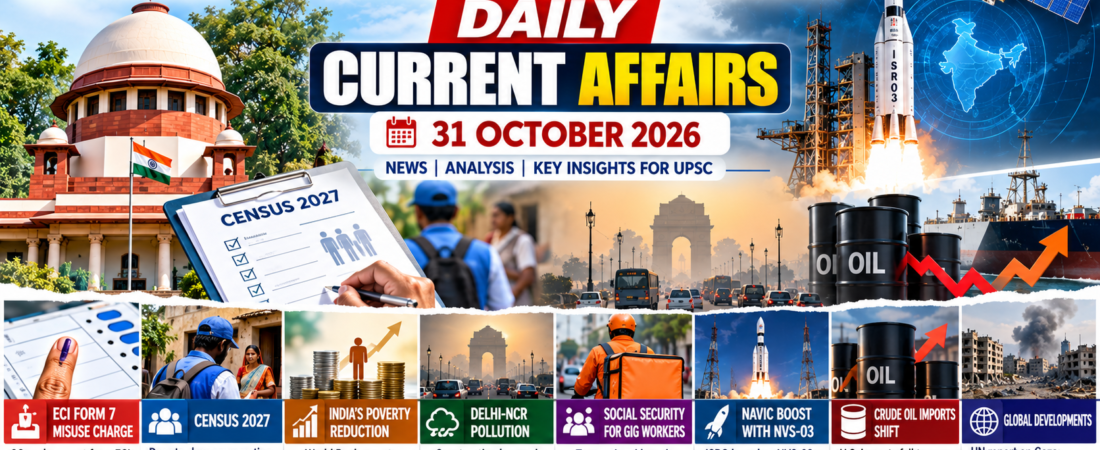
Saturday, 31 October 2026 | Delhi Edition
Today’s edition has several important developments for UPSC preparation, particularly in electoral integrity, Census 2027, poverty and inequality, air-pollution governance, social security, space technology and constitutional safeguards.
The compilation below is based on the uploaded newspaper. I have separated reported facts from political claims and editorial arguments, and included relevant Prelims pointers and Mains dimensions rather than treating every newspaper item as equally important.
1. Major national developments
1.1 Supreme Court seeks ECI report on alleged misuse of Form 7
The Supreme Court has asked the Election Commission of India (ECI) to examine allegations of fraudulent use of Form 7, which is used to seek deletion of a person’s name from the electoral roll, during the Special Intensive Revision (SIR) in Uttar Pradesh.
The ECI told the Court that it had detected false Form 7 applications but had rejected all applications found to violate the prescribed procedure. It said corrective measures were taken promptly.
The petition, filed by Congress MP Tanuj Punia, alleged that some applications contained false particulars, forged signatures and objections filed in the names of people who denied submitting them. It also alleged that pre-filled applications seeking deletion of multiple voters had reached Booth Level Officers.
The Court asked the petitioner to submit further details and directed the ECI to look into the allegations and file a compliance report. The newspaper reports that over two crore voters were removed during the Uttar Pradesh SIR process, which concluded in April.
Why it matters
- Form 7 is an important instrument for correcting electoral rolls, but its misuse can lead to wrongful disenfranchisement.
- The issue raises questions about the verification duties of BLOs and Electoral Registration Officers.
- Electoral-roll revision must balance the removal of duplicate or ineligible entries with the protection of every eligible citizen’s right to vote.
- The controversy highlights the importance of transparent procedures, audit trails and effective grievance redressal.
Prelims pointers: Form 6 is associated with inclusion of names; Form 7 with objections seeking deletion; Form 8 with correction or shifting of residence, among other permitted purposes.
Mains linkage: Electoral reforms; Election Commission; universal adult franchise; transparency and accountability in electoral administration.
th.th_delhi.31_10_2026.pdf
1.2 Census 2027: Population enumeration to begin in January
The second phase of Census 2027, known as Population Enumeration, is scheduled to begin with an online self-enumeration window on 10 January 2027. Door-to-door enumeration is scheduled from 25 January to 28 February 2027.
Enumerators will ask 40 questions, including 13 new questions. The reported subjects include:
- Caste, other than Scheduled Tribe and Scheduled Caste categories.
- Religion and the place and date of birth of both parents.
- Number of bank accounts and spouse’s name.
- Nationality and digital literacy.
- Permanent residential address.
- Place of COVID-19 vaccination.
- Passport and driving licence details.
- Mobile, Aadhaar and voter ID numbers, if available.
The exercise has already been completed in Ladakh and snow-affected areas of Jammu and Kashmir, Himachal Pradesh and Uttarakhand. In poll-bound Uttar Pradesh, Goa, Uttarakhand and Punjab, the exercise is scheduled to begin earlier: from 16 November 2026, with door-to-door enumeration from 1 December 2026 to 5 January 2027.
UPSC significance
The Census is the principal source of demographic data for planning and policy formulation. Its findings are relevant to:
- Population distribution and density.
- Urbanisation and migration.
- Social composition and demographic inequalities.
- Welfare targeting and public-service delivery.
- Delimitation and representation-related debates.
- Evidence-based policy formulation.
The inclusion of caste-related questions is particularly relevant to discussions on social justice, data-based policymaking and the measurement of social disadvantage.
Analytical dimension: Census data must be collected with safeguards for confidentiality, data security and informed public participation. The inclusion of sensitive personal information also makes data governance important.
th.th_delhi.31_10_2026.pdf
1.3 World Bank: India records a sharp reduction in poverty
According to the World Bank’s October 2026 Poverty and Equity Brief for India, India has made substantial progress in reducing both monetary and multidimensional poverty.
| Indicator | Earlier level | Later level |
|---|---|---|
| Population below the lower-middle-income poverty line of $4.20/day | 57.7% (2011) | 16.1% (2023) |
| Population below the extreme-poverty line of $3/day | 27.1% (2011) | 2.6% (2023) |
| Multidimensional poverty, OPHI measure | 53.8% (2005–06) | 16.4% (2019–21) |
| World Bank MPI measure | — | 15.5% (2022–23) |
The report estimates that 496 million people moved above the lower-middle-income poverty line between 2011 and 2023.
It also notes that employment increased by approximately 134 million people between 2017 and 2023, with rural women’s participation in paid work contributing significantly to the increase.
However, the report identifies persistent challenges:
- The median earnings of the top 10% of workers were approximately 13 times those of the bottom 10% in 2023.
- Poverty is geographically concentrated: a contiguous belt from Uttar Pradesh to West Bengal accounted for 57% of India’s poor population.
- Youth unemployment increased from 14.6% to 15.9% between Q1 FY2026 and Q1 FY2027, particularly among rural young women.
- The report expects poverty to continue declining, but at a more gradual pace.
Understanding the distinction
- Monetary poverty measures deprivation through income or consumption relative to a poverty threshold.
- Multidimensional poverty considers overlapping deprivations in areas such as health, education and living standards.
- Inequality concerns the distribution of income, wealth and opportunities, and can persist even when poverty falls.
Mains perspective: Poverty reduction should not be assessed only through a decline in the headcount ratio. The quality of employment, wage distribution, regional disparities, access to public services and women’s economic participation are equally important.
th.th_delhi.31_10_2026.pdf
1.4 Delhi-NCR: Construction restrictions and work-from-home measures
The Union Environment Ministry announced a package of restrictions to address the expected deterioration in air quality in Delhi-NCR.
From 5 November to 20 November 2026:
- Construction and demolition activities that generate dust will be prohibited.
- The restriction will cover outdoor civil construction activities.
- Government and private offices in Delhi and five high-vehicle-density districts—Gurugram, Faridabad, Sonipat, Ghaziabad and Gautam Buddha Nagar—have been directed to operate with no more than 50% of staff physically present.
- The remaining employees are to work from home, subject to exemptions for industrial establishments and essential services where this is not feasible.
Projects related to national security and defence, railways, metro services, airports, inter-State bus terminals, hospitals, water supply and sanitation have been exempted. The order also covers several public infrastructure projects, including highways, roads, flyovers, transmission lines and pipelines.
The government cited the expected contribution of Deepavali firecracker emissions and stubble burning to the pollution load.
The Commission for Air Quality Management (CAQM) has also established an Integrated Command and Control Centre. According to the report, it integrates data from 111 continuous ambient air quality monitoring stations, more than 2,300 industries, over 3,200 active construction sites and traffic congestion hotspots.
Critical analysis
The measures illustrate the use of emergency restrictions during peak pollution periods. However, durable improvement requires:
- Reducing vehicular emissions through public transport and cleaner mobility.
- Dust control at construction sites and on roads.
- Cleaner industrial fuel and effective emissions monitoring.
- Crop-residue management and alternatives to stubble burning.
- Coordination among Delhi and neighbouring States.
Mains linkage: Urban governance, environmental federalism, air pollution, public health and the role of CAQM.
th.th_delhi.31_10_2026.pdf
1.5 Social security boards for unorganised and gig workers
The Union Labour Ministry has constituted two statutory boards under the Code on Social Security, 2020:
| Board | Membership |
|---|---|
| National Social Security Board for Unorganised Workers | 40 |
| National Social Security Board for Gig and Platform Workers | 22 |
Union Labour and Employment Minister Mansukh Mandaviya will chair both boards. Their membership includes representatives of the Union and State governments, employers, aggregators, civil society organisations and workers’ organisations.
Their functions include recommending welfare schemes, advising the Union government on the administration of the Code, monitoring schemes, reviewing State-level record-keeping and examining expenditure from relevant funds.
The boards are expected to meet at least three times a year.
Why this is important
India’s labour market has a large informal component. Gig and platform workers—such as app-based delivery and transport workers—often face income volatility, occupational risks and limited access to conventional employment-linked benefits.
The boards provide an institutional mechanism for bringing these workers into the social-security framework. However, their effectiveness will depend on:
- Actual coverage of workers.
- Adequate and predictable funding.
- Portability of benefits across States and platforms.
- Worker representation in decision-making.
- Effective implementation rather than merely statutory recognition.
The newspaper’s editorial also questions the highly centralised composition of the boards and argues that State governments and a wider range of trade unions should be involved. This is an editorial assessment, not a judicial finding.
th.th_delhi.31_10_2026.pdf
1.6 Supreme Court: Misuse of live-streamed court proceedings
The Supreme Court has asked the Ministry of Electronics and Information Technology (MeitY) to formulate measures against the commercial exploitation and unauthorised circulation of live-streamed judicial proceedings in violation of court orders.
The Court recorded that suggestions had been received from High Courts and other stakeholders. It indicated that the policy framework should also provide for action against those who violate restrictions.
An advocate suggested that clips officially released by the Court should carry verifiable digital signatures or watermarks to distinguish genuine footage from manipulated versions.
Significance
The issue involves a balance between:
- Open justice and public access to judicial proceedings.
- Protection of the dignity and integrity of courts.
- Prevention of misleading edits, misinformation and commercial misuse.
- Authentication of official digital records.
The development is relevant to the broader debate on digital governance, platform accountability and the responsible use of technology.
th.th_delhi.31_10_2026.pdf
1.7 Supreme Court appoints mediator in Krishna-Godavari gas dispute
The Supreme Court appointed former judge Justice Ranjana Prakash Desai as the sole mediator in the dispute between Reliance Industries Ltd. and the Union government over gas migration in the Krishna-Godavari basin.
The Court described the dispute as complex and considered that a mediator with experience in commercial matters could help the parties arrive at a viable solution.
UPSC relevance: Natural-resource governance, petroleum and natural gas regulation, public-private disputes, commercial mediation and alternative dispute resolution.
th.th_delhi.31_10_2026.pdf
1.8 Supreme Court clarifies the distinction between consent and subsequent regret
In a judgment concerning a relationship that had lasted seven years, the Supreme Court observed that a consensual sexual relationship cannot automatically be treated as rape merely because it subsequently breaks down.
The case involved an allegation that the man had concealed his earlier marriage and children. The Court emphasised the need to distinguish between consent obtained through deception or coercion and regret arising after a relationship ends.
The judgment stressed that genuine allegations of sexual violence must be pursued, while cautioning against retrospectively treating every failed consensual relationship as a criminal offence.
Constitutional and legal dimensions
- Consent must be assessed in the circumstances in which it was given.
- Deception that vitiates consent is legally distinct from a later change of feelings.
- The criminal justice system must protect complainants while also preventing misuse of criminal proceedings.
- The issue involves the relationship between individual autonomy, dignity, liberty and due process.
The newspaper reports the Court’s observations; the legal outcome must be understood in the context of the specific facts and the applicable law.
th.th_delhi.31_10_2026.pdf
1.9 NavIC receives a boost with the launch of NVS-03
The Indian Space Research Organisation (ISRO) successfully launched NVS-03 aboard the GSLV-F18 from the Satish Dhawan Space Centre, Sriharikota.
The satellite was placed in the intended geosynchronous transfer orbit approximately 18 minutes after lift-off.
Important details:
| Feature | Details |
|---|---|
| Satellite | NVS-03 |
| Launch vehicle | GSLV-F18 |
| Satellite mass | 2,250 kg |
| Mission life | 12 years |
| Navigation system | NavIC |
| Additional signal | L1, along with existing L5/S signals |
| Coverage | India and a region extending approximately 1,500 km beyond its boundary |
The satellite carries an indigenous atomic clock, along with procured atomic clocks.
The launch is significant because the NavIC constellation had been weakened by repeated failures of atomic clocks and the failure to place the earlier replacement satellite, NVS-02, in its intended orbit. The report notes that the last functioning atomic clock aboard IRNSS-1F stopped working on 13 March 2026.
What is NavIC?
Navigation with Indian Constellation (NavIC) is India’s independent regional satellite navigation system. It provides Position, Navigation and Timing (PNT) services to users in India and the surrounding region.
Applications
- Civilian navigation and transport.
- Maritime and aviation applications.
- Disaster management.
- Surveying and mapping.
- Defence and strategic applications.
- Location-based services and timing synchronisation.
Why an indigenous navigation system matters: It reduces dependence on foreign navigation systems and strengthens India’s strategic autonomy in critical positioning and timing services.
th.th_delhi.31_10_2026.pdf
1.10 World Bank poverty findings and the debate on inequality
The poverty report also raises an important analytical issue: a reduction in poverty does not automatically imply a reduction in inequality.
Even when more people cross a poverty threshold, differences in earnings, asset ownership, access to quality education and regional development may remain substantial.
For UPSC answers, it is useful to distinguish:
| Concept | What it measures |
|---|---|
| Poverty | Deprivation below a defined threshold |
| Inequality | Unequal distribution of income, wealth or opportunities |
| Vulnerability | Risk of falling into poverty due to shocks |
| Social exclusion | Barriers to participation in economic, social and political life |
This distinction can strengthen answers on inclusive growth, human development and the quality of economic development.
2. Economy and business
2.1 India’s crude oil import pattern changes amid sanctions
India’s crude oil sourcing underwent a significant shift in September 2026, according to the government data reported by the newspaper.
- India’s crude oil imports from the United States fell to zero.
- Russian oil imports declined substantially.
- The UAE’s share rose to more than one-fourth of India’s crude oil imports.
- Russia and the UAE together accounted for approximately 60% of India’s oil imports.
India imported 209.4 lakh tonnes of crude oil in September 2026, an increase of 9.5% over August and 4.1% over September 2025.
However, the import bill rose much faster than import volumes:
- September 2026 import bill: approximately $14.3 billion.
- Increase over August 2026: 16.4%.
- Increase over September 2025: 33%.
The article links the change in sourcing to the U.S. Russia Sanctions Act of 2026, signed by President Donald Trump on September 18. The legislation empowered the U.S. to impose tariffs of up to 100% on countries importing substantial quantities of Russian oil and gas. The tariffs were subsequently temporarily waived.
Russia’s share of India’s oil imports had reached approximately 51% in July, declined to 44% in August and further to 33% in September.
UPSC analysis
India’s crude oil import dependence creates multiple vulnerabilities:
- Geopolitical vulnerability: Sanctions, wars and diplomatic pressure can affect access to supplies.
- Price vulnerability: Higher global crude prices increase the import bill and can contribute to imported inflation.
- Supply concentration: Dependence on a small number of suppliers can increase exposure to disruptions.
- Energy security: Diversification of suppliers, strategic petroleum reserves, domestic exploration and alternative energy sources become important.
The important policy objective is not merely to secure cheaper oil, but to ensure reliable, affordable and diversified energy supplies.
th.th_delhi.31_10_2026.pdf
2.2 IDBI Bank disinvestment triggers political debate
The proposed sale of a 60.72% stake in IDBI Bank to Fairfax Financial Holdings for approximately ₹53,000 crore became the subject of a political exchange between Rahul Gandhi and Finance Minister Nirmala Sitharaman.
Rahul Gandhi questioned the proposed sale, arguing that public-sector banks are instruments of national development and that employees and depositors must be protected.
The Finance Minister defended the government’s position and alleged that the previous UPA government had pressured public-sector banks to lend to politically connected business groups, contributing to the accumulation of bad loans.
Conceptual understanding: Strategic disinvestment
- Disinvestment refers to the sale of government equity in a public-sector enterprise.
- Strategic disinvestment generally involves the transfer of management control along with the sale of government shareholding.
- Privatisation involves the transfer of ownership or control from the public sector to private ownership.
Arguments supporting disinvestment
- Improved efficiency and professional management.
- Reduction in the government’s direct commercial role.
- Mobilisation of resources for public expenditure.
- Greater competition and market discipline.
Concerns
- Protection of employees and depositors.
- Financial inclusion and priority-sector lending.
- Continuity of banking services in underserved regions.
- Regulatory safeguards against excessive risk-taking.
Mains linkage: Public-sector enterprises, banking reforms, financial inclusion and the role of the State in the economy.
th.th_delhi.31_10_2026.pdf
2.3 Major corporate results
The business pages reported the following developments for the September quarter:
| Company | Key development |
|---|---|
| Reliance Industries | Consolidated net profit rose 41% year-on-year to ₹25,548 crore; revenue increased 27.8% to ₹3,62,268 crore. |
| Indian Oil Corporation | Standalone net profit more than doubled to ₹21,630 crore, supported by improved refining margins. |
| GAIL | Q2 net profit more than doubled to ₹4,650.22 crore; GAIL Gas received in-principle approval for an IPO in FY28. |
| Indraprastha Gas | Net profit fell over 93% to ₹24.38 crore as higher input gas costs squeezed margins. |
| Sun Pharma | Consolidated net profit declined 36.4% to ₹1,988.5 crore, partly due to exceptional charges. |
These developments provide examples of how global commodity prices, input costs, refining margins, acquisitions and business investment affect corporate profitability.
th.th_delhi.31_10_2026.pdf
2.4 Alphabet’s share price falls amid concerns over AI expenditure
Shares of Alphabet, Google’s parent company, fell 12.6% on the Nasdaq on Thursday, wiping out approximately $482 billion in market capitalisation, according to the report.
The decline came despite a 25% year-on-year increase in quarterly revenue to $127.6 billion.
The central concern was the scale of expenditure required to build AI infrastructure:
- Capital expenditure during the September quarter was $51.4 billion.
- The company retained its 2026 capital expenditure guidance of $195–205 billion.
- Google Cloud revenue more than doubled to $30.7 billion.
- Investors were concerned about whether the large investments in AI would generate adequate returns.
Analytical significance
The development illustrates the difference between technological investment and commercial returns. AI infrastructure requires large investments in data centres, servers, specialised chips, electricity and cloud capacity.
For businesses, the key question is whether the future revenue generated by AI products and services will justify the present capital expenditure.
UPSC linkage: Artificial intelligence, digital economy, technology infrastructure, data centres and the economics of innovation.
th.th_delhi.31_10_2026.pdf
2.5 Other business developments
- Sun Pharma: Drug regulators reportedly ordered the company to stop manufacturing, selling and distributing ophthalmic products made at its Assam facility following inspection-related quality and safety concerns.
- GAIL Gas: The proposed IPO in FY28 would involve the parent company diluting a 25% stake. The subsidiary operates CNG stations and domestic piped natural gas connections.
- Indraprastha Gas: Higher input gas costs affected profitability even as sales volumes increased.
These items are useful for understanding the effects of regulatory compliance, commodity-price volatility and capital-market activity on Indian businesses.
th.th_delhi.31_10_2026.pdf
3. International developments
3.1 UN Commission reports continued violations in occupied Palestinian territory
A UN Commission of Inquiry, chaired by former High Court judge Justice S. Muralidhar, presented findings to the UN General Assembly concerning the situation in the occupied Palestinian territory.
According to the report carried by the newspaper, Israeli military operations and settler violence continued after the Gaza ceasefire agreement. The Commission alleged that these actions formed part of a coordinated effort to entrench settlements, annex Palestinian territory and displace its population.
The Commission reported that more than 75,000 Palestinians, including at least 21,500 children and 11,000 women, had been killed across the occupied Palestinian territory since October 7, 2023. It also reported continued displacement in the West Bank.
The Commission called on States to avoid providing assistance that could sustain the occupation and settlements, and urged support for the International Criminal Court.
Israel’s Permanent Representative to the UN rejected the findings, describing the report as politically motivated and disputing its conclusions.
Important distinction: These are findings and allegations of a UN Commission of Inquiry, which Israel has rejected. They should not be presented as a final judgment of an international court.
UPSC relevance
- Israel-Palestine conflict.
- International humanitarian law.
- Geneva Conventions and protection of civilians.
- International Court of Justice (ICJ) and International Criminal Court (ICC).
- Role and limitations of UN investigative mechanisms.
- Accountability for alleged violations of international law. th.th_delhi.31_10_2026.pdf
3.2 Israel election: Netanyahu’s bloc falls short of a majority
The final results of Israel’s general election showed that Prime Minister Benjamin Netanyahu’s coalition finished ahead of the Opposition but failed to secure a parliamentary majority.
| Political grouping | Seats |
|---|---|
| Netanyahu’s coalition | 53 |
| Opposition bloc | 48 |
| Arab groupings—Ra’am and Joint List | 19 |
| Total Knesset seats | 120 |
A majority requires 61 seats in the 120-member Knesset.
The Arab groupings could therefore play an important role in coalition negotiations. The results point towards a potentially difficult process of government formation.
Prelims pointer: Israel has a parliamentary system. The Knesset is its unicameral legislature and has 120 members.
th.th_delhi.31_10_2026.pdf
3.3 China expels 33 officials amid widening anti-corruption campaign
China confirmed the expulsion of 33 senior figures following a four-day plenum of the Communist Party’s Central Committee.
The list reportedly included former Politburo member Zhang Youxia, who had once been China’s highest-ranking general.
Chinese authorities described the action as part of a campaign to eliminate corruption and strengthen party discipline. The Central Commission for Discipline Inspection stated that disciplinary bodies had punished 7.9 million people since 2012.
However, analysts cited in the report suggested that the campaign could also consolidate President Xi Jinping’s political authority ahead of the next Party Congress, expected in the second half of 2027.
Analytical dimension
The development raises questions about:
- Centralisation of political power.
- Civil-military relations in China.
- The role of the Communist Party’s disciplinary institutions.
- The relationship between anti-corruption campaigns and political consolidation.
- Implications for China’s defence establishment and regional security.
3.4 Italy: Students and workers protest over living costs
Thousands of students and workers protested across several Italian cities, demanding greater public funding for education and relief from rising living costs.
The demonstrations were supported by a general strike called by the USB trade union. Participants included students, teachers, truck drivers, taxi drivers, farmers and retired people.
Their concerns included:
- Rising tuition fees and housing costs.
- Higher fuel prices.
- Insufficient education funding.
- Rising defence expenditure.
- The broader cost-of-living crisis.
The protests reflect a wider debate in several European countries over housing affordability, employment, public services and the distribution of government expenditure.
Mains linkage: Youth aspirations, unemployment, cost-of-living pressures, social movements and the political consequences of economic inequality.
th.th_delhi.31_10_2026.pdf
3.5 Strait of Hormuz: Maritime tensions continue
Oman reported rescuing 25 sailors from a Panama-flagged merchant vessel, RITI, which had been attacked and set ablaze.
Iran also reported that three oil tankers had been halted while crossing the Strait of Hormuz. The newspaper reported that Iran had restricted maritime traffic through the Strait following the outbreak of the West Asia conflict on February 28.
Why the Strait of Hormuz matters
- It connects the Persian Gulf with the Gulf of Oman and the Arabian Sea.
- It is a critical route for global oil and gas shipments.
- Disruptions can raise energy prices and freight and insurance costs.
- India is particularly exposed because of its dependence on imported crude oil and energy supplies from West Asia.
Prelims pointer: The Strait of Hormuz lies between Iran to the north and Oman and the UAE to the south.
th.th_delhi.31_10_2026.pdf
3.6 Other international news
- Russia: Independent newspaper Novaya Gazeta announced its closure, attributing the decision to sustained pressure on journalists critical of the Kremlin and its war in Ukraine.
- United Kingdom: Scottish police began investigating reports of Jeffrey Epstein’s stay at the Balmoral royal estate in 1999, reportedly at the invitation of former Prince Andrew.
- United States and defence technology: An editorial discussed the growing role of AI and software companies in the U.S. military-industrial ecosystem, including the shift towards autonomous systems and software-defined defence capabilities.
- United States and AI investment: The Alphabet share-price decline highlighted concerns over the financial sustainability of very large AI infrastructure investments.
th.th_delhi.31_10_2026.pdf
4. Science, technology, environment and disaster management
4.1 Tribal astronomy: IIT Jodhpur documents indigenous knowledge systems
Researchers at IIT Jodhpur have undertaken an interdisciplinary study of astronomy-related knowledge among tribal communities in western Rajasthan.
The communities covered include the Bhil, Meena, Banjara, Gond, Kolam and Korku.
The study documents how traditional communities interpret celestial objects and use observations of the sky, stars and seasonal cycles in their agricultural and pastoral practices.
Examples include:
- Using the Moon for time reckoning.
- Observing stars to anticipate seasonal changes.
- Integrating celestial phenomena into agricultural and pastoral practices.
- Preserving astronomical knowledge through oral traditions and rituals.
The researchers have also worked with residents of Nandiya Kalan village to develop a Nakshatra Vatika on degraded community land. Approximately 1,000 trees have been planted, with medicinal plants and biodiversity conservation forming part of the initiative.
Why it matters
Traditional ecological knowledge can complement scientific research in climate adaptation, biodiversity conservation and sustainable livelihoods. The initiative also illustrates the importance of documenting oral traditions before they are lost through social and cultural change.
Mains linkage: Indian Knowledge Systems, tribal knowledge, biodiversity conservation, community participation and sustainable development.
th.th_delhi.31_10_2026.pdf
4.2 Odisha: Cyclone-related floods and landslide
The newspaper reported that three people, including a couple and their nine-month-old child, were killed in a landslide at Dangeshi village in Kandhamal district, Odisha.
The flood situation remained serious in Ganjam and Gajapati districts. The State government air-dropped relief materials in areas cut off by floodwaters.
Approximately 84,564 people were affected by flash floods associated with heavy rainfall triggered by Cyclone Arnab:
- Ganjam: 42,564.
- Gajapati: 30,000.
- Kandhamal: 12,000.
Koraput and Rayagada districts were also affected.
The State government announced financial assistance for the deceased and directed officials to restore roads, bridges and electricity supply and address post-flood health concerns.
Disaster-management perspective
The event demonstrates the cascading effects of extreme weather: heavy rainfall can trigger flash floods, landslides, infrastructure damage, displacement and public-health risks.
Disaster preparedness must therefore include:
- Early-warning systems.
- Risk mapping and land-use planning.
- Safe evacuation arrangements.
- Resilient roads, bridges and communication systems.
- Emergency health services and drinking-water supply.
- Post-disaster livelihood restoration. th.th_delhi.31_10_2026.pdf
4.3 Bhutan glacial lake outburst flood: North Bengal on alert
A glacial lake outburst flood (GLOF) in Bhutan prompted authorities in parts of the Darjeeling hills and Dooars region of West Bengal to issue alerts.
More than 4,000 people were moved to safer areas from locations in Kumargram and Tufanganj. Authorities also monitored the possibility of rising water levels in the Sankosh river.
What is a GLOF?
A Glacial Lake Outburst Flood occurs when water stored in a glacial lake is suddenly released, often following the failure of an ice or moraine dam.
Possible triggers include:
- Ice or rock avalanches into the lake.
- Failure of a moraine dam.
- Rapid melting of glaciers.
- Heavy rainfall and rising lake levels.
Why Himalayan regions are vulnerable
Climate change, glacier retreat, the formation and expansion of glacial lakes, fragile mountain slopes and limited infrastructure increase the vulnerability of Himalayan communities.
UPSC linkage: Climate change, Himalayan ecology, disaster preparedness and transboundary river management.
th.th_delhi.31_10_2026.pdf
4.4 Chola-period bronze idols unearthed in Nagapattinam
The Tamil Nadu State Department of Archaeology unearthed bronze-alloy idols of Nataraja and Sivagami, along with their pedestals, during excavations in Nagapattinam.
The idols are estimated to date to the 12th century CE.
- Nataraja is depicted in the Ananda Tandava posture, with four arms.
- The Nataraja idol measures 110 cm in height and 100 cm in width.
- Sivagami is depicted in the Tribhanga posture, with two arms.
Art and culture significance
The discovery provides evidence relating to Chola-period metal sculpture, religious practices and the development of bronze iconography in Tamil Nadu.
For Prelims, revise:
- Chola contributions to bronze sculpture.
- Nataraja iconography.
- Lost-wax casting (cire perdue).
- The role of temples in the Chola political, economic and cultural system. th.th_delhi.31_10_2026.pdf
4.5 Cheetah cub death at Kuno: arrests made
Two people were arrested in connection with the killing of a male cheetah cub at Kuno National Park in Madhya Pradesh. The arrests were made under the Arms Act, and six forest personnel were suspended.
The incident is relevant to the broader discussion on wildlife protection, protected-area management, human-wildlife interaction and enforcement of wildlife laws.
th.th_delhi.31_10_2026.pdf
5. Important judicial, constitutional and governance developments
5.1 Bombay High Court declares activist’s 2011 arrest illegal
The Bombay High Court held that activist Arun Ferreira’s arrest in September 2011 on charges of membership in a Naxal group was illegal.
The Court directed the Maharashtra government to pay him ₹2 lakh in compensation.
It observed that the police had violated his fundamental rights under:
- Article 21: Protection of life and personal liberty.
- Article 22: Safeguards against arbitrary arrest and detention.
The Court also criticised the police for describing him as absconding even though he had been in prison since 2007.
UPSC linkage: Constitutional safeguards, police accountability, due process, personal liberty and compensation for unlawful state action.
th.th_delhi.31_10_2026.pdf
5.2 Gujarat High Court: Somnath non-vegetarian food restriction
A single judge of the Gujarat High Court had struck down a notification restricting the preparation, storage and sale of non-vegetarian food within a 500-metre radius of the Somnath temple and along specified pilgrimage routes.
However, a Division Bench stayed the single judge’s ruling after an appeal by the Gujarat government. The restriction will therefore continue pending further hearing.
Hotel and restaurant owners had argued that the restriction infringed their fundamental right to carry on a lawful business and earn a livelihood.
Constitutional dimensions
- Article 19(1)(g): Freedom to practise any profession or carry on any occupation, trade or business.
- Article 19(6): Permits reasonable restrictions in the public interest.
- The need to balance religious and cultural considerations with individual freedoms and livelihood rights.
The matter remains subject to further judicial consideration.
th.th_delhi.31_10_2026.pdf
5.3 Tamil Nadu relaxes upper age limit for State government recruitment
The Tamil Nadu government enhanced the upper age limit for direct recruitment to various categories of government services by five years.
The relaxation is in addition to existing age concessions for specified categories, including backward classes, Scheduled Castes, Scheduled Tribes and destitute widows.
Governance relevance: Public employment, equal opportunity, affirmative action and the balance between age eligibility and access to government jobs.
th.th_delhi.31_10_2026.pdf
5.4 Other judicial and governance updates
- Kerala PSC examination: A Crime Branch remand report alleged manipulation of a Kerala Public Service Commission examination for the State Planning Board. Police alleged that 10 questions were deliberately excluded from evaluation. These remain investigative allegations.
- Bengaluru Central Prison: Police conducted a large-scale search at Parappana Agrahara Central Prison following complaints and earlier FIRs over banned items.
- Delhi building collapse: A magisterial inquiry was ordered into the October 7 Seemapuri building collapse, which killed five people.
- Uttarakhand helicopter crash: Six people, including the pilot, died in a helicopter crash near Joshimath. The fleet of the operator was grounded pending investigation by aviation authorities.
- Judicial livestreams: The Supreme Court asked MeitY to develop safeguards against unauthorised commercial exploitation of court proceedings.
th.th_delhi.31_10_2026.pdf
6. Other important national and State news
| Development | Key information | UPSC relevance |
|---|---|---|
| Jamia Millia Islamia | Offline classes to resume from November 10; mid-term examinations scheduled for November 16–21 following an agreement on restoring the students’ union. | University autonomy, student representation, institutional governance |
| Punjab stubble burning | Farm-fire incidents rose to 1,007; 194 were reported on October 29 alone. | Air pollution, agricultural incentives, crop-residue management |
| Delhi factory fire | Four people died and two were injured in a fire at a shoe factory in Mangolpuri. | Industrial safety, labour protection, urban regulation |
| Rajasthan panchayat elections | Approximately 1.06 crore voters participated in the second phase of panchayat elections across 22 districts. | Local self-government, grassroots democracy |
| Uttar Pradesh UCC proposal | Union Home Minister Amit Shah said a Uniform Civil Code would be implemented in Uttar Pradesh if the BJP won the 2027 Assembly election. | Article 44, Directive Principles, personal laws |
| Punjab politics | AAP was preparing to announce its first candidate list for the 2027 Assembly election; SAD announced proposed industrial power and clearance measures. | State politics, industrial policy |
| Arunachal Pradesh border | Political debate followed remarks by the Chief Minister on recurring Chinese transgressions. | India-China relations, border management |
| West Bengal electoral appeals | Questions were raised over the authority of officials who appealed against the inclusion of voters cleared by judicial officers during SIR. | Election law, electoral-roll integrity |
th.th_delhi.31_10_2026.pdf
7. Editorial and opinion analysis
The editorial and opinion pages deserve separate attention because they contain arguments and interpretations rather than only factual reporting.
7.1 Digital arrest scams: Beyond individual gullibility
The editorial argues that digital arrest scams cannot be explained merely by the gullibility of victims. Scammers exploit fear of law enforcement, particularly among older citizens.
The editorial welcomes the RBI’s proposed KYC directions requiring banks to identify suspected mule accounts and place temporary debit restrictions where necessary. It also supports the principle that banks should compensate victims where institutional failures or inadequate due diligence contribute to losses.
However, it raises concerns about excessive account freezing. A small trader or a Jan Dhan account holder who unknowingly receives money from a mule account should not automatically face prolonged restrictions.
Central argument: Stronger financial surveillance must be accompanied by safeguards against wrongful freezing of accounts, excessive policing and violations of privacy.
Mains question: How can India strengthen institutional accountability against cyber-enabled financial fraud without compromising the privacy and financial rights of innocent citizens?
th.th_delhi.31_10_2026.pdf
7.2 Social security boards: Institutional representation matters
The editorial welcomes the constitution of the National Social Security Boards but criticises their centralised structure.
It argues that labour is in the Concurrent List and that State governments and trade unions should play a meaningful role in designing and implementing social-security arrangements.
The central issue is whether the new boards can effectively represent workers who constitute a large proportion of India’s workforce but remain outside conventional social-security systems.
Central argument: Social protection requires not only statutory institutions but also democratic representation, cooperative federalism and effective implementation.
th.th_delhi.31_10_2026.pdf
7.3 India-China relations: The case for managed coexistence
An opinion article by former National Security Adviser M.K. Narayanan argues that India-China relations should move beyond a permanent state of suspicion towards managed coexistence.
The article discusses:
- The historical legacy of the 1962 war.
- The 2020 Galwan clash.
- Unresolved boundary questions in Ladakh and Arunachal Pradesh.
- The role of the McMahon Line and disputed border perceptions.
- The impact of the Quad and wider geopolitical competition.
- The need for communication between military and border authorities.
It argues that a direct military conflict would be costly for both countries and that the two sides should avoid unintended escalation.
Critical assessment
The argument for peaceful coexistence does not mean that India should overlook security concerns. A sustainable approach requires:
- Strong border infrastructure and surveillance.
- Military preparedness and deterrence.
- Diplomatic engagement.
- Confidence-building measures.
- Clear mechanisms to prevent local incidents from escalating.
Mains question: India-China relations are characterised by economic interdependence, strategic competition and unresolved territorial disputes. Examine the case for managed coexistence.
th.th_delhi.31_10_2026.pdf
7.4 The changing military-industrial complex: AI and autonomous warfare
An opinion article examines how the U.S. military-industrial complex is shifting from traditional weapons manufacturers towards software, algorithms, artificial intelligence and autonomous systems.
The article identifies three major trends:
- The changing economics of warfare, where relatively inexpensive drones can challenge expensive defence platforms.
- Changes in defence procurement, including a greater role for technology companies.
- The growing importance of software-defined military capabilities.
It discusses the integration of AI companies into military networks and the increasing importance of autonomous systems, cloud infrastructure, data analysis and algorithmic decision-making.
India’s relevance
India needs to consider the implications for:
- Defence indigenisation.
- AI-based intelligence, surveillance and reconnaissance.
- Autonomous drones and counter-drone systems.
- Cybersecurity and secure military networks.
- Dependence on foreign technology platforms.
- Ethical and legal questions surrounding autonomous weapons.
Mains question: Artificial intelligence is transforming the character of modern warfare. Discuss its implications for India’s defence preparedness and strategic autonomy.
th.th_delhi.31_10_2026.pdf
8. Science and technology: Prelims fact file
| Term | Explanation |
|---|---|
| NavIC | India’s regional satellite navigation system, providing Position, Navigation and Timing services. |
| Atomic clock | A highly accurate timekeeping device based on the frequency of atomic transitions; essential for satellite navigation. |
| GSLV | Geosynchronous Satellite Launch Vehicle, used to place satellites into geosynchronous transfer orbit and other designated orbits. |
| GLOF | Sudden release of water from a glacial lake, potentially causing destructive downstream flooding. |
| AI-based military systems | Systems using algorithms and machine learning for intelligence analysis, surveillance, targeting support and autonomous functions. |
| CAAQMS | Continuous Ambient Air Quality Monitoring Station, used for real-time monitoring of air pollution. |
9. Prelims practice questions
Q1. Consider the following statements about Census 2027:
- The second phase is known as Population Enumeration.
- Online self-enumeration is scheduled to begin on January 10, 2027.
- Door-to-door enumeration is scheduled from January 25 to February 28, 2027.
Which of the statements given above are correct?
A. 1 only
B. 1 and 2 only
C. 2 and 3 only
D. 1, 2 and 3
Q2. With reference to NavIC, consider the following statements:
- It is India’s independent regional navigation satellite system.
- It provides Position, Navigation and Timing services.
- Its primary service area extends approximately 1,500 km beyond the Indian landmass.
Which of the statements given above are correct?
A. 1 only
B. 1 and 2 only
C. 2 and 3 only
D. 1, 2 and 3
Q3. Which of the following statements about a Glacial Lake Outburst Flood is correct?
A. It occurs only due to earthquakes.
B. It involves the sudden release of water stored in a glacial lake.
C. It is caused exclusively by riverbank erosion.
D. It is restricted to coastal regions.
Q4. The Code on Social Security, 2020 is relevant to which of the following categories?
- Unorganised workers.
- Gig workers.
- Platform workers.
Select the correct answer:
A. 1 only
B. 1 and 2 only
C. 2 and 3 only
D. 1, 2 and 3
Q5. Form 7 under the electoral-roll framework is primarily associated with:
A. Registration of a new voter.
B. Application for deletion of a name from the electoral roll.
C. Correction of a voter photograph only.
D. Registration of a political party.
Q6. Consider the following statements about the Strait of Hormuz:
- It connects the Persian Gulf with the Gulf of Oman.
- It is an important route for global oil shipments.
- Iran lies to its north.
Which of the statements given above are correct?
A. 1 only
B. 1 and 2 only
C. 2 and 3 only
D. 1, 2 and 3
Q7. Which constitutional provision directs the State to endeavour to secure a Uniform Civil Code for citizens?
A. Article 14
B. Article 19
C. Article 44
D. Article 51A
Q8. Which of the following is the correct distinction between monetary poverty and multidimensional poverty?
A. Monetary poverty measures only health outcomes.
B. Multidimensional poverty considers overlapping deprivations in areas such as health, education and living standards.
C. Monetary poverty is unrelated to income.
D. Multidimensional poverty measures only regional inequality.
Q9. The right to life and personal liberty is protected under which Article of the Constitution?
A. Article 19
B. Article 20
C. Article 21
D. Article 22
Q10. Which of the following best describes the function of an atomic clock in a satellite navigation system?
A. It measures atmospheric pressure.
B. It provides highly accurate timekeeping necessary for positioning and timing calculations.
C. It measures the satellite’s fuel consumption.
D. It controls the satellite’s solar panels.
Answer key and explanations
| Question | Answer | Explanation |
|---|---|---|
| 1 | D | All three statements correspond to the schedule reported for the Population Enumeration phase of Census 2027. |
| 2 | D | NavIC provides regional PNT services, with a primary service area extending approximately 1,500 km beyond India’s landmass. |
| 3 | B | A GLOF involves the sudden release of water stored in a glacial lake, often following the failure of an ice or moraine dam. |
| 4 | D | The Code on Social Security, 2020 provides a framework relevant to unorganised, gig and platform workers. |
| 5 | B | Form 7 is used for objections seeking deletion of names from electoral rolls. |
| 6 | D | The Strait connects the Persian Gulf with the Gulf of Oman, with Iran to the north. |
| 7 | C | Article 44 is a Directive Principle of State Policy concerning a Uniform Civil Code. |
| 8 | B | Multidimensional poverty captures overlapping disadvantages beyond income alone. |
| 9 | C | Article 21 protects life and personal liberty. |
| 10 | B | Precise timekeeping is essential for calculating satellite-based positioning and timing information. |
10. Mains answer-writing questions
1. Electoral integrity: The misuse of electoral-roll objection mechanisms can undermine the principle of universal adult franchise. Examine the institutional safeguards needed to prevent wrongful deletion of voters.
2. Census and social justice: Discuss the importance of comprehensive demographic data for evidence-based policymaking. What challenges arise in collecting and using sensitive personal information?
3. Poverty and inequality: India has made substantial progress in reducing poverty, but significant inequalities persist. Analyse the distinction between poverty reduction and inclusive development.
4. Air pollution: Emergency restrictions can reduce pollution during peak periods, but they cannot substitute for structural reforms. Discuss with reference to Delhi-NCR.
5. Gig economy: Examine the challenges involved in extending social security to gig and platform workers in India.
6. Energy security: Discuss how geopolitical developments and sanctions influence India’s crude oil sourcing strategy. Suggest measures to improve energy security.
7. NavIC: Explain the strategic and economic significance of an indigenous satellite navigation system for India.
8. India-China relations: Discuss the feasibility of managed coexistence between India and China in the context of unresolved border disputes and strategic competition.
9. Artificial intelligence and defence: Examine how AI and autonomous systems are changing modern warfare. What opportunities and challenges does this create for India’s defence sector?
10. Disaster management: Explain why Himalayan regions are particularly vulnerable to glacial lake outburst floods, landslides and extreme rainfall events. Suggest an integrated risk-reduction strategy.
11. Constitutional safeguards: Examine the significance of Articles 21 and 22 in ensuring accountability of law-enforcement agencies.
12. International law: Discuss the role of UN Commissions of Inquiry, the ICJ and the ICC in addressing alleged violations of international humanitarian law.
11. Important topics to revise
| Priority | Topic | Syllabus connection |
|---|---|---|
| High | Census 2027 and caste-related enumeration | Indian Society; Governance |
| High | Electoral-roll revision and Form 7 | Polity; Electoral Reforms |
| High | World Bank poverty estimates | Economy; Inclusive Growth |
| High | Social security for gig workers | Economy; Labour Reforms |
| High | NavIC and NVS-03 | Science and Technology |
| High | India-China relations | International Relations; Security |
| High | Strait of Hormuz and crude oil imports | Economy; International Relations |
| High | Delhi-NCR air pollution | Environment; Governance |
| Medium | AI and autonomous warfare | Science and Technology; Security |
| Medium | GLOF and Himalayan vulnerability | Geography; Disaster Management |
| Medium | Chola bronze sculptures | Art and Culture |
| Medium | UN Commission report on Palestine | International Relations |
Editorial takeaway for 31 October 2026: The edition is particularly important for understanding how institutional credibility and governance capacity affect democratic participation, social protection and public welfare. Electoral-roll integrity, the quality of poverty measurement, the social-security needs of informal workers and the management of environmental risks are connected by a common concern: the ability of public institutions to deliver rights and services fairly and effectively.
Source: The Hindu, Delhi City Edition, Saturday, 31 October 2026. The factual compilation above is based on the uploaded newspaper; editorial arguments and allegations have been identified separately from established findings.
th.th_delhi.31_10_2026.pdf