
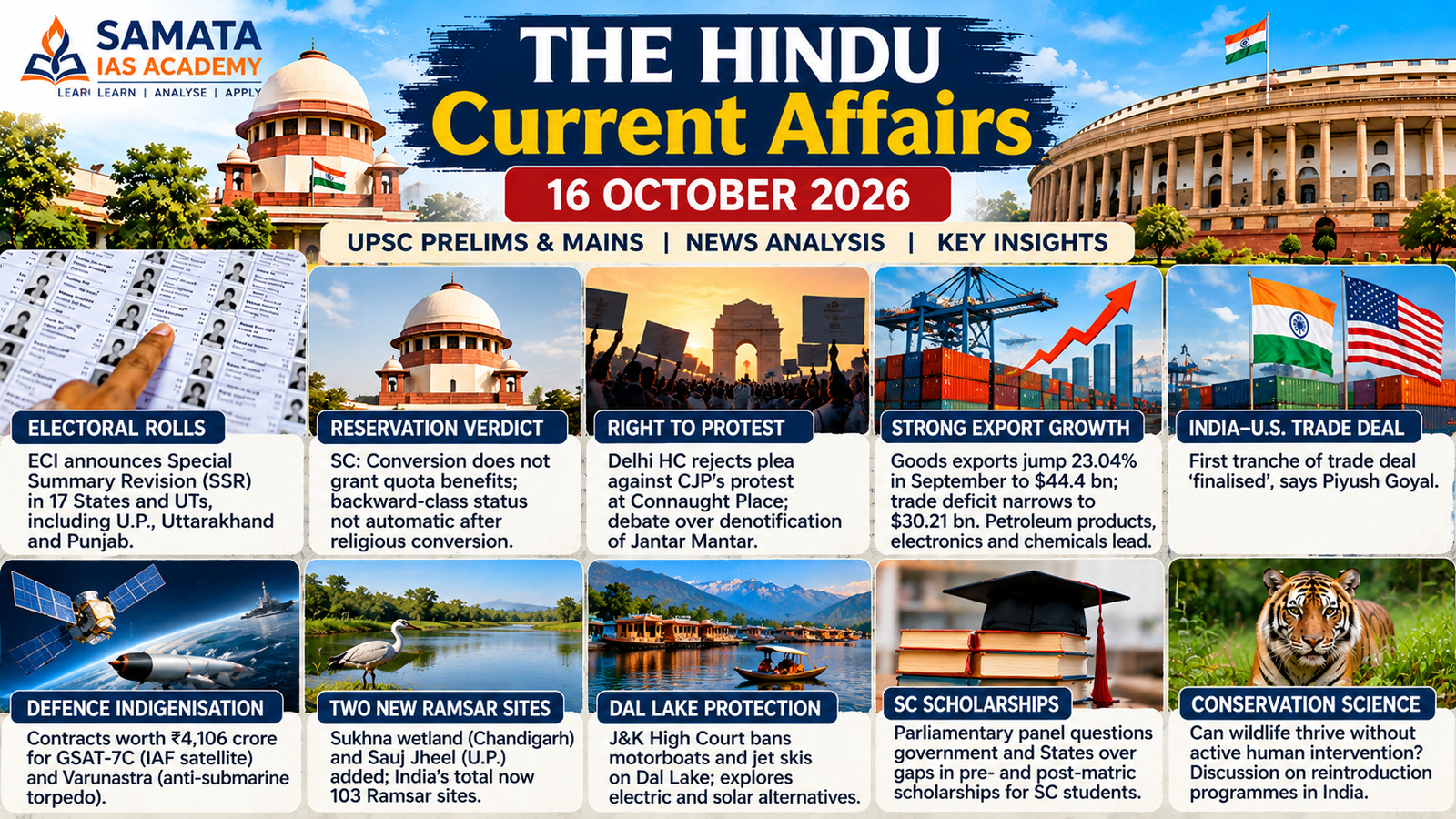
The Hindu Current Affairs – 16 October 2026 | UPSC Prelims and Mains
Samata IAS Academy | UPSC Prelims and Mains | Based on the uploaded The Hindu Delhi edition dated 16 October 2026
Today’s edition has several important themes for UPSC preparation: electoral-roll integrity, freedom of protest, reservation and constitutional interpretation, merchandise exports, defence indigenisation, environmental conservation, and public welfare delivery.
1. National news and polity
1.1 Election Commission announces Special Summary Revision of electoral rolls
The Election Commission of India (ECI) announced a Special Summary Revision (SSR) of electoral rolls in 17 States and Union Territories, including poll-bound Uttar Pradesh, Uttarakhand and Punjab. The annual exercise aims to enrol eligible voters and update electoral rolls.
th.th_delhi.16_10_2026.pdf
Key details:
- Unlike the ongoing Special Intensive Revision (SIR), the SSR does not require applicants to submit documents to prove citizenship or map themselves to earlier electoral rolls.
- The SSR will cover Andaman and Nicobar Islands, Assam, Bihar, Chhattisgarh, Goa, Gujarat, Kerala, Lakshadweep, Madhya Pradesh, Manipur, Puducherry, Punjab, Rajasthan, Tamil Nadu, Uttar Pradesh, Uttarakhand and West Bengal.
- The ECI says readable PDF electoral rolls will be provided to recognised political parties and contesting candidates.
- The Commission is also conducting a special drive to re-enrol eligible voters left out during the SIR.
Why it matters: Electoral-roll accuracy is essential to universal adult suffrage and free and fair elections. Errors can exclude eligible voters or retain ineligible entries.
UPSC relevance: GS-II — Election Commission, electoral reforms, Representation of the People Act, 1950, Article 324 and Article 326.
1.2 Questions over the use of Form 7 during SIR
A report raises concerns that electoral officials in some States have used system-generated Form 7 applications during the SIR process to delete names from electoral rolls. The report says the ECI had not issued a written standard operating procedure for this method, even though Form 7 is ordinarily used to object to an entry or request deletion.
th.th_delhi.16_10_2026.pdf
The report identifies questions about the authority to initiate deletion proceedings, digital signatures, verification and procedural safeguards.
Analytical perspective: Digitisation can improve administrative efficiency, but automated processes must preserve due process, traceability and opportunities for affected voters to challenge errors. These are reported concerns, not a final judicial determination of illegality.
UPSC relevance: GS-II — electoral integrity, transparency, accountability and rule of law.
1.3 Supreme Court on reservation benefits following religious conversion
The Supreme Court dismissed a Tamil Nadu government appeal concerning a State order intended to extend reservation benefits to certain communities after conversion to Islam. The Court held that a person cannot automatically claim membership of a notified Backward Class merely by converting from a Hindu community.
th.th_delhi.16_10_2026.pdf
The judgment discussed Article 16(4) and the relationship between community membership, social identity and eligibility for affirmative action.
Why it matters: The case raises questions about the legal criteria used to determine backward-class status and the relationship between social disadvantage and community recognition.
UPSC relevance: GS-II — equality, affirmative action, constitutional interpretation and social justice.
1.4 Public protest and the denotification of Jantar Mantar
An editorial titled “Out of site” criticises the decision to denotify Jantar Mantar as a designated protest site. It argues that public demonstrations are an important means through which citizens and groups with limited access to decision-makers make their grievances visible.
th.th_delhi.16_10_2026.pdf
The debate involves two competing considerations:
- Public order: Traffic management, commuter convenience and regulation of demonstrations.
- Democratic freedoms: Freedom of speech and expression, peaceful assembly, and the ability to petition public authorities.
Analytical perspective: A proportionate approach should regulate the manner and impact of demonstrations without making peaceful protest practically impossible. Alternative sites should be accessible and capable of serving the purpose of public visibility.
UPSC relevance: GS-II — Articles 19(1)(a), 19(1)(b), reasonable restrictions, public order and democratic participation.
1.5 Supreme Court and the immunity of Election Commissioners
The edition also discusses a petition challenging lifelong immunity granted to the Chief Election Commissioner and Election Commissioners for actions taken in the discharge of official duties. The Supreme Court has issued notice to the Union government on the petition filed by the Association for Democratic Reforms.
th.th_delhi.16_10_2026.pdf
UPSC relevance: GS-II — independence of constitutional bodies, accountability, equality before law and the institutional safeguards required for free and fair elections.
2. Economy and infrastructure
2.1 Merchandise exports rise 23.04% in September
India’s merchandise exports rose from $36.08 billion in September 2025 to $44.4 billion in September 2026, an increase of 23.04%. The year-on-year merchandise trade deficit narrowed to $30.21 billion, compared with $33 billion a year earlier.
th.th_delhi.16_10_2026.pdf
Key trade figures
Merchandise exports
$44.4 bn
September 2026
Merchandise imports
$74.61 bn
Up 8% year-on-year
Trade deficit
$30.21 bn
September 2026
April–September exports
$259.89 bn
Up 18.51% year-on-year
Sectoral performance:
- Petroleum products exports increased by 31.9% to $6.2 billion.
- Electronic goods exports increased by 70.44% to $5.3 billion.
- Chemical exports increased by 24.21% to $3 billion.
- Gold and silver imports declined sharply, while crude oil imports increased by 30.76% to $18.34 billion.
The trade deficit for April–September 2026–27 widened to $177.64 billion, against $156.88 billion in the corresponding period of the previous financial year.
th.th_delhi.16_10_2026.pdf
Analysis: Export growth is encouraging, particularly in electronics, but higher crude oil prices and the widening half-year trade deficit remain concerns. Export competitiveness also depends on logistics, trade agreements, domestic manufacturing capacity and access to global markets.
UPSC relevance: GS-III — balance of trade, export diversification, global value chains, energy prices and external-sector stability.
2.2 First tranche of India–U.S. trade deal reportedly finalised
The newspaper’s business-page headline reports that Commerce and Industry Minister Piyush Goyal said the first tranche of the India–U.S. trade deal had been finalised.
th.th_delhi.16_10_2026.pdf
For examination purposes, distinguish between a tranche being described as finalised and a trade agreement being formally signed, brought into force or fully implemented. The precise terms are not established by the headline alone.
UPSC relevance: GS-II — bilateral relations; GS-III — international trade, tariffs and export opportunities.
2.3 India signs ₹4,106-crore defence contracts
The Ministry of Defence signed contracts worth approximately ₹4,106 crore for two indigenous defence capabilities.
th.th_delhi.16_10_2026.pdf
- GSAT-7C: A dedicated communication satellite for the Indian Air Force, contracted through New Space India Limited for ₹2,563 crore.
- Varunastra: An indigenous heavyweight, ship-launched anti-submarine warfare torpedo, contracted through Bharat Dynamics Limited for ₹1,543 crore.
The satellite is intended to strengthen secure and resilient communications for Air Force assets. Varunastra is designed to engage enemy submarines at long ranges.
Why it matters: These procurements connect operational readiness with domestic defence manufacturing, technology development and reduced dependence on foreign suppliers.
UPSC relevance: GS-III — defence technology, indigenisation, space applications and Aatmanirbhar Bharat.
2.4 Development projects launched in Ladakh
The Prime Minister virtually inaugurated five development projects worth around ₹3,350 crore, covering airport infrastructure and strategic road connectivity. The projects include a new passenger terminal at Leh’s Kushok Bakula Rimpochee Airport, incorporating geothermal energy to improve energy efficiency. The newspaper also reports progress on proposals for satellite campuses of IIT Jammu and IIM Jammu.
th.th_delhi.16_10_2026.pdf
UPSC relevance: GS-III — strategic infrastructure, sustainable construction, connectivity and development in border regions.
3. Environment and biodiversity
3.1 Sukhna wetland and Sauj Jheel designated Ramsar sites
Sukhna wetland in Chandigarh and Sauj Jheel in Uttar Pradesh were designated as Ramsar sites. According to the report, the additions bring India’s total to 103 Ramsar sites.
th.th_delhi.16_10_2026.pdf
The Ramsar Convention is an international treaty adopted in 1971 for the conservation and wise use of wetlands.
Why it matters: Wetlands support biodiversity, regulate water flows, help recharge groundwater, store carbon and provide livelihoods. Ramsar designation can strengthen conservation attention, but the effectiveness of protection depends on management and enforcement.
UPSC relevance: GS-III — wetland conservation, biodiversity, ecosystem services and international environmental conventions.
3.2 High Court bans motorboats on Dal Lake
The Jammu and Kashmir High Court directed that motorboats, including fuel-driven jet skis, should not operate on Dal Lake until further orders. Emergency, law-and-order and disaster-management boats are exempt. The court asked authorities to explore solar-powered or electric alternatives.
th.th_delhi.16_10_2026.pdf
Key issue: Tourism revenue and livelihoods must be balanced with water quality, noise reduction and the ecological health of the lake.
UPSC relevance: GS-III — urban and freshwater ecosystems, pollution control and sustainable tourism.
3.3 Can wildlife conservation succeed without human intervention?
A discussion on conservation science examines India’s reintroduction programmes, including tigers in Buxa Tiger Reserve and cheetahs in Madhya Pradesh. It considers whether active intervention is necessary for species recovery and how conservation priorities are chosen.
th.th_delhi.16_10_2026.pdf
The discussion raises broader questions about habitat protection, minimum viable populations, human–wildlife coexistence and the relative attention given to prominent species versus less-publicised species.
UPSC relevance: GS-III — conservation biology, protected areas, species recovery and the role of scientific evidence in environmental policy.
4. Social justice and public administration
4.1 Parliamentary panel questions gaps in SC scholarships
The Public Accounts Committee questioned the Union and State governments over deficiencies in pre-matric and post-matric scholarships for Scheduled Caste students identified in a 2025 CAG report.
th.th_delhi.16_10_2026.pdf
The report identified:
- Delays affecting 40.75 lakh beneficiaries across 14 States, ranging from one to 90 months.
- More than 3.5 lakh beneficiaries who reportedly did not receive scholarships.
- More than 5,700 cases involving disbursement without adequate income-eligibility checks.
- More than 6,000 cases involving non-SC beneficiaries receiving scholarships.
- Cases of duplicate, short and excess payments.
The committee gave the Union Ministry of Social Justice and Empowerment one month to submit a detailed action-taken report.
Analysis: Scholarship delivery requires both financial accountability and timely access. Stronger verification should prevent fraud without creating avoidable barriers for eligible students.
UPSC relevance: GS-II — vulnerable sections, education, DBT, CAG, parliamentary oversight and welfare delivery.
4.2 Health risks increasingly require a cross-sector approach
A report on a Lancet Commission identifies 17 interconnected threats to global health through 2100, including pandemics, antimicrobial resistance, climate change, air pollution, malnutrition, obesity, poor mental health, nuclear conflict and malicious uses of artificial intelligence.
th.th_delhi.16_10_2026.pdf
The report argues that health threats cannot be addressed in isolation because they interact with environmental conditions, inequality, economic security, technology and international cooperation.
UPSC relevance: GS-II — public health; GS-III — climate change, emerging technologies and disaster risks.
4.3 Other important developments
- Midday meals: Idli and sambar had reportedly not been introduced in Delhi government schools under a revised PM-POSHAN menu because kitchens lacked the necessary equipment and arrangements. This highlights the gap between policy announcements and implementation. th.th_delhi.16_10_2026.pdf
- Bihar boat accidents: The newspaper reports 30 deaths in country-made boat capsizing incidents in Bihar during 2026, including 13 deaths in the recent Vaishali tragedy. Overcrowding, unsafe boats, limited transport alternatives and flood conditions are key concerns. th.th_delhi.16_10_2026.pdf
- Women’s empowerment: An opinion article argues for moving from women-focused welfare towards women-led development, including leadership opportunities and access to social and economic justice. th.th_delhi.16_10_2026.pdf
5. States and regional developments
5.1 Punjab protests after the killing of an anti-drug activist
A statewide protest disrupted normal life in parts of Punjab following the killing of anti-drug activist Parvinder Singh Jhota in Mansa. The report says the main accused was arrested in Rajasthan and a police inspector was suspended in connection with the case. Some organisations demanded a CBI investigation.
th.th_delhi.16_10_2026.pdf
UPSC perspective: Drug abuse requires a combination of law enforcement, public-health interventions, rehabilitation, prevention and action against illegal supply networks.
5.2 Ladakh’s demands for Statehood and Sixth Schedule protection
Talks between Ladakh civil society groups and a Union Home Ministry team were described as unsatisfactory and inconclusive. The Leh Apex Body and Kargil Democratic Alliance reiterated their demands for Statehood and constitutional safeguards, with another round of talks scheduled for October 22.
th.th_delhi.16_10_2026.pdf
UPSC relevance: GS-II — federalism, tribal and regional aspirations, decentralisation and constitutional safeguards.
5.3 Other State-level news
- Kerala: The High Court dismissed applications by former Chief Minister Pinarayi Vijayan and two relatives seeking leave to appeal against an order directing registration of an FIR in the ₹278-crore CMRL–Exalogic case. The court said they retained other legal remedies. The allegations remain subject to legal process. th.th_delhi.16_10_2026.pdf
- West Bengal: The Calcutta High Court supported the CPI(M)’s right to set up a bookstall near a Durga Puja pandal, emphasising that different political ideologies should be able to express themselves in a democracy. th.th_delhi.16_10_2026.pdf
- Uttar Pradesh: The State government announced housing projects for economically weaker families on land described in the report as reclaimed from a former criminal-politician. The announcement also involved renaming the area. th.th_delhi.16_10_2026.pdf
6. International relations and world affairs
6.1 U.S. policy on Russian energy and sanctions
An editorial examines the U.S. decision to ease sanctions on Russian diesel exports after previously penalising countries for buying Russian energy. It argues that the policy shift exposes inconsistencies in Western sanctions policy, particularly as higher energy prices create pressure to maintain supplies.
th.th_delhi.16_10_2026.pdf
Key concepts for UPSC:
- Economic sanctions as an instrument of foreign policy.
- Energy security and geopolitical interests.
- The impact of sanctions on third countries.
- Strategic autonomy in India’s foreign policy.
- The relationship between economic pressure and conflict resolution.
Mains angle: “Examine the challenges faced by countries seeking strategic autonomy amid competing geopolitical and energy-security interests.”
6.2 School roof collapse in Pakistan
At least 34 children and a teacher were killed when the roof of a private school collapsed in Peshawar, according to the report. Police said the building was poorly constructed, and the owner was arrested.
th.th_delhi.16_10_2026.pdf
UPSC relevance: Disaster-risk reduction, building safety, regulatory enforcement and the protection of children.
6.3 Additional international and economic indicators
The edition’s data section reports the following:
- India’s unemployment rate among people aged 15 and above remained at 5% in September 2026, according to the Periodic Labour Force Survey.
- Delhi’s tax revenue for the first half of the financial year was ₹2,030.38 crore, 3.5% higher than in the comparable period last year.
- Nepal’s remittance inflows rose 23.9% during the first two months of the 2026–27 fiscal year, reaching NPR 436.36 billion.
- Spain planned to release 4.4 million barrels from strategic reserves during October. th.th_delhi.16_10_2026.pdf
These figures are useful for economic context, but remember to identify the reporting period and the relevant measure when using them in answers.
7. Editorial analysis: themes to understand
Democracy requires visible avenues for dissent
The Jantar Mantar editorial argues that public protest is more than a traffic-management issue: it allows citizens who lack institutional influence to make their concerns visible. The challenge is to maintain public order while preserving meaningful access to democratic participation.
th.th_delhi.16_10_2026.pdf
Sanctions reveal the tension between values and interests
The discussion of Russian energy illustrates how foreign-policy principles can collide with domestic energy needs and global market pressures. For India, the issue reinforces the importance of diversified energy sources and strategic decision-making.
th.th_delhi.16_10_2026.pdf
Conservation needs science and long-term management
The conservation discussion raises questions about habitat, species selection and the need for active intervention. Successful conservation requires evidence-based decisions, ecological monitoring and attention to the communities living alongside wildlife.
th.th_delhi.16_10_2026.pdf
8. UPSC Prelims quick revision
| Topic | Fact to remember |
|---|---|
| Special Summary Revision | Annual electoral-roll update; announced for 17 States and UTs |
| Article 16(4) | Enables reservation for backward classes of citizens in public employment, subject to constitutional and legal requirements |
| Ramsar Convention | International treaty concerning wetlands; adopted in 1971 |
| India’s Ramsar sites | 103 following the reported additions of Sukhna wetland and Sauj Jheel |
| GSAT-7C | Dedicated communication satellite for the Indian Air Force |
| Varunastra | Indigenous heavyweight anti-submarine torpedo |
| Public Accounts Committee | Parliamentary committee that examines CAG reports and government expenditure |
| PLFS | Periodic Labour Force Survey; source of the reported September unemployment figure |
| DBT | Direct Benefit Transfer; aims to transfer welfare benefits directly to beneficiaries |
9. Mains practice questions
- GS-II: Electoral-roll revision is essential for electoral integrity, but procedural safeguards are necessary to prevent wrongful exclusion. Discuss.
- GS-II: How can the State balance public order with the constitutional protection of peaceful protest?
- GS-II: Examine the importance of parliamentary financial oversight in improving the delivery of scholarships and welfare benefits.
- GS-III: India’s rising merchandise exports coexist with a widening half-year trade deficit. Analyse the opportunities and vulnerabilities in the external sector.
- GS-III: Discuss how indigenous defence technologies can strengthen operational autonomy and domestic manufacturing.
- GS-III: Ramsar designation is an important conservation tool, but effective wetland protection depends on implementation. Examine.
- GS-III: Explain why wildlife conservation requires both scientific intervention and community participation.
10. Overall assessment
The most important issues to prioritise for today’s preparation are:
- Electoral reforms and democratic rights — SSR, SIR, Form 7 and access to protest sites.
- External-sector performance — export growth, the trade deficit and energy-price exposure.
- Constitutional and social justice issues — reservation eligibility and scholarship implementation.
- Defence indigenisation — GSAT-7C and Varunastra.
- Environment — Ramsar sites, Dal Lake pollution and conservation science.
Source note: This compilation is based on the uploaded The Hindu Delhi edition dated 16 October 2026. It summarises the reports and opinion pieces selected above; reported allegations and ongoing legal proceedings should not be treated as final findings. Page references and figures should be checked against the original edition before quoting them in formal academic material.