
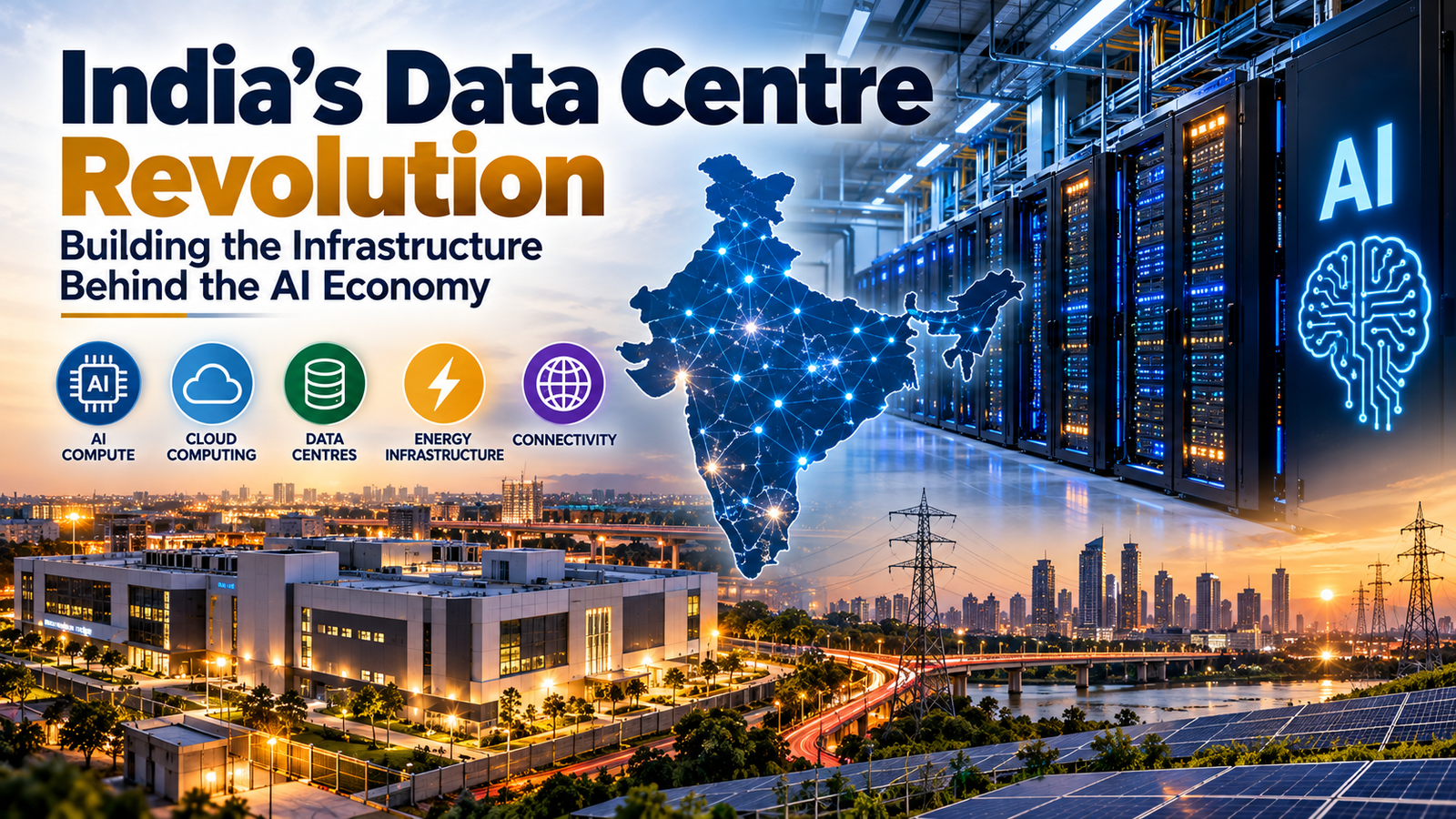
Artificial intelligence is often discussed in terms of algorithms, foundation models and applications. Yet behind every AI system lies a less visible physical infrastructure: data centres, high-performance computing systems, semiconductor chips, electricity networks, cooling systems and high-speed connectivity.
India is now entering a phase in which this physical infrastructure is becoming an important component of its economic and technological strategy.
The country’s installed data-centre power capacity has increased from about 375 MW in 2020 to around 1.57 GW by August 2026, according to the Ministry of Electronics and Information Technology. Major data-centre locations include Mumbai, Navi Mumbai, Chennai, Hyderabad, Bengaluru, Delhi NCR and Gujarat, while new investments are expanding into states such as Andhra Pradesh, Madhya Pradesh, Chhattisgarh and West Bengal.
This expansion is being driven not merely by conventional cloud computing but increasingly by artificial intelligence and high-performance computing.
The central question, therefore, is no longer simply whether India will adopt AI.
It is whether India can build the physical infrastructure required to develop, train, deploy and govern AI at scale.


8
What Exactly Is a Data Centre?
A data centre is a specialised facility containing computing equipment, storage systems, networking infrastructure, power systems and cooling mechanisms required to store and process digital information.
In simple terms:
Data → Servers → Processing → Storage → Network → Digital Service
Whenever a person makes a digital payment, accesses an online government service, uses cloud storage, streams content, conducts an online transaction or interacts with an AI application, computing infrastructure somewhere processes that information.
Data centres therefore constitute an important part of the physical foundation of the digital economy.
The Government’s recent backgrounder describes data centres as infrastructure supporting banking, e-governance and online services, while noting that growing digitalisation is generating increasing demand for computing capacity, data storage and high-speed connectivity.
India’s National Informatics Centre has also established National Data Centres at Delhi, Pune, Hyderabad and Bhubaneswar, along with smaller facilities at State capitals to support government digital services.
For UPSC preparation, this makes data centres relevant not only to Science & Technology, but also to infrastructure, economic development, governance and national security.
Why Are Data Centres Becoming More Important?
The transformation of India’s economy is increasing the volume of data that must be stored, transmitted and processed.
Several forces are operating simultaneously:
- expansion of cloud computing;
- digital payments;
- e-governance;
- e-commerce;
- streaming and digital entertainment;
- enterprise digitisation;
- Internet of Things;
- 5G connectivity;
- cybersecurity requirements;
- big-data analytics;
- artificial intelligence.
AI adds a new dimension because AI workloads can require large amounts of specialised computing power.
Training and running advanced AI models requires high-performance processors, particularly GPUs and other accelerators. These systems must operate inside facilities capable of supplying enormous amounts of electricity while maintaining appropriate temperature and humidity.
Thus:
AI growth → More computing → More servers → More data-centre capacity → More electricity and cooling requirements
This is why AI policy increasingly overlaps with infrastructure policy.
The Ministry of Electronics and Information Technology has explicitly linked the rapid growth of AI and high-performance computing with increasing demand for data-centre capacity.
Data Centres and the AI Infrastructure Stack
AI infrastructure should not be understood as a single technology.
It is better understood as a layered ecosystem.
1. Semiconductor layer
AI systems depend on advanced processors, GPUs, memory and other semiconductor components.
2. Compute layer
The processors are assembled into computing systems capable of training and running AI models.
3. Data-centre layer
The computing systems require secure facilities with power, cooling, storage and networking.
4. Connectivity layer
Fibre networks, broadband, 5G and submarine cables move data between users and computing facilities.
5. Data layer
AI requires large datasets for training, testing and deployment.
6. Model layer
Foundation models and specialised AI models transform computing power and data into usable intelligence.
7. Application layer
AI is ultimately deployed in areas such as healthcare, agriculture, education, finance, manufacturing, governance and defence.
Therefore, AI sovereignty cannot be achieved simply by developing an indigenous AI model.
It requires capabilities across the entire technological stack.
India’s policy framework increasingly reflects this understanding. The Government has linked the IndiaAI Mission, semiconductor initiatives, electronics manufacturing and IT-hardware manufacturing with the broader objective of strengthening the domestic AI ecosystem.
IndiaAI Mission and the Compute Question
One of the central constraints for AI development is access to compute.
Large technology companies can spend enormous amounts on specialised computing infrastructure, but startups, universities and independent researchers generally face much greater barriers.
The IndiaAI Mission, approved with an outlay of ₹10,371.92 crore, seeks to build a broader AI ecosystem, including access to computing capacity.
By June 2026, the shared IndiaAI compute ecosystem had expanded to more than 45,000 GPUs, while by August 2026, 237 projects had accessed subsidised AI computing, according to a government factsheet.
Earlier in 2026, the Government had also announced plans to add another 20,000 GPUs to India’s national AI compute capacity.
The significance is broader than the number of GPUs.
The objective is to reduce the entry barrier to AI research and development.
For an Indian university or startup, access to affordable compute can determine whether an idea remains a research paper or becomes a functioning AI product.
Data Centres and India’s Digital Sovereignty
Data centres also have a strategic dimension.
A country increasingly dependent on digital systems must consider:
- Where is its data stored?
- Who controls the infrastructure?
- Where is computing performed?
- Who supplies the processors?
- Who controls cloud platforms?
- How resilient are the networks?
- Can essential services continue during disruptions?
This is the idea of digital sovereignty.
It does not necessarily mean that every component must be manufactured domestically.
Rather, it means that a country should possess sufficient capability, resilience, regulatory control and technological alternatives to protect critical digital functions.
India’s policy approach therefore combines several initiatives.
The IndiaAI Mission addresses AI compute and models.
Semicon 2.0 seeks to strengthen the semiconductor ecosystem.
The PLI Scheme 2.0 for IT Hardware supports domestic manufacturing of products such as servers.
The Electronics Components Manufacturing Scheme seeks to strengthen the component ecosystem.
India’s Science & Technology resources at Samata IAS Academy
The Economics of Data Centres
Data centres are also becoming an important infrastructure investment opportunity.
The Government reported in September 2026 that discussions with industry stakeholders have focused on power availability, land, regulatory approvals and fiscal issues required for rapid expansion of the sector. The Government has cited an expected investment potential of around US$200 billion in India’s data-centre industry.
This creates a wider economic ecosystem involving:
Data centres → Construction → Power → Transmission → Cooling → Equipment → IT hardware → Fibre → Cloud services → AI applications
Therefore, the economic impact extends beyond the data-centre building itself.
It can generate demand for:
- electrical equipment;
- construction;
- specialised cooling systems;
- networking equipment;
- servers;
- storage systems;
- cybersecurity;
- engineering services;
- skilled technical personnel;
- renewable-energy capacity.
The Government has also highlighted the potential for employment and associated economic activity from the sector.
Indian Economy resources at Samata IAS Academy
The Hidden Constraint: Electricity
Perhaps the most important economic question surrounding AI infrastructure is energy.
A data centre cannot function without reliable electricity.
AI workloads make this challenge more significant because high-density computing systems can consume substantially more power than conventional enterprise workloads.
The Government has recognised data centres as an emerging source of electricity demand in national transmission planning. India’s National Electricity Plan for transmission takes into account emerging demand from sectors including electric mobility, data centres and industrial expansion.
This creates an important policy relationship:
AI expansion → Data-centre expansion → Electricity demand → Generation + Transmission requirements
Consequently, India’s AI strategy cannot be separated from its energy strategy.
The country will need to balance three objectives:
Reliable electricity + competitive electricity prices + lower carbon intensity
The Water Challenge
Electricity is not the only resource requirement.
Data centres generate considerable heat, and cooling is essential for maintaining equipment within safe operating conditions.
Traditional cooling systems can require significant water use, although the exact requirement varies according to technology and location.
India is increasingly seeing the deployment of:
- direct-to-chip liquid cooling;
- adiabatic cooling;
- immersion cooling;
- closed-loop cooling;
- high-density server configurations.
The Government says these technologies are being adopted to improve Water Use Efficiency and reduce water requirements associated with high-performance computing and AI workloads.
This is particularly important because India’s major technology hubs include regions where water stress is already a policy concern.
The environmental question is therefore not:
Should India build data centres?
The more relevant question is:
How can India expand digital infrastructure without creating unsustainable pressure on electricity, water and land?
AI Infrastructure and Green Data Centres
This brings the concept of the green data centre into focus.
A sustainable data-centre strategy can include:
- renewable electricity;
- energy-efficient servers;
- advanced cooling;
- waste-heat recovery;
- water recycling;
- closed-loop cooling;
- efficient building design;
- higher server utilisation;
- location optimisation;
- battery storage;
- smart-grid integration.
India’s Government has specifically highlighted energy-efficient and clean-energy measures for sustainable data-centre growth.
The issue is important for UPSC because it demonstrates how digitalisation and environmental sustainability are becoming interconnected policy questions.


7
Geography of India’s Data-Centre Industry
Data centres tend to cluster where several conditions come together:
Reliable power + connectivity + land + skilled manpower + customers + regulatory environment
Major Indian locations include:
- Mumbai and Navi Mumbai
- Chennai
- Hyderabad
- Bengaluru
- Delhi NCR
- Gujarat
- Pune
- Noida
The Government has also identified emerging investment destinations such as Andhra Pradesh, Madhya Pradesh, Chhattisgarh and West Bengal.
This geographical diversification is important.
Concentration in a small number of cities can create:
- power bottlenecks;
- land pressures;
- water stress;
- network congestion;
- disaster vulnerability;
- higher operating costs.
Dispersed infrastructure can improve resilience and redundancy, provided that connectivity and power infrastructure are adequate.
Data Centres and Submarine Cables
Data centres cannot operate as isolated facilities.
They need high-speed connections to users, cloud platforms and other data centres.
This makes submarine telecommunications cables another critical component of India’s AI infrastructure.
India currently has multiple submarine cable systems connecting it to international networks, while additional systems are being commissioned or planned. The Government reported in March 2026 that four submarine cable systems were being commissioned and three more were under planning.
This produces an important infrastructure chain:
Submarine cables → Cable landing stations → Fibre networks → Data centres → Cloud/AI compute → Users
A weakness anywhere in this chain can affect digital services.
This is why future discussions of critical infrastructure will increasingly have to include both physical and digital infrastructure.
GS Paper III — Economy, Infrastructure and Science & Technology
Data Centres and National Security
The strategic importance of data centres extends beyond economic growth.
Modern governments depend on digital infrastructure for:
- financial systems;
- public administration;
- communication;
- health systems;
- identity services;
- defence;
- emergency response;
- critical infrastructure management.
A major disruption to computing or connectivity can therefore have consequences far beyond the technology sector.
This creates several security concerns:
Cybersecurity
Data centres are attractive targets for cyberattacks.
Physical security
Facilities need protection against physical disruption and sabotage.
Supply-chain security
Dependence on imported chips, servers and specialised equipment can create vulnerabilities.
Network resilience
Multiple routes and geographically distributed infrastructure reduce dependence on a single location.
Data security
Sensitive information must be protected against unauthorised access.
Thus, data-centre policy is gradually becoming part of national-security policy.
India’s Policy Ecosystem
India’s emerging AI infrastructure is not being built through one programme.
It is a combination of several policy interventions.
IndiaAI Mission
Focuses on building a comprehensive AI ecosystem, including compute capacity, datasets, models, innovation and responsible AI.
Semicon 2.0
Approved in July 2026 with an outlay of ₹1,27,500 crore, it seeks to strengthen India’s semiconductor ecosystem.
PLI Scheme 2.0 for IT Hardware
Supports domestic manufacturing of IT hardware, including servers.
Electronics Components Manufacturing Scheme
Its financial support was increased from ₹22,000 crore to ₹40,000 crore, strengthening the domestic electronics-component ecosystem.
Budget 2026–27
The Union Budget introduced measures intended to position India as a global hub for cloud and AI infrastructure, including a proposed long-term tax framework for eligible foreign cloud providers using India-based data centres for global operations.
Together these measures indicate a shift from treating digital technology primarily as a services-sector issue towards viewing computing infrastructure as a strategic economic asset.
What Are the Major Challenges?
Despite rapid expansion, India’s data-centre ecosystem faces several challenges.
1. Energy intensity
Large-scale AI computing can significantly increase electricity demand.
2. Water use
Cooling requirements can become difficult in water-stressed regions.
3. Imported technology
Advanced processors and some specialised equipment remain dependent on global supply chains.
4. High capital requirements
Hyperscale data centres require large upfront investments.
5. Skilled manpower
The sector requires specialists in:
- electrical engineering;
- cooling systems;
- networking;
- cybersecurity;
- cloud architecture;
- AI computing;
- data-centre operations.
6. Regional concentration
Excessive concentration can create infrastructure bottlenecks.
7. Cybersecurity
Growing concentration of valuable data creates an expanding attack surface.
8. Environmental sustainability
Rapid infrastructure expansion needs to be reconciled with India’s climate and resource constraints.
9. Regulatory coordination
Land, electricity, water, telecommunications, construction and environmental regulation involve multiple authorities.
What Should India Do?
India’s objective should not merely be to maximise the number of data centres.
The emphasis should be on resilient, efficient and strategically distributed digital infrastructure.
1. Integrate AI and energy planning
AI infrastructure should be incorporated into long-term electricity and transmission planning.
2. Encourage renewable energy
Data-centre expansion should increasingly be matched with reliable low-carbon electricity.
3. Promote water-efficient cooling
Water-stressed regions should encourage closed-loop, liquid and other efficient cooling systems.
4. Build geographically distributed capacity
Multiple data-centre clusters can improve resilience.
5. Strengthen domestic hardware capability
Servers, components, networking equipment and semiconductor capabilities need greater domestic depth.
6. Improve cybersecurity
Data centres supporting critical services should be treated as important elements of the national cyber-resilience framework.
7. Develop specialised skills
India’s traditional IT-services strength needs to be complemented by expertise in AI compute, cloud infrastructure, data-centre engineering and advanced hardware.
8. Strengthen network redundancy
Data-centre expansion should be accompanied by resilient fibre networks and diverse international connectivity.
9. Encourage sustainable location planning
Investment decisions should consider electricity, water availability, climate risks and disaster vulnerability rather than land availability alone.
10. Maintain technological openness
India can pursue strategic autonomy while remaining integrated with global technology and investment ecosystems.
The Larger Economic Significance
The data-centre story is ultimately about more than servers.
It represents a transition in the nature of economic infrastructure.
In the industrial era, infrastructure meant:
roads + ports + railways + electricity
In the digital era, infrastructure increasingly includes:
fibre + cloud + data centres + semiconductors + computing + cybersecurity
And in the AI era, another layer is being added:
high-performance compute + GPUs + AI models + specialised energy and cooling infrastructure
This changes the meaning of infrastructure-led development.
A country seeking to become a major AI economy needs not only talented software engineers and entrepreneurs but also the physical infrastructure capable of supporting them.
India’s expanding data-centre ecosystem therefore sits at the intersection of:
Technology + Economy + Energy + Environment + Security + Geopolitics
That makes it an increasingly important issue for understanding India’s development trajectory towards Viksit Bharat 2047.
Conclusion
India’s digital transformation is entering a new stage.
The first phase was largely about connectivity — mobile phones, broadband, digital payments and digital public infrastructure.
The next phase is increasingly about compute.
Data centres will provide the physical environment in which cloud services, artificial intelligence, advanced analytics and future digital technologies operate.
But the expansion of this infrastructure also creates new demands for electricity, water, skilled manpower, cybersecurity, resilient networks and advanced hardware.
The policy challenge is therefore not simply to build more data centres.
It is to create an ecosystem in which computing capacity is affordable, infrastructure is resilient, energy use is sustainable, data is secure and technological capabilities increasingly extend across the value chain.
For India, the strategic question is ultimately straightforward:
Can the country transform its large digital user base and software capabilities into a complete physical and technological infrastructure for the AI economy?
The answer will depend not on AI models alone, but on the infrastructure beneath them.
UPSC Prelims Corner
Key facts to remember
- India’s data-centre capacity increased from about 375 MW in 2020 to around 1.57 GW by August 2026.
- Major data-centre hubs include Mumbai, Navi Mumbai, Chennai, Hyderabad, Bengaluru, Delhi NCR and Gujarat.
- The IndiaAI Mission has an outlay of ₹10,371.92 crore.
- More than 45,000 GPUs had been incorporated into the IndiaAI shared compute ecosystem by June 2026.
- Semicon 2.0 was approved with an outlay of ₹1,27,500 crore.
- Advanced cooling technologies include direct-to-chip liquid cooling, adiabatic cooling and immersion cooling.
UPSC Mains Corner
GS Paper III
Science & Technology
- Artificial Intelligence
- Digital infrastructure
- Semiconductors
- Emerging technologies
- Indigenous technological capability
Economy
- Infrastructure
- Investment
- Industrial development
- Digital economy
- Employment
Environment
- Energy consumption
- Water use
- Sustainable infrastructure
- Green data centres
Internal Security
- Critical digital infrastructure
- Cybersecurity
- Data security
- Infrastructure resilience
Explore GS Paper III at Samata IAS Academy
Possible Mains Question
“Data centres are emerging as critical infrastructure for India’s AI-driven digital economy. Examine the opportunities and challenges associated with their rapid expansion in India.”
Key dimensions for an answer
Introduction: Define data centres and their growing role in the digital economy.
Body:
- AI and cloud-driven demand
- Economic opportunities
- Digital sovereignty
- Energy requirements
- Water consumption
- Cybersecurity
- Semiconductor dependence
- Regional concentration
- Environmental sustainability
Way forward:
- Renewable energy
- Efficient cooling
- Distributed infrastructure
- Domestic hardware ecosystem
- Skilled manpower
- Cyber resilience
- Regulatory coordination
Conclusion: India needs not merely more data centres but resilient, sustainable and strategically capable digital infrastructure.
Key Takeaway
AI is software on the surface, but infrastructure underneath.
India’s ability to become a major AI economy will depend not only on algorithms and talent, but also on data centres, GPUs, semiconductors, electricity, cooling, connectivity and cybersecurity.
Explore Science & Technology at Samata IAS Academy
Explore Current Affairs at Samata IAS Academy