
The plate tectonic theory is a scientific model that explains the movement and interaction of the Earth’s lithospheric plates. It provides a framework for understanding various geological phenomena, such as earthquakes, volcanic activity, mountain formation, and the distribution of continents and oceans.
According to the plate tectonic theory, the Earth’s outermost layer, known as the lithosphere, is divided into several large and smaller rigid plates that float on the semi-fluid layer beneath called the asthenosphere. These plates are composed of the crust and the uppermost part of the mantle.
The lithospheric plates are in constant motion, albeit very slowly, with an average rate of a few centimeters per year. The movement is driven by the convective currents in the underlying asthenosphere. These currents are caused by the transfer of heat from the Earth’s interior to the surface.
There are three main types of plate boundaries where the plates interact with each other:
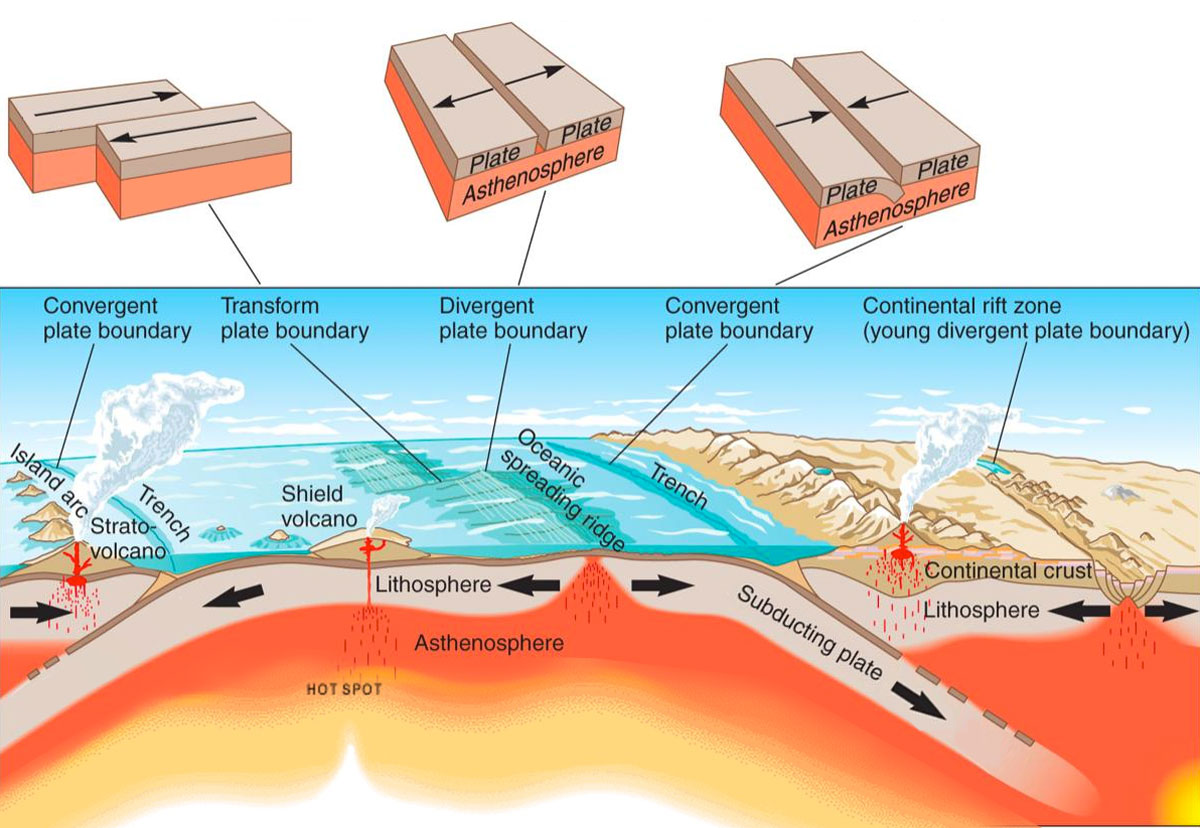
- Divergent Boundaries: At divergent boundaries, two plates move away from each other. This creates a gap that allows magma from the asthenosphere to rise, leading to the formation of a new crust. The most famous example of a divergent boundary is the Mid-Atlantic Ridge, where the Eurasian and North American plates are moving apart, causing the Atlantic Ocean to widen.
- Convergent Boundaries: Convergent boundaries occur when two plates collide. There are three types of convergent boundaries: a. Oceanic-Oceanic Convergence: When two oceanic plates collide, one of them is usually forced beneath the other in a process called subduction. This subduction leads to the formation of deep ocean trenches and volcanic arcs. A notable example is the collision between the Pacific Plate and the Philippine Sea Plate, resulting in the formation of the Mariana Trench and the Mariana Islands. b. Oceanic-Continental Convergence: When an oceanic plate collides with a continental plate, the denser oceanic plate is subducted beneath the lighter continental plate. This leads to the formation of coastal mountain ranges and a volcanic arc. The subduction of the Nazca Plate beneath the South American Plate, resulting in the formation of the Andes Mountains, is an example of this type of convergence. c. Continental-Continental Convergence: When two continental plates collide, neither is dense enough to be subducted. Instead, the collision leads to the uplift and folding of the crust, forming massive mountain ranges. The collision between the Indian Plate and the Eurasian Plate, resulting in the formation of the Himalayas, is a well-known example.
- Transform Boundaries: Transform boundaries occur where two plates slide past each other horizontally. They are characterized by intense earthquakes and the absence of volcanic activity. The San Andreas Fault in California is a famous example of a transform boundary, where the Pacific Plate and the North American Plate slide past each other.
The plate tectonic theory explains how these plate movements and interactions are responsible for the distribution of geological features and processes across the Earth’s surface. It also helps scientists understand the formation and breakup of supercontinents, the opening and closing of ocean basins, and the long-term geological history of our planet.