
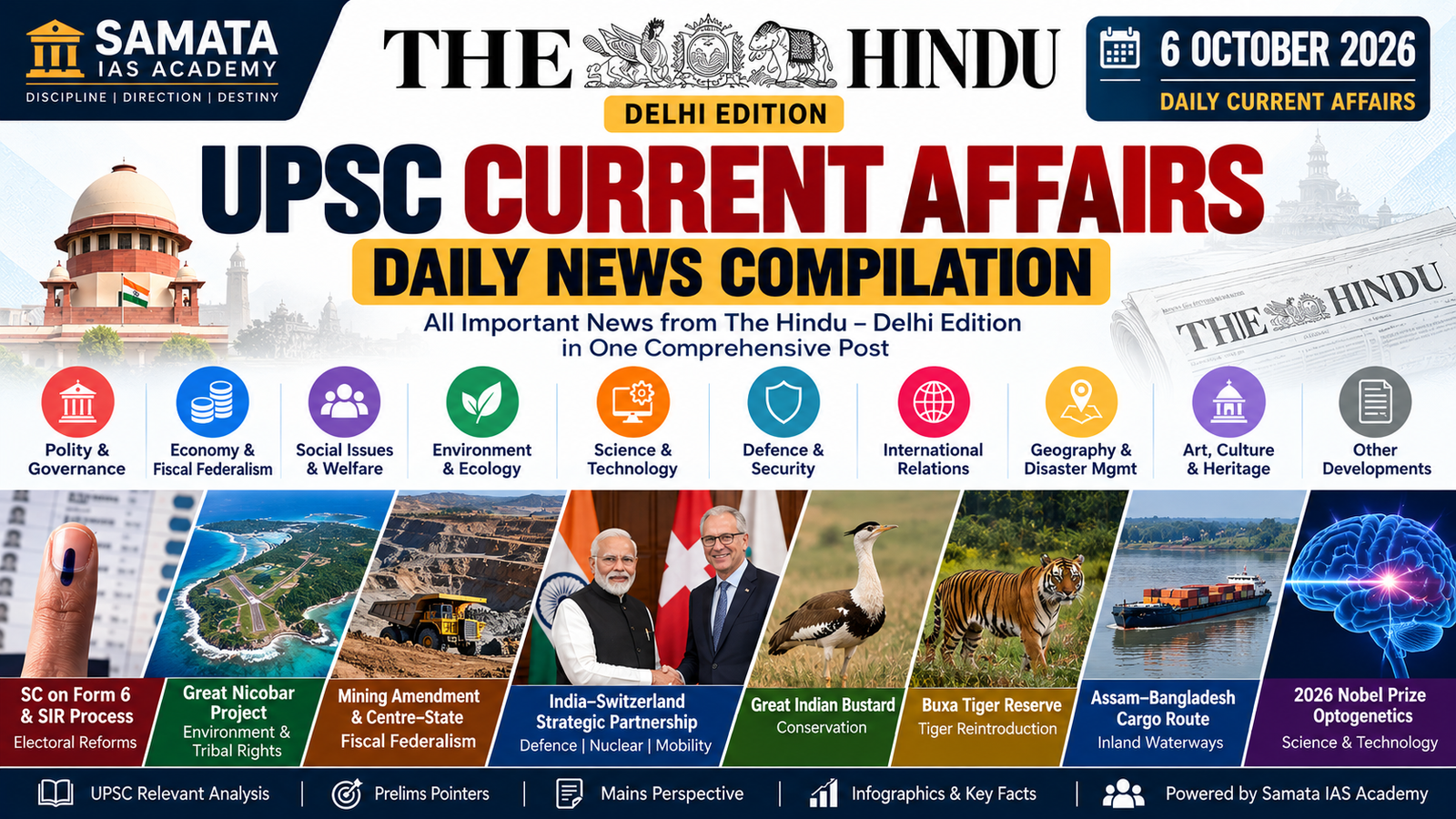
UPSC Current Affairs 6 October 2026: Daily News Compilation
Source: The Hindu, Delhi City Edition, Tuesday, 6 October 2026, 16 pages. th.th_delhi.06_10_2026
1. 🏛️ POLITY & GOVERNANCE
1.1 Supreme Court distances itself from changes to Form 6 during SIR
The Supreme Court said that it had not itself made or approved modifications to Form 6 used for voter registration during the ongoing Special Intensive Revision (SIR) of electoral rolls.
The observation came while hearing petitions seeking action against Chief Election Commissioner Gyanesh Kumar over alleged procedural irregularities in the SIR exercise. The Court issued notice to the Election Commission and the Centre. th.th_delhi.06_10_2026
Why is this important?
Form 6 is the application used by an eligible person seeking inclusion in the electoral roll for the first time.
The case raises broader questions regarding:
- Independence and accountability of the Election Commission
- Electoral-roll revision
- Due process in deletion/inclusion of voters
- Institutional credibility
- Judicial review of electoral administration
- Immunity available to Election Commissioners
The Court also discussed Section 16 of the Chief Election Commissioner and other Election Commissioners Act, 2023, which provides protection against civil or criminal proceedings against a person who is or was a CEC/EC. th.th_delhi.06_10_2026
UPSC Prelims
Form 6: Inclusion of name in electoral roll.
Form 7: Objection to inclusion/deletion of name from electoral roll.
Form 8: Correction/shifting/replacement-related electoral-roll applications.
Mains
GS-II — Election Commission, electoral reforms, constitutional institutions
How can electoral-roll revision be made simultaneously accurate, transparent and rights-protective?
1.2 SIR and voter disenfranchisement concerns in West Bengal
West Bengal Booth Level Officers have sought security arrangements while conducting a fresh exercise to enrol new voters and re-enrol eligible voters whose names were deleted during SIR.
The edition reports that over 91 lakh voters were deleted from West Bengal electoral rolls during the SIR exercise, while around 27 lakh subsequently approached tribunals seeking restoration. th.th_delhi.05_10_2026
The issue becomes particularly significant because:
- Electoral-roll revision directly affects the right to participate in elections.
- BLOs are the grassroots administrative interface of the electoral system.
- Delays in appellate mechanisms can effectively prevent citizens from voting.
1.3 Nearly 19,000 West Bengal voters may miss bypolls
A particularly important development concerns the functioning of Appellate Tribunals created to deal with appeals against deletion of names.
According to the report:
- 38.31 lakh appeals remain pending.
- Only about 1.26 lakh have been cleared.
- This represents roughly 3% of the total.
- Only 16 of 19 tribunals remain functional.
- Three retired judges have resigned.
- The Calcutta High Court had observed that at the present pace, clearing the backlog could take 21 years. th.th_delhi.06_10_2026
UPSC significance
This is a classic case for studying the relationship between:
Electoral integrity → administrative capacity → access to justice → democratic participation.
1.4 Telangana: allegations of bulk Form 7 applications
The Telangana Pradesh Congress Committee approached Hyderabad Police alleging an organised attempt to delete genuine voters through pre-filled Form 7 applications during SIR.
The party demanded an FIR and SIT investigation.
Meanwhile, the Telangana CEO directed election authorities to act against persons making knowingly false statements in Forms 6, 6A, 7 and 8. th.th_delhi.06_10_2026
Karnataka development
Between June 16 and October 4, 91,278 Form 7 applications had been received in Karnataka.
The Karnataka CEO clarified that merely filing Form 7 does not automatically delete a voter. An inquiry and hearing are required before deletion. th.th_delhi.06_10_2026
Mains angle
Electoral-roll purification must not become electoral exclusion.
1.5 Supreme Court and simultaneous elections debate
A Parliamentary Joint Committee examining the proposed simultaneous election legislation had planned a study visit to the Supreme Court.
DMK Rajya Sabha MP P. Wilson defended the proposal to interact with judges, arguing that separation of powers does not mean that the three organs of the State operate in completely isolated compartments.
He cited:
- Article 143
- Historical interaction between constitutional judges and constitution-makers
- The distinction between seeking informal views and seeking judicial adjudication
The proposed visit was eventually cancelled.
UPSC
Relevant concept:
Separation of powers vs institutional dialogue
1.6 Supreme Court to examine delimitation during Census
The Supreme Court agreed to hear a petition questioning whether State governments can redraw municipal ward boundaries during an ongoing Census exercise.
The petition refers to Rule 8(iv) of the Census Rules, 1990, which requires administrative boundaries to be frozen from the date notified by the Census Commissioner. th.th_delhi.06_10_2026
Why important?
This connects:
- Census
- Delimitation
- Local government
- Administrative boundaries
- Electoral representation
1.7 Centre appoints three High Court Chief Justices to Supreme Court
The Centre appointed:
- Justice Sunita Agarwal, Chief Justice of Gujarat High Court
- Justice Devendra Kumar Upadhyaya, Chief Justice of Delhi High Court
- Justice Aparesh Kumar Singh, Chief Justice of Telangana High Court
Their elevation takes the Supreme Court’s working strength to 37, against a sanctioned strength of 38. th.th_delhi.06_10_2026
1.8 Punjab High Court orders CBI probe into corruption allegations
The Punjab and Haryana High Court directed the CBI to investigate corruption allegations linked to the Punjab Chief Minister’s office.
The allegations include:
- Corruption in transfers and postings
- Policy manipulation
- Cash-for-tenders
- Other alleged irregularities
The CBI has been directed to submit a status report within two months.
2. ⚖️ JUDICIARY & CONSTITUTIONAL ISSUES
2.1 Great Nicobar Island Project: Supreme Court refuses to stay proceedings
The Supreme Court refused to stay proceedings before the Calcutta High Court challenging the Great Nicobar Island Project.
The project has an estimated value of about ₹72,000 crore and has been presented by the Centre as strategically important. th.th_delhi.06_10_2026
The case involves concerns regarding:
- Indigenous tribal communities
- Shompen tribe
- Forest Rights Act, 2006
- Environmental impacts
- Tribal culture
- Constitutional protection of cultural rights
- Strategic infrastructure
The Supreme Court emphasised that preservation of culture is a constitutionally protected fundamental right. th.th_delhi.06_10_2026
Environmental governance angle
The Centre pointed out that the National Green Tribunal had earlier dealt with challenges to the environmental clearance, subject to conditions and a high-powered committee examining specific ecological impacts.
Mains question
Strategic infrastructure in ecologically fragile and tribal regions must balance national security with constitutional and environmental obligations. Discuss.
2.2 Legislative privilege versus freedom of speech
The Supreme Court’s seven-judge Constitution Bench is scheduled to consider a reference involving whether legislative privilege can restrict freedom of speech, arising from a 2003 Tamil Nadu Assembly resolution targeting editors of The Hindu.
The specific Assembly resolution was subsequently withdrawn, but the broader constitutional issue remains relevant.
Constitutional provisions to remember
- Article 19(1)(a) — Freedom of speech and expression
- Article 105 — Parliamentary privileges
- Article 194 — State Legislature privileges
3. 💰 ECONOMY
3.1 India–U.S. trade negotiations reach a “plateau”
Finance Minister Nirmala Sitharaman said India–U.S. trade negotiations have reached a stage where adding further demands and concessions may be difficult.
She noted that:
- India has a substantial trade surplus with the U.S.
- The U.S. seeks to address the imbalance.
- Tariffs have increasingly become instruments of trade policy.
- India’s Russian oil imports were not a condition in negotiations for the India–EU FTA. th.th_delhi.06_10_2026
UPSC significance
This reflects the changing character of global trade:
FTA negotiations → tariffs → trade imbalance → geopolitical considerations → supply-chain realignment.
4. 🇮🇳 INDIA–SWITZERLAND RELATIONS
4.1 India and Switzerland deepen defence and nuclear cooperation
Prime Minister Narendra Modi and Swiss President Guy Parmelin discussed new areas of cooperation in:
- Defence
- Defence production
- Nuclear energy
- Transport
- Mobility
- Infrastructure
- Research and innovation
The two countries signed five agreements/MoUs/Letters of Intent. th.th_delhi.06_10_2026
Migration and mobility
The Migration and Mobility Partnership provides for:
- Multiple-entry visas of up to five years
- Stays of up to six months per visit
- Renewable one-year student permits
Young Professionals
The Young Professionals agreement provides for an exchange of 300 people annually per country, potentially increasing to 500. th.th_delhi.06_10_2026
Science & technology
India’s Department of Science and Technology and the Swiss National Science Foundation signed an LoI to strengthen research cooperation.
5. ⛏️ CENTRE–STATE RELATIONS & FISCAL FEDERALISM
5.1 Mining Amendment raises questions over States’ fiscal autonomy
The Mines and Minerals (Development and Regulation) Amendment Act, 2026 has triggered a Centre–State debate.
The amended framework expands the Centre’s regulatory powers to include mineral-bearing lands and restricts States’ ability to impose fresh taxes on mineral rights and mineral-bearing lands except under conditions prescribed by the Union.
Constitutional framework
Mining involves distribution of powers between Centre and States.
State List — Entry 23:
Regulation of mines and mineral development subject to Union control.
Union List — Entry 54:
Parliament can legislate on regulation and development of mines and minerals in the public interest.
State List — Entry 50:
Taxes on mineral rights, subject to limitations imposed by Parliament.
State List — Entry 49:
Taxes on lands and buildings.
The controversy concerns the balance between these powers. th.th_delhi.06_10_2026
Fiscal dependence
Mineral-related receipts account for:
| State | Share of non-tax revenue |
|---|---|
| Jharkhand | 85% |
| Odisha | 80% |
| Karnataka | 48% |
| Madhya Pradesh | 41% |
| Rajasthan | 39% |
| Telangana | 11% |
| Chhattisgarh | 6% |
Thus, the amendment has particularly significant fiscal implications for mineral-rich States such as Jharkhand and Odisha.
Mains
GS-II — Federalism
Does India’s fiscal federalism provide adequate autonomy to mineral-rich States?
6. ⚡ ENERGY & CLIMATE
6.1 Critically low coal stocks amid rising power demand
The newspaper’s data analysis highlights a major energy-security concern.
According to the CEA data cited:
- India has 191 thermal power plants.
- 84 plants were critically low on coal stocks.
- This represents more than 44% of the plants.
- Power demand increased by around 10% in 2026, the highest annual increase in a decade.
- India’s highest-ever power demand cited was 270.8 GW on May 21, 2026.
- Coal accounted for 79% of total energy generated in 2024–25. th.th_delhi.06_10_2026
The analysis links higher electricity demand to:
- Rising temperatures
- Greater cooling demand
- Declining hydropower generation
- Possible El Niño-related monsoon weakness
- Continued dependence on coal
UPSC concept
Climate change → heatwaves → cooling demand → electricity demand → coal dependence → emissions
This is a classic energy trilemma:
Energy security + energy affordability + environmental sustainability
7. 🌳 ENVIRONMENT & ECOLOGY
7.1 Great Indian Bustard conservation
Two male Great Indian Bustards (GIB) were released into the wild at Desert National Park, Jaisalmer.
The conservation programme now has:
- 97 birds
- 9 more awaiting release
- 57 captive-bred birds
- 29 chicks produced in the current year
- 24 chicks produced the previous year
The overall wild population remains extremely small, at around 120 birds. th.th_delhi.06_10_2026
Major threats
- Habitat conversion
- Agricultural expansion
- Irrigation
- Roads
- High-tension power lines
- Collision with transmission infrastructure
The Supreme Court’s interventions concerning undergrounding power lines in critical GIB habitats illustrate the conservation–renewable-energy conflict.
Key UPSC fact
Great Indian Bustard — critically endangered; Rajasthan is its principal habitat.
7.2 Buxa Tiger Reserve: tiger reintroduction
A three-year-old tigress, T138, was released in Buxa Tiger Reserve, West Bengal, as part of a phased tiger-reintroduction programme.
Buxa:
- Was declared a tiger reserve in 1983
- Is the 15th tiger reserve in India
- Covers about 760.87 sq km
- Has ecological connectivity with forests of Bhutan
- Connects with Manas Tiger Reserve and other landscapes
The tigress came from Valmiki Tiger Reserve, Bihar, because of similarities in terrain and habitat.
Conservation challenges
- Habitat degradation
- Habitat fragmentation
- Declining prey
- Human settlements
- Human–wildlife conflict
- Railway infrastructure
- Road traffic
- Relocation of villages
The State has reportedly persuaded around 300 families to relocate to support the reintroduction programme.
th.th_delhi.06_10_2026
Important concept
Species-based conservation → landscape-based conservation
The newspaper editorial argues that conservation should increasingly treat landscapes rather than isolated species as the fundamental unit of ecological planning.
8. 🏭 INDUSTRY & MSMEs
8.1 Coimbatore MSMEs face rising metal prices
Coimbatore’s MSMEs have raised concerns over rising costs of:
- Steel
- Pig iron
- Copper
- Aluminium
- Diesel
- Furnace oil
- LPG
The industry body reported that steel prices increased by around ₹8,000–₹10,000 per tonne between August and September.
It sought:
- A steel price-monitoring mechanism
- Measures against hoarding and cartelisation
- Temporary withdrawal of certain import/safeguard duties
- Measures to facilitate imports of copper and aluminium scrap
- A SAIL depot in Coimbatore
Mains
MSMEs + input costs + competitiveness + manufacturing + Make in India
9. 🚢 GEOGRAPHY, CONNECTIVITY & NORTH-EAST
9.1 First international cargo vessel from Assam since Independence
A barge carrying 540 metric tonnes of methanol left Bogibeel Terminal in Dibrugarh for Bangladesh.
It represents the first international shipment from eastern Assam since Independence. th.th_delhi.06_10_2026
Route
The vessel will:
Dibrugarh → Brahmaputra → India-Bangladesh border → Indo-Bangladesh Protocol Route → Bangladesh
It will travel:
- Around 768 km on the Brahmaputra
- Around 1,300 km in total
National Waterway-2
The 891-km stretch of Brahmaputra from Sadiya to Dhubri was declared National Waterway-2 in 1988.
Regular cargo services resumed in 2017.
Strategic significance
This has implications for:
- Act East Policy
- North-East economic integration
- Inland waterways
- India-Bangladesh connectivity
- Regional trade
- Multimodal logistics
- Lower freight emissions
India is also working on regional waterway connectivity with:
Bangladesh, Nepal, Bhutan and Myanmar.
10. 🤖 SCIENCE & TECHNOLOGY
10.1 2026 Nobel Prize in Physiology or Medicine — Optogenetics
Three scientists were awarded the 2026 Nobel Prize in Physiology or Medicine for work that led to optogenetics:
- Karl Deisseroth
- Peter Hegemann
- Georg Nagel
Optogenetics allows scientists to control specific nerve cells using light. th.th_delhi.06_10_2026
How does it work?
Scientists identified light-sensitive proteins called channelrhodopsins.
When exposed to light, these proteins open channels allowing charged ions to enter cells, generating electrical signals.
Applications
Optogenetics has become a powerful neuroscience research tool for studying:
- Pain
- Attention
- Sleep
- Memory
- Social behaviour
- Schizophrenia
- Depression
- Alzheimer’s disease
- Parkinson’s disease
It is also being investigated in approaches related to restoring vision and hearing.
Prelims
Optogenetics = use of light to control genetically modified neurons.
11. 🧠 AI & DIGITAL INFRASTRUCTURE
11.1 20,000 additional NVIDIA Rubin GPUs for India and Malaysia
AM Intelligence has ordered 20,000 NVIDIA Rubin GPUs for deployment in India and Malaysia.
This follows an earlier commitment for 9,000 GPUs for its first AI factory in Hyderabad.
The additional facilities will have around 70 MW of capacity and are expected to be delivered in Q2 2027. th.th_delhi.06_10_2026
UPSC significance
This illustrates the growing importance of:
AI compute → semiconductor ecosystem → data centres → electricity demand → cooling infrastructure → digital sovereignty
It also links directly with the energy story discussed earlier.
11.2 AI accessibility and persons with disabilities
An opinion article highlights an emerging policy challenge: AI systems can reproduce disability bias.
It points to concerns involving:
- Inaccessible government websites
- AI bias
- Under-representation of disability in datasets
- Accessibility of digital public services
- Energy requirements of AI data centres
Constitutional angle
The article refers to the 2024 Rajive Raturi judgment, in which the Supreme Court recognised accessibility as connected with the fundamental right to life and dignity.
Mains
GS-II + GS-III
How can India ensure that AI-driven governance is inclusive, accessible and non-discriminatory?
12. 🌐 INTERNATIONAL RELATIONS
12.1 India–France: strategic autonomy and middle-power cooperation
French Minister-Delegate for European Affairs Benjamin Haddad highlighted convergence between India and France around:
- Strategic autonomy
- Multilateralism
- International law
- Middle-power cooperation
- Space
- Artificial intelligence
France supports the conclusion of the India–EU FTA and sees India as an important partner in a changing geopolitical environment. th.th_delhi.06_10_2026
UPSC concept
Strategic autonomy does not necessarily mean isolation.
It implies maintaining sufficient policy independence to pursue national interests while engaging with multiple partners.
12.2 India and Bangladesh: proposed visit by Bangladesh PM
Bangladesh’s State Minister for Foreign Affairs Humaiyun Kobir said activities of former Prime Minister Sheikh Hasina and her associates in India remain a challenge in planning a possible visit to India by Prime Minister Tarique Rahman.
At the same time, Bangladesh emphasised:
- Strategic autonomy
- Importance of India
- Continued bilateral dialogue
- Need for reciprocal cooperation
The issue demonstrates the complex interaction between:
Neighbourhood First + domestic political change + extradition/security concerns + bilateral diplomacy. th.th_delhi.06_10_2026
12.3 Brazil presidential election
Brazil’s presidential election is heading towards a runoff on October 25 after neither leading candidate secured more than 50%.
The contest is between:
- Luiz Inácio Lula da Silva
- Flávio Bolsonaro
Around 159 million Brazilians are eligible to vote.
The contest also has geopolitical implications because of differing approaches towards:
- The United States
- China
- Trade
- Foreign policy
th.th_delhi.06_10_2026
12.4 South China Sea tensions
China warned the Philippines against what it described as “provocative acts” in the South China Sea.
The dispute involves activities around the Scarborough Shoal, where the Philippines said a Chinese fighter aircraft interfered with a routine military patrol. th.th_delhi.06_10_2026
UPSC
Know:
- South China Sea
- Scarborough Shoal
- Spratly Islands
- Nine-dash line
- UNCLOS
- Freedom of navigation
- ASEAN’s strategic importance
12.5 Ethiopia: renewed Tigray conflict
Fighting has again intensified in Ethiopia’s Tigray region.
A drone strike on a camp for internally displaced persons reportedly killed at least eight people.
The renewed fighting has revived concerns of a return to the 2020–2022 Tigray conflict. th.th_delhi.06_10_2026
Prelims
Tigray — northern Ethiopia
12.6 Myanmar deportations
Nearly 1,500 Myanmar nationals deported from Malaysia arrived in Myanmar despite concerns over security conditions.
The UN has criticised the repatriation because of the continuing instability in Myanmar. th.th_delhi.05_10_2026(1)
13. 🌍 GLOBAL EMPLOYMENT CRISIS
13.1 The demographic dividend may become a demographic crisis
A major editorial argues that the Global South could face a massive employment shortfall.
According to the figures cited:
- Around 1.2 billion young people in the Global South are expected to reach working age over the coming decade.
- The global economy may generate only around 400 million viable jobs.
- Potential employment gap: approximately 800 million.
th.th_delhi.06_10_2026
Why is this happening?
Traditional development theory assumed:
Falling fertility → larger working-age population → manufacturing jobs → rising productivity → demographic dividend
But this model is under pressure because of:
- Automation
- Artificial intelligence
- Robotics
- Premature deindustrialisation
- Skill mismatches
- Weak vocational training
- Low female labour-force participation
India’s challenge
India faces:
- Large youth population
- Underemployment
- Low female labour-force participation
- Agriculture absorbing a large workforce
- Manufacturing not generating sufficient employment
- Skill–job mismatch
Possible solutions
The article highlights:
Agriculture
→ agri-tech + food processing + cold chains
Healthcare
→ nurses + care economy + community health workers
Tourism
→ labour-intensive local employment
Manufacturing
→ green manufacturing + light assembly
Infrastructure
→ physical + digital infrastructure
Mains
India’s demographic dividend will depend not merely on the size of its young population but on its ability to convert young people into productive human capital. Discuss.
14. 🏥 HEALTH & SOCIAL SECTOR
14.1 Supreme Court seeks preventive measures against sexual offences in Delhi
The Supreme Court directed Delhi Police to establish 24-hour monitoring cells to continuously monitor vulnerable areas.
It also called for:
- Stronger patrolling
- Focus on educational institutions
- Identification of vulnerable locations
- Better police–community interaction
- Continuous CCTV monitoring
The Court observed that CCTV cameras have limited preventive value if nobody is continuously monitoring them. th.th_delhi.06_10_2026
Mains
This is a good example of the shift from:
reactive policing → preventive policing
14.2 Andhra Pradesh assistance to Sri City blast victims
Following the industrial explosion at a pharmaceutical unit in Sri City, Andhra Pradesh, the State government and company announced compensation and rehabilitation support.
The company is to provide ₹50 lakh to each victim’s nominee, alongside compensation under the applicable Workmen’s Compensation framework.
The State also indicated assistance with employment for eligible family members. th.th_delhi.06_10_2026
UPSC angle
Industrial safety + occupational health + disaster compensation + corporate responsibility
14.3 Debate over angioplasty in Kerala
A debate has emerged in Kerala over claims concerning “unnecessary” angioplasty.
The Interventional Cardiology Council of Kerala said public concerns about unnecessary procedures should not delay life-saving treatment.
Its registry data indicate that more than 70% of angioplasties in Kerala involve acute and emergency situations.
UPSC relevance
- Public health
- Medical ethics
- Evidence-based healthcare
- Regulation of private healthcare
- Patient awareness
15. 🏫 EDUCATION
15.1 Odisha to hold student union elections after eight years
Student union elections will be held in public colleges and universities across Odisha on October 15, ending an eight-year hiatus.
The stated objective is to develop future leadership at the college level.
UPSC relevance
Student politics + democratic participation + political socialisation
16. 📈 FINANCIAL MARKETS
16.1 SEBI may partially reverse closing-auction mechanism
SEBI introduced a Closing Auction Session (CAS) for stocks linked to futures and options.
The mechanism reportedly produced sharp swings in derivatives prices on expiry days.
SEBI received around 20,000 suggestions during consultation.
The proposed alternative would use the volume-weighted average price of the final 30 minutes of trading for derivatives settlement.
th.th_delhi.06_10_2026
Prelims concept
VWAP — Volume Weighted Average Price
It gives greater weight to prices at which larger trading volumes occurred.
17. ✈️ ENERGY PRICES & AVIATION
17.1 IndiGo increases fuel surcharge
IndiGo increased its fuel surcharge for the third time following volatility in aviation turbine fuel (ATF) prices.
The airline said ATF prices had increased by more than 14% month-on-month.
Domestic surcharge now ranges from:
₹375 to ₹1,300, depending on distance. th.th_delhi.06_10_2026
UPSC linkage
Geopolitical conflict → crude oil prices → ATF → airline operating costs → passenger fares → inflationary pressures
18. 🔋 BATTERY STORAGE & TELECOM
Cygni Energy and Indus Towers have agreed to explore cooperation in energy-storage solutions for telecom infrastructure.
They are considering battery-energy-storage manufacturing capacity of up to 1.5 GWh.
Significance
This connects:
- Renewable energy
- Grid flexibility
- Telecom infrastructure
- Battery manufacturing
- Energy transition
- Make in India
th.th_delhi.06_10_2026
19. 🏅 SPORTS — UPSC-RELEVANT DEVELOPMENT
India’s performance at the Aichi-Nagoya Asian Games has triggered discussion about India’s sports ecosystem.
India won:
- 85 medals
- 21 gold medals
- Fourth position
The editorial notes that India had won 106 medals at Hangzhou.
India also had 310 debutants, while men and women each contributed 38 medals. th.th_delhi.06_10_2026
Policy relevance
The discussion concerns:
- Khelo India
- Sports funding
- Grassroots infrastructure
- Women’s participation
- Olympic preparation
- Individual vs team sports
20. 📚 ADDITIONAL SCIENCE & HISTORY — NUCLEAR ARCHAEOLOGY
A fascinating Science & Technology + History article examines Nazi Germany’s attempt to build a nuclear reactor during World War II.
Researchers studying surviving uranium cubes and historical data concluded that Heisenberg’s reactor experiment was much farther from achieving criticality than previously believed.
The reactor’s neutron multiplication factor was estimated at around 0.942, whereas a sustained chain reaction requires a factor of 1.
The study suggests that Nazi Germany lacked adequate quantities and quality of:
- Uranium
- Heavy water
- Reactor-grade graphite
The episode illustrates the importance of industrial capacity and supply chains, not merely scientific knowledge, in strategic technologies.
th.th_delhi.06_10_2026
UPSC connection
Science → industrial capacity → strategic autonomy → national security
🔑 PRELIMS QUICK REVISION
| Topic | Key Fact |
|---|---|
| Form 6 | Application for inclusion of name in electoral roll |
| Form 7 | Objection/deletion from electoral roll |
| Form 8 | Correction/shifting/replacement-related electoral applications |
| National Waterway-2 | Brahmaputra, Sadiya–Dhubri |
| Buxa Tiger Reserve | West Bengal; declared tiger reserve in 1983 |
| Valmiki Tiger Reserve | Bihar; source reserve for Buxa tiger reintroduction |
| Great Indian Bustard | Major habitat: Rajasthan |
| Optogenetics | Uses light to control specific neurons |
| Channelrhodopsins | Light-sensitive proteins used in optogenetics |
| Article 19(1)(a) | Freedom of speech and expression |
| Article 105 | Parliamentary privileges |
| Article 194 | State Legislature privileges |
| Article 143 | Presidential reference to Supreme Court |
| Entry 23, State List | Mines and mineral development, subject to Union control |
| Entry 54, Union List | Regulation/development of mines and minerals |
| Entry 50, State List | Taxes on mineral rights |
| VWAP | Volume Weighted Average Price |
| National Waterway-2 | Brahmaputra |
| GIB threat | Power-line collisions among major threats |
| AI infrastructure | Increasing electricity/data-centre requirements |
🎯 TOP 10 TOPICS FOR UPSC PREPARATION TODAY
1. SIR, Form 6/Form 7 and electoral-roll integrity
GS-II | Polity
2. Great Nicobar Project and tribal/environmental rights
GS-II + GS-III | Environment + Governance
3. Centre–State conflict over mining taxation
GS-II | Federalism
4. India–Switzerland strategic partnership
GS-II | International Relations
5. Optogenetics and 2026 Nobel Prize
GS-III | Science & Technology
6. India’s coal dependence and rising power demand
GS-III | Energy + Climate
7. Great Indian Bustard and landscape-based conservation
GS-III | Environment
8. Buxa Tiger reintroduction
GS-III | Biodiversity
9. Brahmaputra as an international freight corridor
GS-I + GS-II | Geography + Connectivity
10. Global employment crisis and India’s demographic dividend
GS-III | Economy + Human Capital
📝 HIGH-VALUE MAINS QUESTIONS
Q1. Electoral-roll revision is necessary for electoral integrity, but the process must not result in disenfranchisement. Discuss with reference to the ongoing SIR exercise.
Q2. The Great Nicobar Project illustrates the difficult balance between strategic infrastructure, environmental protection and indigenous rights. Examine.
Q3. The recent mining legislation raises fundamental questions about the fiscal autonomy of mineral-rich States. Discuss in the context of Indian federalism.
Q4. India’s demographic dividend could turn into a demographic burden unless employment generation keeps pace with the expansion of the working-age population. Analyse.
Q5. Landscape-based conservation is more sustainable than species-centric conservation in a densely populated country like India. Discuss.
Q6. Climate change is increasingly becoming an energy-security issue rather than merely an environmental issue. Explain with reference to India’s rising power demand.
Q7. Optogenetics represents the convergence of molecular biology, neuroscience and engineering. Explain its principle and potential applications.
Q8. Inland waterways can transform India’s North-East from a peripheral region into a regional trade gateway. Discuss.