
🔴 High-Priority Topics
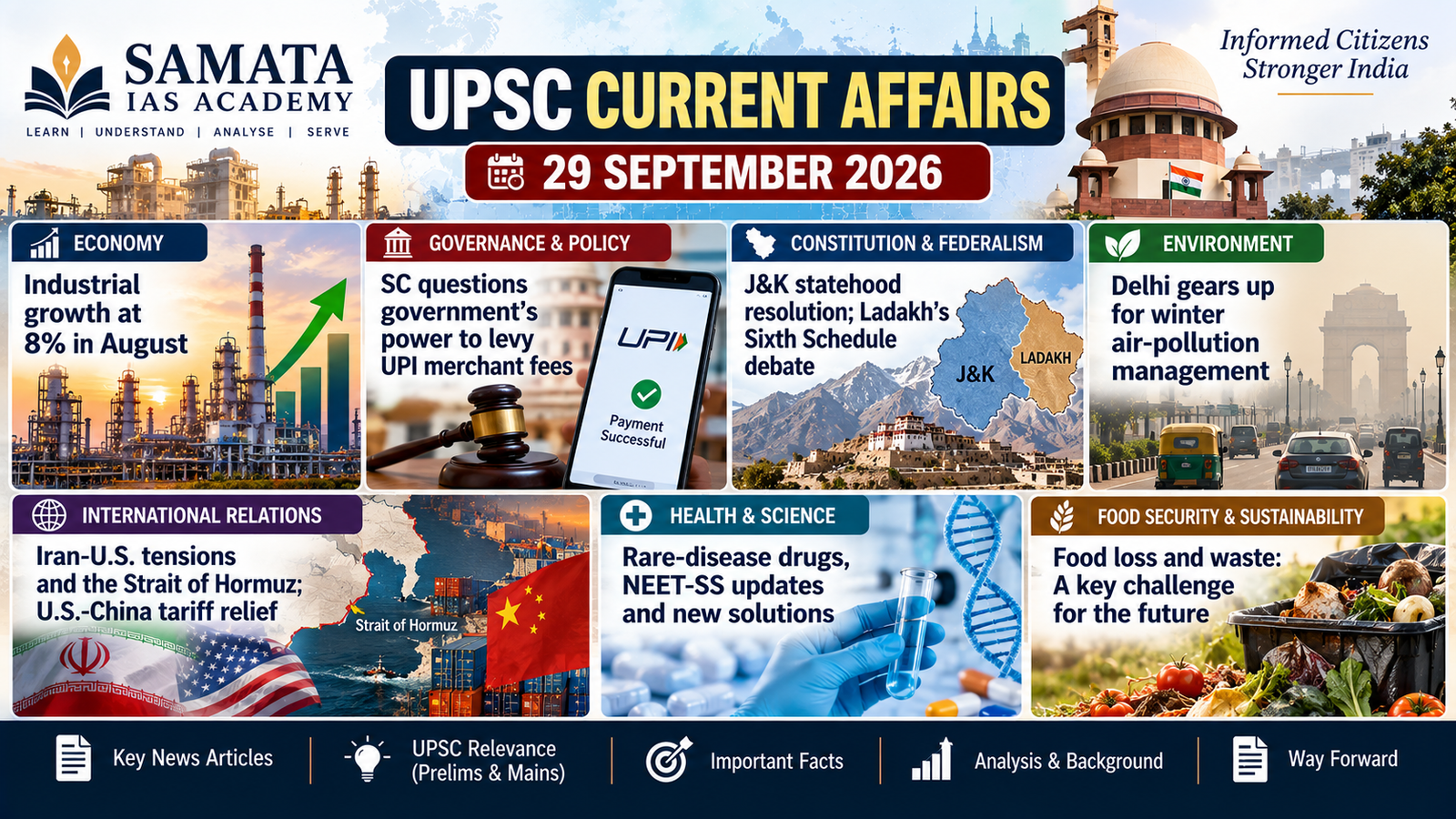
1. Industrial growth accelerates to 8% in August 2026
India’s Index of Industrial Production (IIP) grew by 8% in August 2026, up from 7.35% in July, according to the latest data released by the Ministry of Statistics and Programme Implementation.
The expansion was broad-based:
- Manufacturing: 8.95%
- Electricity: 12.3%
- Capital goods: 16.9%
- Consumer durables: 11.1%
Manufacturing growth was supported by sectors including motor vehicles, machinery, electronics, textiles, beverages, rubber and non-metallic products.
The August growth is significant because it indicates continued momentum in industrial activity after the earlier expansion in June. MoSPI released the August 2026 IIP estimates on September 28. (Ministry of Statistics)
UPSC relevance:
GS-III — Indian Economy
Concepts: IIP, manufacturing, capital goods, industrialisation, economic growth, business cycle.
2. Supreme Court questions legal basis of 0.4% UPI merchant fee
The Supreme Court has questioned the Government’s legal authority to impose a 0.4% Merchant Discount Rate (MDR) on specified UPI Person-to-Merchant transactions above ₹2,000.
The proposed system is scheduled to begin from 15 October 2026.
According to the report:
- MDR will be 0.4% for specified P2M transactions above ₹2,000.
- For transactions of ₹75,000 and above, the charge is capped at ₹300.
- The Government argued that the charge would apply only to a limited portion of transactions.
- The Court has sought affidavits from the Union Government, RBI and NPCI.
- The Court did not grant an interim stay on implementation.
The petition also challenges the constitutional validity of the amended Section 10A of the Payment and Settlement Systems Act, 2007.
UPSC relevance:
GS-II — Governance, Judiciary, Digital Public Infrastructure
GS-III — Digital Economy
Concepts: UPI, MDR, payment systems, regulatory authority, digital payments, constitutional scrutiny.
3. SC directs stronger measures for women’s safety in Delhi-NCR
Taking suo motu cognisance of recent incidents of sexual violence in Delhi-NCR, the Supreme Court directed Delhi Police to:
- identify vulnerable locations;
- increase patrolling;
- prepare district-wise vulnerability maps;
- audit CCTV coverage;
- audit street lighting;
- repair non-functional CCTV cameras and lighting;
- install additional infrastructure where necessary;
- examine the use of the National Database on Sexual Offenders (NDSO); and
- report on the functioning of the Investigation Tracking System for Sexual Offences (ITSSO).
The Court linked public safety to Article 21, emphasising the right to live with dignity and personal liberty.
UPSC relevance:
GS-II — Fundamental Rights, Police Reforms, Governance, Women and Children
Concepts: Article 21, suo motu jurisdiction, policing, preventive policing, gender-sensitive governance, accountability.
4. Delhi announces new winter air-pollution measures
Delhi has announced a more permanent institutional framework for tackling winter air pollution.
Major measures include:
- restriction on entry of non-BS-VI vehicles registered outside Delhi from November 1;
- 50% work-from-home requirement for government and private offices during the winter pollution period;
- No PUCC, No Fuel enforcement;
- restrictions on vehicles that have crossed prescribed lifespan;
- doubling of parking charges at authorised parking facilities, with an exception for Delhi Metro-managed facilities;
- staggered office timings;
- restrictions on construction and demolition;
- an AI-enabled command-and-control centre;
- increase in continuous air-quality monitoring stations from 47 to 60;
- 334 enforcement teams;
- weekly pollution-hotspot inspections;
- daily evening AQI bulletins; and
- greater coordination among NCR cities under an airshed approach.
The announced restrictions are particularly important from the perspective of airshed-level pollution management, because air pollution does not respect administrative boundaries.
UPSC relevance:
GS-III — Environment
Concepts: AQI, airshed management, vehicular pollution, BS-VI, emission control, urban environmental governance.
5. J&K Assembly passes resolution seeking restoration of Statehood
The Jammu & Kashmir Assembly passed a resolution seeking restoration of full Statehood.
The resolution was supported by most parties in the House, while BJP legislators opposed it and staged a walkout.
Chief Minister Omar Abdullah stated that the resolution concerned Statehood and did not seek restoration of Articles 370 or 35A.
This is important in understanding the constitutional status of Jammu & Kashmir after the Jammu and Kashmir Reorganisation Act, 2019.
UPSC relevance:
GS-II — Federalism, Union Territories, Constitutional Governance
Important distinction:
Statehood ≠ restoration of Article 370.
The two issues need to be treated separately in an examination answer.
6. Ladakh and the Sixth Schedule: proposed Article 371-K
A Text & Context analysis in the newspaper examines the demand for Sixth Schedule status for Ladakh and the reported proposal for a directly elected legislative body.
The Sixth Schedule currently applies to specified tribal areas in:
- Assam
- Meghalaya
- Tripura
- Mizoram
It derives its constitutional basis principally from Articles 244(2) and 275(1) and provides for Autonomous District Councils.
The discussion is particularly relevant because Ladakh is a Union Territory without a Legislative Assembly, and local groups have sought greater constitutional and political safeguards for:
- land;
- culture;
- language;
- customary practices; and
- political representation.
The article discusses a proposed Article 371-K as a possible sui generis arrangement.
UPSC relevance:
GS-II — Federalism, Fifth/Sixth Schedules, Tribal Governance, Special Constitutional Provisions
This is an excellent topic for a comparative question:
Why does the Sixth Schedule exist, and why might a separate constitutional arrangement be considered for Ladakh?
🟠 Economy & Development
7. UAE signals another $25 billion investment in India
The UAE has indicated its intention to invest an additional $25 billion in India, according to Commerce Minister Piyush Goyal.
The two countries discussed cooperation in:
- ports;
- shipbuilding;
- energy security;
- space technology;
- financial services;
- logistics;
- taxation;
- trade facilitation; and
- use of local currencies in bilateral trade.
The UAE has already invested around $25 billion in India and has a longer-term investment objective of $100 billion.
UPSC relevance:
GS-II + GS-III — India-UAE relations, FDI, trade, energy security, economic diplomacy
8. Rupee again breaches ₹96 per dollar
The Indian rupee settled at ₹95.97 against the U.S. dollar, after touching an intraday low of ₹96.05.
The newspaper attributes the pressure to:
- uncertainty surrounding the Iran-U.S. conflict;
- higher crude oil prices;
- risk aversion in global markets; and
- foreign capital outflows.
Brent crude was reported above $108 per barrel.
UPSC relevance:
GS-III — External Sector
Concepts: exchange rate, crude oil, current account, capital flows, imported inflation, RBI intervention.
9. India has more than 80 days of fuel reserves, says Petroleum Minister
Petroleum Minister Hardeep Singh Puri stated that India has more than 80 days of fuel reserves, taking into account the country’s refineries, import terminals and storage capacity.
This is particularly relevant in the context of the continuing West Asia conflict and Strait of Hormuz disruptions.
For UPSC, distinguish:
Strategic Petroleum Reserves (SPR)
from
overall petroleum/fuel storage and supply capacity.
The two should not be treated as synonymous.
10. Tata Trusts proposes restructuring Tata Sons
Tata Trusts has proposed restructuring Tata Sons by merging Tata Electronics Systems Solutions (TESS) and Tata Consulting Engineers (TCE) into Tata Sons.
The objective is reportedly to alter Tata Sons’ regulatory classification and avoid certain obligations associated with its classification as an Upper-Layer NBFC/Core Investment Company, including potential listing requirements.
This is useful for understanding:
- RBI regulation of NBFCs;
- Core Investment Companies;
- holding-company structures;
- corporate governance; and
- financial-sector regulation.
UPSC relevance:
GS-III — Financial Sector
🟠 Science & Technology
11. Rare-disease drugs: India as a potential global manufacturing hub
A major Science page analysis examines the possibility of India becoming a global hub for rare-disease drug development and manufacturing.
The article notes:
- around 8,000 rare diseases globally;
- 1,004 rare genetic disorders reported in India;
- extremely high prices for several orphan drugs;
- Government assistance of up to ₹50 lakh for rare-disease treatment;
- significant dependence on crowdfunding;
- limited availability of drugs for many rare diseases.
The article proposes greater use of India’s strengths in:
- generic pharmaceuticals;
- biosimilars;
- clinical trials;
- low-cost manufacturing;
- regulatory capacity; and
- government procurement.
It suggests policy instruments similar to Production Linked Incentive (PLI) schemes for selected orphan drugs.
UPSC relevance:
GS-III — Biotechnology, Health Technology, Pharmaceuticals
Concepts: orphan drugs, rare diseases, gene therapy, biosimilars, clinical trials, pharmaceutical policy.
12. Pakistan moves closer to sending astronaut to China’s Tiangong
Two Pakistani pilots, Muhammad Zeeshan Ali and Khurram Daud, are undergoing astronaut training in China.
Pakistan and China are expected to select one of them for a future mission to China’s Tiangong space station.
The cooperation is part of a broader China-Pakistan space relationship involving:
- satellites;
- satellite navigation;
- lunar exploration;
- biotechnology experiments; and
- human spaceflight.
The planned astronaut would serve as a payload specialist, conducting scientific experiments rather than piloting the spacecraft.
UPSC relevance:
GS-III — Space Technology + India-China/Pakistan strategic context
13. Supreme Court questions social-media access by children
The Supreme Court questioned how minors can legally enter into contracts with social-media platforms when minors generally lack contractual capacity under Indian law.
The Court suggested that the Government should consider directions under the Intermediary Rules to protect children online.
The case involves questions concerning:
- children’s digital rights;
- age verification;
- online safety;
- intermediary responsibility;
- data protection; and
- the Digital Personal Data Protection Act, 2023.
UPSC relevance:
GS-II + GS-III
Concepts: child rights, digital governance, privacy, intermediary liability, data protection.
🟠 Environment & Agriculture
14. Andhra Pradesh faces renewed Godavari flooding
Heavy rainfall associated with a deep depression over the Bay of Bengal has caused renewed flooding concerns in the Godavari Delta and Valley.
The report states:
- more than 9.7 lakh cusecs was being received at the Sir Arthur Cotton Barrage;
- agricultural crops were damaged across tens of thousands of hectares;
- roads were damaged across approximately 2,405 km;
- flood alerts were issued for villages in Polavaram district;
- several habitations were submerged.
This is particularly relevant for disaster management, river-basin management and climate-resilient agriculture.
UPSC relevance:
GS-I + GS-III
Concepts: Bay of Bengal depressions, floods, river morphology, disaster management, crop vulnerability, climate resilience.
15. Food loss and waste: an overlooked climate and food-security issue
September 29 is the International Day of Awareness of Food Loss and Waste.
The newspaper highlights India’s efforts to generate national data on post-harvest losses.
India has conducted three national post-harvest loss surveys, with a fourth round underway.
The issue is important because food loss represents not merely wasted food but also wasted:
- water;
- land;
- energy;
- labour;
- fertilisers;
- transport capacity; and
- associated greenhouse-gas emissions.
Potential solutions include:
- better cold storage;
- drying facilities;
- moisture management;
- food processing;
- supply-chain traceability;
- organic-waste segregation;
- composting;
- biogas; and
- bio-CNG.
UPSC relevance:
GS-III — Agriculture + Environment
Core concept: Circular economy in agrifood systems.
16. Karnataka prepares final drought memorandum
Karnataka is expected to submit a final memorandum to the Centre after the monsoon season ends.
Three Central teams are scheduled to assess the drought situation.
The issue is relevant to:
- drought declaration;
- disaster relief;
- Centre-State fiscal relations;
- crop losses;
- agricultural risk;
- climate variability.
🌍 International Relations
17. Iran-U.S. negotiations and Strait of Hormuz remain critical
The Iran-U.S. conflict remains one of the most important international developments.
Iranian Supreme Leader Mojtaba Khamenei said the United States would eventually be forced to leave West Asia, while Qatar is attempting to mediate between Tehran and Washington.
Iran’s earlier seven-day proposal reportedly involved:
Iran
→ end hostilities in Iran and Lebanon
→ unfreeze Iranian assets
→ lift sanctions on Iranian oil
→ end U.S. naval blockade
In return
→ reopening of the Strait of Hormuz
→ resumption of negotiations over Iran’s nuclear programme.
The U.S. President had rejected the proposal but indicated that further negotiations could take place.
The Strait of Hormuz is strategically important because it carries a very large share of global oil and gas shipments.
UPSC relevance:
GS-II — International Relations
GS-III — Energy Security
Must-study concepts: Strait of Hormuz, maritime chokepoints, sanctions, energy security, nuclear diplomacy, West Asian geopolitics.
18. U.S. and China announce reciprocal tariff-reduction lists
The U.S. and China released reciprocal lists of non-sensitive products worth about $30 billion each that will receive tariff reductions.
The lists include products such as:
- agricultural goods;
- personal-care products;
- timber;
- medical equipment;
- toys;
- tableware; and
- some consumer products.
However, strategically important sectors such as:
- semiconductors
- electric vehicles
- batteries
are excluded.
The development comes shortly after the meeting between Donald Trump and Xi Jinping.
UPSC relevance:
GS-II — India and the World
GS-III — International Trade
Concepts: tariff wars, trade diplomacy, supply chains, strategic trade, de-risking, WTO.
19. Myanmar: military air strike reportedly kills 33
An air strike on a market in Kyauktaw, Rakhine State, reportedly killed 33 people and injured 36, according to the Arakan Army.
Myanmar continues to face conflict following the 2021 military coup, with large-scale displacement in several regions.
UPSC relevance:
GS-II — India’s neighbourhood
For India, the broader issues include:
- refugee flows;
- border security;
- insurgency;
- connectivity projects;
- Act East policy;
- humanitarian assistance.
20. Russia-Ukraine war: renewed attacks and North Korean POW issue
Russian strikes across Ukraine reportedly killed at least seven people and injured dozens.
Separately, South Korea criticised Ukraine after President Volodymyr Zelenskyy publicly disclosed the transfer of two North Korean prisoners of war to South Korea.
The episode illustrates the increasingly complex geopolitical dimensions of the Russia-Ukraine conflict involving countries beyond Europe.
UPSC relevance:
GS-II — International Relations
🧠 Additional High-Value Topics from Today’s Edition
SC proposes second woman judge for elevation to Supreme Court
The Collegium has recommended Gujarat High Court Chief Justice Sunita Agarwal for elevation to the Supreme Court, along with the Chief Justices of the Delhi and Telangana High Courts.
UPSC angle:
Judicial appointments, Collegium system, representation in judiciary.
NEET-SS qualifying percentile reduced to 30%
The Centre has agreed to reduce the qualifying percentile for 2025 NEET-Super Speciality admissions from 50% to 30%, with a counselling round for vacant seats.
The issue highlights:
- medical education;
- specialist-doctor shortages;
- public-sector medical capacity;
- seat utilisation;
- government versus private medical education.
WHO issues new guidance on male contraception
A Data Point article examines the gender imbalance in contraceptive responsibility and discusses the WHO’s new guidance concerning reversible male contraceptive options.
The article highlights the very large difference between female and male sterilisation in India.
UPSC angle:
Population policy, reproductive health, gender equality, demographic transition.
📌 Today’s UPSC Priority List
| Priority | Topic | GS |
|---|---|---|
| 🔴 | IIP growth at 8% | GS-III |
| 🔴 | Supreme Court and UPI MDR | GS-II/III |
| 🔴 | Delhi air-pollution action plan | GS-III |
| 🔴 | J&K Statehood resolution | GS-II |
| 🔴 | Ladakh, Sixth Schedule & Article 371-K | GS-II |
| 🔴 | Iran-U.S. conflict & Strait of Hormuz | GS-II/III |
| 🔴 | U.S.-China tariff reduction | GS-II/III |
| 🟠 | Food loss and waste | GS-III |
| 🟠 | Rare-disease pharmaceutical policy | GS-III |
| 🟠 | Social media and children | GS-II/III |
| 🟠 | AP floods & disaster resilience | GS-III |
| 🟠 | UAE investment in India | GS-II/III |
| 🟠 | Digital space cooperation: China-Pakistan | GS-III |
| 🟡 | NEET-SS vacant seats | GS-II |
| 🟡 | Male contraception & reproductive health | GS-I/II |