
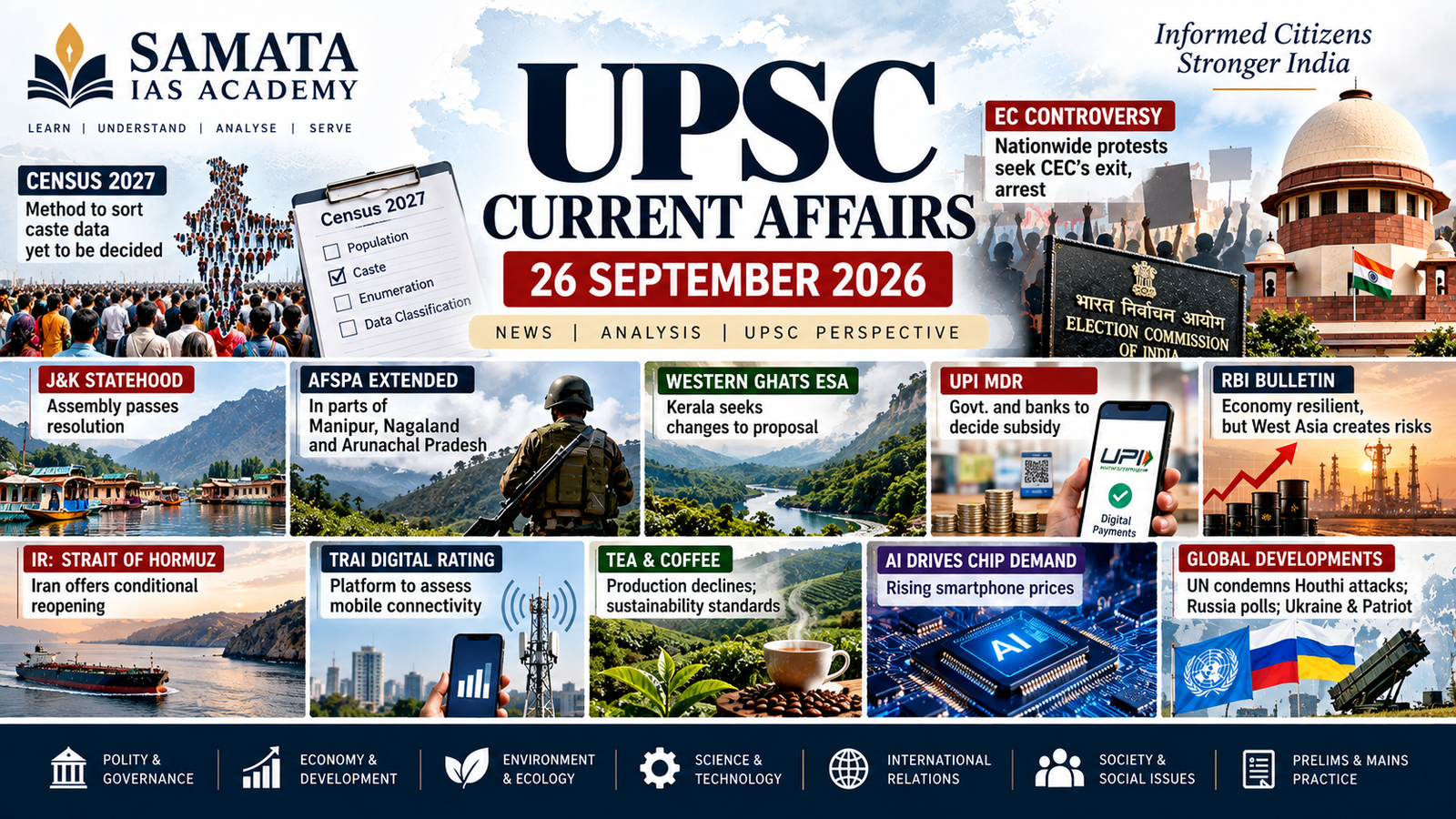
UPSC Current Affairs Compilation — 26 September 2026
Source: The Hindu, Delhi City Edition, Saturday, 26 September 2026. The edition contains 18 pages.
I. POLITY & GOVERNANCE
1. Census 2027: Method of sorting caste data yet to be finalised
One of the most important developments today concerns the Caste Census component of Census 2027.
The second phase of Census 2027 contains 40 questions, including a question on caste. The government has adopted an open-column approach, under which people outside the SC/ST categories can enter the name of their caste rather than selecting it from a predefined list.
However, the method by which the enormous volume of caste names will subsequently be sorted, standardised, classified and tabulated has not yet been finalised.
Why is this important?
The 2011 Socio-Economic and Caste Census had reportedly generated over 46 lakh caste names because of variations in nomenclature, spelling and local identities. The question therefore is not merely how caste is enumerated, but how the raw data will be converted into a usable statistical classification.
UPSC relevance
Census → caste enumeration → data classification → reservation → social justice → public policy
Important concepts:
- Census of India
- Population Enumeration
- Caste data
- SECC 2011
- OBC classification
- Data standardisation
- Evidence-based policymaking
The Centre has already confirmed that caste will be enumerated during the second phase of Census 2027. (PM India)
Mains angle:
The effectiveness of caste enumeration depends not only on comprehensive data collection but also on a transparent and methodologically sound system of classification.
2. Election Commission: SIR controversy and Form 6
The controversy surrounding the Special Intensive Revision (SIR) of electoral rolls continues.
A significant procedural issue highlighted today concerns Form 6, which is used for fresh voter registration.
The newspaper reports that the declaration attached to Form 6 has changed during the later phases of SIR. In Bihar, new applicants have been required to provide information relating to their or their parents’ presence in the previous SIR database, including details such as:
- Assembly constituency
- Polling booth
- Serial number
This raises questions regarding:
- Electoral-roll revision
- Documentary requirements for voter registration
- Inclusion and exclusion errors
- Administrative powers of the Election Commission
- Relationship between electoral rules and the Representation of the People Act
The Election Commission has also faced demands for greater clarification regarding the SIR process.
Constitutional connection
Article 324 gives the Election Commission superintendence, direction and control over elections.
The broader UPSC issue is the balance between:
accurate electoral rolls ↔ voter inclusion ↔ prevention of fraudulent entries ↔ administrative verification.
3. Plea in Supreme Court seeks independent probe against CEC
A petition filed before the Supreme Court has sought an independent judicial inquiry/SIT into allegations concerning Chief Election Commissioner Gyanesh Kumar and the functioning of the Election Commission.
The plea reportedly seeks an end-to-end audit of Election Commission data and investigation into allegations connected with electoral-roll processes.
This should be treated as a petition and allegations before the court, not as established findings.
UPSC relevance
This provides a case study in:
- Constitutional authorities
- Accountability mechanisms
- Judicial review
- Institutional independence
- Electoral integrity
- Limits of executive and judicial intervention
II. FEDERALISM & INTERNAL SECURITY
4. Jammu & Kashmir Assembly passes Statehood resolution
Jammu & Kashmir Chief Minister Omar Abdullah moved a resolution in the Legislative Assembly seeking restoration of Statehood.
The resolution refers to earlier resolutions, including the 2000 autonomy resolution.
The move generated strong opposition from BJP legislators, who protested against discussion of Article 370 and autonomy.
UPSC relevance
This connects with:
- Jammu & Kashmir Reorganisation Act, 2019
- Union Territory status
- Restoration of Statehood
- Article 3
- Federalism
- Asymmetric federalism
- Constitutional status of J&K
Mains angle
The larger issue is the constitutional distinction between:
Statehood → territorial reorganisation → legislative powers → federal representation → Union–State relations.
5. AFSPA extended in parts of Northeast
The Union government has extended the Armed Forces (Special Powers) Act, 1958 for another six months in specified areas of:
- Manipur
- Nagaland
- Arunachal Pradesh
The extension takes effect from October 1, 2026. (Akashvani News)
In Manipur, the notification continues the disturbed-area designation while excluding areas under 13 police stations. In Nagaland and Arunachal Pradesh, specified districts/areas remain under the Act. (Akashvani News)
UPSC Prelims
AFSPA allows specified powers to the armed forces in areas declared “disturbed” under the Act.
Mains relevance
The issue involves the balance between:
national security + counter-insurgency + protection of civilians + accountability + human rights.
The constitutional debate around AFSPA is therefore not simply about whether it should exist, but also about:
- periodic review,
- proportionality,
- accountability,
- withdrawal criteria,
- civil-military relations.
III. ENVIRONMENT
6. Kerala seeks changes to Western Ghats Ecologically Sensitive Area
Kerala has asked the Centre to limit the proposed Ecologically Sensitive Area (ESA) in the Western Ghats primarily to forested areas.
The State has proposed excluding:
- Populated areas
- Farmlands
- Plantations
The proposal would reduce the ESA area from the previously proposed 9,993.7 sq km to around 8,590.69 sq km. (Onmanorama)
Background
The Western Ghats ESA issue is associated with the recommendations of the Gadgil Committee and subsequently the Kasturirangan Committee.
UPSC connection
Western Ghats → biodiversity hotspot → ESA → development restrictions → ecological conservation → livelihood concerns
This is an excellent example of the tension between:
environmental protection vs developmental and livelihood requirements.
Mains question
How can India reconcile ecological sensitivity with the livelihood and developmental needs of densely populated regions such as the Western Ghats?
7. Delhi’s Mission Green Delhi
The Delhi government announced that it had achieved its target of planting 70 lakh saplings under Mission Green Delhi.
The programme involved:
- Government departments
- Local bodies
- Schools and colleges
- RWAs
- NGOs
- Citizens
The next challenge is explicitly identified as survival and growth of planted saplings, rather than merely counting plantations.
UPSC concept
This is an important distinction:
Tree plantation ≠ ecological restoration.
For meaningful urban greening, outcomes should include:
- survival rate,
- native species,
- canopy development,
- biodiversity,
- groundwater and soil benefits,
- long-term maintenance.
8. Noise pollution and wildlife
The newspaper highlights the impact of loud sounds from religious processions near the National Zoological Park.
The issue is relevant to the Noise Pollution (Regulation and Control) Rules, 2000, which regulate loudspeakers and ambient noise.
UPSC angle
This connects:
Noise pollution → wildlife stress → urban ecology → environmental regulation → festival management.
It also illustrates how environmental governance must consider non-human impacts of urban activities.
IV. ECONOMY
9. UPI MDR: Government and banks to decide subsidy
The government will discuss with the Indian Banks’ Association (IBA) the appropriate subsidy structure for UPI after the introduction of Merchant Discount Rate (MDR).
The new MDR is scheduled to come into effect on October 15, and the government says there is no proposal to postpone it.
The newspaper reports that the government has budgeted ₹2,000 crore under the existing incentive framework for RuPay debit cards and low-value BHIM-UPI transactions.
A key policy issue is whether MDR revenues will be sufficient to cover the cost of maintaining the UPI ecosystem.
Another important issue: GST
The Finance Ministry has indicated that GST treatment of MDR cannot simply be altered unilaterally because the GST Council is the relevant constitutional institution for GST-rate/exemption decisions.
UPSC linkage
UPI → Digital Public Infrastructure → network economics → MDR → subsidies → financial inclusion → GST Council
This is one of today’s strongest GS-III economy topics.
10. RBI: Indian economy remains resilient but West Asia creates risks
The RBI’s latest bulletin says the Indian economy has remained resilient despite global uncertainties.
However, it highlights risks arising from the West Asia conflict, particularly through:
- Higher crude-oil prices
- Inflationary pressures
- Supply-chain disruptions
- Global financial uncertainty
- Geopolitical risks
The RBI also noted strengthening financial and external-sector conditions but warned that geopolitical and weather-related uncertainties remain downside risks. (The Economic Times)
UPSC linkage
Geopolitical conflict → crude prices → import bill → inflation → current account → rupee → monetary policy
This is an excellent example of the transmission mechanism of external shocks into the Indian economy.
11. AI chip demand pushes up smartphone prices
The newspaper reports that smartphone prices are rising because of increased demand for memory chips from AI companies and data centres.
The development illustrates an important emerging economic phenomenon:
AI boom → semiconductor demand → memory-chip demand → component prices → consumer electronics prices.
This also highlights the interdependence of:
- AI
- Semiconductor industry
- Electronics manufacturing
- Global supply chains
- Consumer prices
UPSC relevance
This can be connected with India’s:
- semiconductor mission,
- electronics manufacturing,
- supply-chain diversification,
- technology sovereignty.
12. India may blend imported coal with domestic coal
The government is considering allowing power plants to blend imported coal with domestic coal to address supply pressures.
The newspaper reports that most Indian coal-fired power plants rely primarily on domestic coal but can blend a limited quantity of imported coal.
Why this matters
India’s energy strategy has to balance:
energy security + cost + domestic coal availability + imports + electricity prices + environmental concerns.
It is also a reminder that coal remains significant in India’s electricity mix despite the expansion of renewable energy.
V. DIGITAL ECONOMY & INFRASTRUCTURE
13. TRAI launches Digital Connectivity Rating platform
The Telecom Regulatory Authority of India (TRAI) has launched an integrated Digital Connectivity Rating (DCR) platform and mobile application.
The platform is intended to assess connectivity inside:
- Residential buildings
- Commercial buildings
- Government properties
It can help prospective buyers and tenants assess mobile and internet connectivity before purchasing or leasing property.
UPSC significance
This is a useful example of digital infrastructure becoming part of urban infrastructure assessment.
It also demonstrates the changing meaning of infrastructure:
roads + electricity + water + telecom + digital connectivity.
VI. AGRICULTURE & EXPORTS
14. Tea production and exports decline
India’s tea production declined by 1.7% year-on-year to 658.3 million kg during January–July 2026, according to the data cited by the newspaper.
Tea exports declined by 16.11% year-on-year during the same period.
The decline has been linked partly to climatic conditions and changing weather patterns.
At the same time, the Tea Board’s Tea Mark certification programme has begun certifying producers and mini-factories.
UPSC linkage
Climate change → agriculture → productivity → exports → rural livelihoods
The Tea Mark initiative also connects with:
- quality standards,
- branding,
- small growers,
- value addition,
- export competitiveness.
15. Coffee sustainability standards
The Coffee Board of India has developed sustainability standards and is implementing a certification process.
The proposed certification has three levels:
- Self-certification by growers
- Independent third-party verification
- Benchmarking against internationally recognised sustainability frameworks
The development is significant because Indian coffee is heavily associated with shade-grown cultivation in ecologically sensitive regions of the Western and Eastern Ghats. The Coffee Board currently lists the Indian Coffee Sustainability Standard and Certification Scheme. (Coffee Board)
UPSC relevance
Sustainable agriculture + certification + biodiversity + exports + value addition
VII. INTERNATIONAL RELATIONS
16. Iran offers conditional reopening of Strait of Hormuz
Iran has reportedly offered to reopen the Strait of Hormuz and resume nuclear talks within seven days, subject to conditions including:
- lifting of the U.S. naval blockade,
- waiver of sanctions on Iranian oil sales,
- ceasefire arrangements.
Iran’s proposal comes amid continuing conflict and diplomatic efforts.
Why Hormuz matters to India
The Strait of Hormuz is critical for global energy trade.
For India:
Hormuz disruption → crude supply risk → higher oil prices → import bill → inflation → current account → economic growth.
Recent market reporting has similarly linked developments around possible reopening of Hormuz to movements in oil prices. (Reuters)
17. UN Security Council condemns Houthi attacks on Saudi Arabia
The UN Security Council condemned continued Houthi attacks against Saudi Arabia.
The development is important in the context of:
- Yemen conflict
- Red Sea security
- Bab-el-Mandeb
- Saudi Arabia–Iran regional competition
- Global shipping
- Energy security
UPSC map-based preparation
Remember:
Strait of Hormuz → Persian Gulf
Bab-el-Mandeb → Red Sea/Gulf of Aden
Both are strategic maritime chokepoints, but they affect different segments of global trade.
18. Xi Jinping–Donald Trump engagement
Chinese President Xi Jinping concluded his U.S. visit and indicated that he expected to meet President Donald Trump again before the end of the year.
The development comes amid continued U.S.–China competition involving:
- Trade
- Technology
- AI
- Taiwan
- Global supply chains
- Strategic competition
For India, the broader significance lies in navigating a changing global order involving simultaneous competition and engagement among major powers.
19. Russia’s parliamentary election
Final results of Russia’s parliamentary election indicate that United Russia secured 349 of 450 seats in the State Duma, according to the newspaper.
The election is significant for understanding:
- Russian political institutions
- State Duma
- Executive dominance
- Russia’s wartime political environment
- Russia’s domestic political system
For UPSC, distinguish between:
State Duma → lower house
and
Federation Council → upper house.
20. Ukraine and Patriot missile production
Ukrainian President Volodymyr Zelenskyy said U.S. President Donald Trump had agreed to allow Ukraine to obtain licences for production of Patriot missiles.
The development illustrates the evolution of defence cooperation from:
weapons transfers → licensed production → domestic defence manufacturing.
This has wider relevance to:
- defence industrial ecosystems,
- technology transfer,
- strategic autonomy,
- licensed manufacturing.
VIII. SCIENCE, TECHNOLOGY & GOVERNANCE
21. AI is reshaping semiconductor demand
The smartphone-price story provides a useful Science & Technology + Economy linkage.
AI data centres require enormous quantities of computing infrastructure, increasing demand for:
- GPUs
- memory chips
- advanced processors
- data-centre infrastructure
This demonstrates that the AI revolution is no longer restricted to software; it is influencing hardware supply chains and consumer markets.
22. Cyber-enabled financial fraud targeting U.S. citizens
The CBI has arrested an accused in a transnational cyber-enabled financial fraud case involving illegal call centres targeting U.S. nationals.
The alleged operation involved impersonation of officials of U.S. agencies and manipulation of victims through fraudulent claims.
UPSC relevance
This is useful for:
- Cybercrime
- Digital fraud
- International criminal networks
- Mutual legal assistance
- Cross-border investigation
- Digital evidence
It demonstrates why cybercrime increasingly requires international cooperation rather than purely domestic policing.
IX. SOCIAL JUSTICE & EDUCATION
23. IIT Bombay student death: caste discrimination allegations
The Mumbai Crime Branch has recorded statements from around 20 people in connection with the death of an IIT Bombay student.
The National Commission for Scheduled Castes has conducted an inquiry following allegations of caste-based discrimination.
The issue is relevant to:
- Article 15
- Article 17
- Equality
- Educational institutions
- Social discrimination
- Institutional accountability
- SC safeguards
The allegations remain subject to investigation; they should not be treated as established findings.
X. OTHER IMPORTANT GOVERNANCE DEVELOPMENTS
24. Delhi High Court and student accommodation
The Delhi High Court questioned Delhi University’s response to the shortage of hostel facilities.
The court noted that only 5,698 students were receiving hostel accommodation despite more than 1.3 lakh students regularly attending classes.
The case arose during proceedings related to the Satya Niketan building collapse.
The broader issue is:
urban student housing + building safety + institutional responsibility + regulatory compliance.
This can be linked to safe and inclusive urbanisation.
PRELIMS QUICK REVISION
| Topic | Key fact |
|---|---|
| Census 2027 | Caste to be enumerated in second phase |
| Population Enumeration | Second phase of Census |
| Form 6 | Used for fresh voter registration |
| SIR | Special Intensive Revision of electoral rolls |
| Article 324 | Election Commission |
| AFSPA | Armed Forces (Special Powers) Act, 1958 |
| Western Ghats | Biodiversity hotspot |
| ESA | Ecologically Sensitive Area |
| UPI MDR | Merchant Discount Rate |
| GST Council | Constitutional body under Article 279A |
| RBI Bulletin | Highlights West Asia-related inflationary risks |
| TRAI | Telecom Regulatory Authority of India |
| Hormuz | Persian Gulf–Gulf of Oman maritime chokepoint |
| Bab-el-Mandeb | Red Sea–Gulf of Aden chokepoint |
| State Duma | Lower house of Russian Parliament |
| Patriot | U.S.-origin air-defence missile system |
| Coffee Board | Coffee sustainability certification |
| Tea Board | Tea sector regulation and promotion |
HIGH-VALUE MAINS THEMES
GS-II
1. Caste enumeration can generate valuable policy data, but classification and standardisation of caste identities pose major methodological challenges. Discuss.
2. Examine the constitutional significance of an independent Election Commission in ensuring the legitimacy of electoral democracy.
3. Discuss the constitutional and federal dimensions of restoring Statehood to a Union Territory.
4. AFSPA represents the tension between national security and civil liberties. Discuss the importance of periodic review and accountability.
GS-III
5. How can India balance ecological conservation with livelihood and developmental concerns in the Western Ghats?
6. Geopolitical conflicts increasingly transmit into domestic inflation through energy and supply-chain channels. Explain with reference to India.
7. The expansion of AI is creating pressures not only on software but also on semiconductor and electronics supply chains. Examine.
8. Digital infrastructure is becoming an essential component of modern urban infrastructure. Discuss.
MOST IMPORTANT TOPICS FOR TODAY
Tier 1 — Must Study
- Census 2027 and caste-data methodology
- Election Commission, SIR and Form 6
- AFSPA extension in Northeast
- Western Ghats ESA
- RBI assessment of West Asia-related economic risks
- Strait of Hormuz and India’s energy security
Tier 2 — Important
- J&K Statehood resolution
- UPI MDR and subsidy architecture
- Tea production and climate vulnerability
- Coffee sustainability certification
- TRAI Digital Connectivity Rating
- AI-driven semiconductor demand
Tier 3 — Useful Enrichment
- Russia parliamentary election
- Patriot missile licensed production
- UN Security Council and Houthi attacks
- Cyber-enabled financial fraud
- Urban student housing and building safety
Core Conceptual Linkages for 26 September
Census → Caste data → Classification → Social justice → Evidence-based policy
SIR → Electoral rolls → Form 6 → Voter inclusion → Electoral integrity
Western Ghats → ESA → Biodiversity → Livelihoods → Sustainable development
West Asia → Hormuz → Crude oil → Inflation → Current account → Indian economy
AI → Memory chips → Semiconductor demand → Smartphone prices → Supply chains
AFSPA → Internal security → Disturbed areas → Armed forces → Civil liberties
UPI → MDR → Subsidy → Digital public infrastructure → Financial inclusion
Coffee/Tea → Climate variability → Sustainable agriculture → Certification → Export competitiveness
The Census 2027, SIR/Form 6, Western Ghats ESA, AFSPA, RBI’s West Asia assessment and Strait of Hormuz are the strongest areas for serious UPSC preparation from today’s edition.