
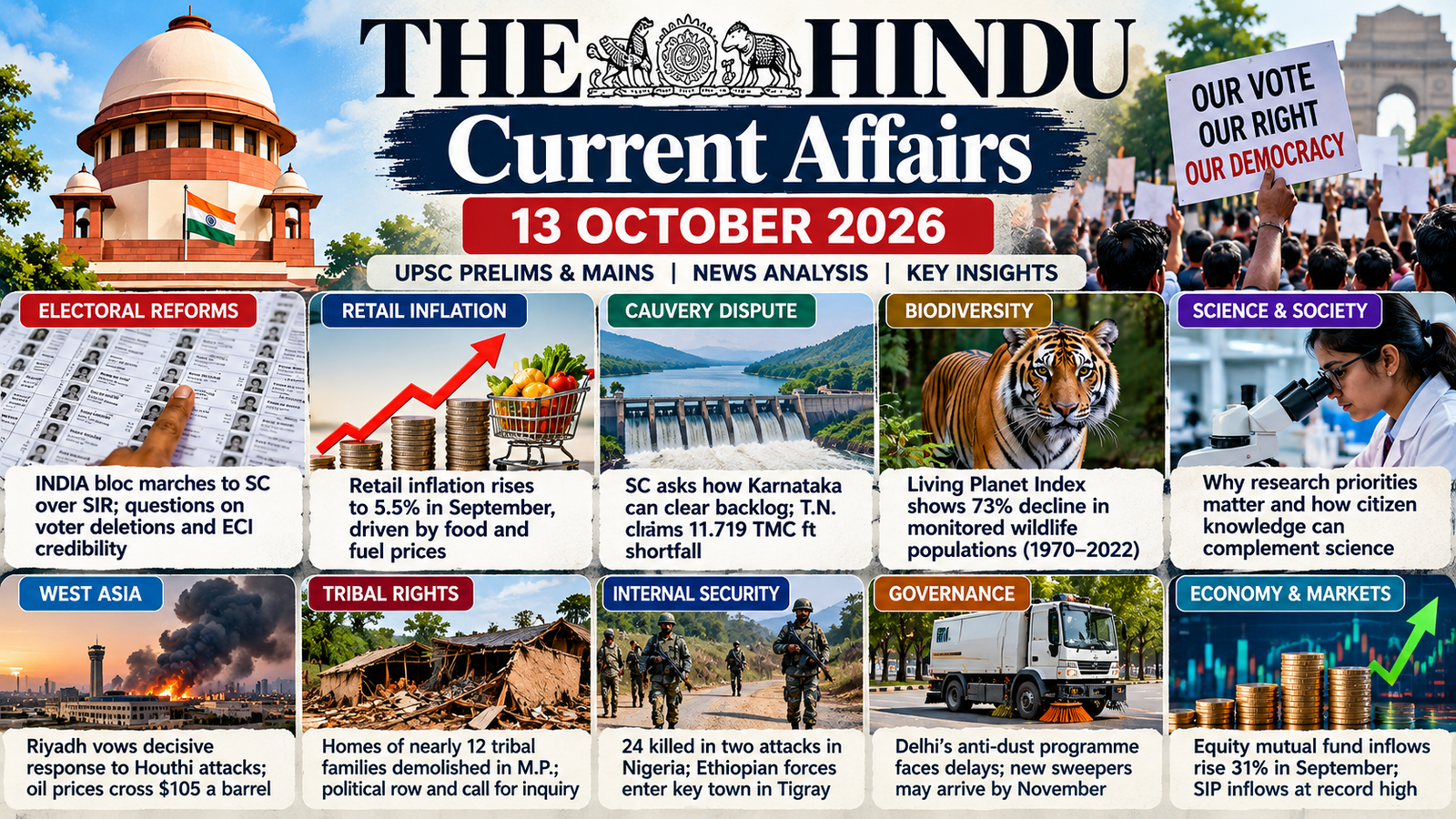
The Hindu Current Affairs – 13 October 2026 | UPSC Prelims and Mains
UPSC Civil Services Examination | Prelims and Mains | Based on the uploaded The Hindu, Delhi City Edition, dated Tuesday, 13 October 2026.
Today’s newspaper is dominated by electoral-roll revision and democratic accountability, rising retail inflation, the Cauvery water-sharing dispute, wildlife conservation, the relationship between science and society, and escalating tensions in West Asia.
1. Electoral integrity and the Special Intensive Revision (SIR)
GS Paper II — Polity, Constitution, Election Commission and electoral reforms
What happened?
- Opposition parties belonging to the INDIA bloc marched through Delhi and submitted a petition to the Supreme Court over alleged large-scale voter deletions and irregularities in the Special Intensive Revision (SIR) of electoral rolls.
- The Congress claimed that 2.5 lakh people participated in the march. This is the party’s estimate reported by the newspaper.
- The Kerala Assembly passed a resolution seeking the removal of the Chief Election Commissioner (CEC) and reforms to improve the transparency of the Election Commission of India (ECI).
- In Delhi, the Chief Electoral Officer’s office reported that approximately 20 lakh of the 33 lakh electors served notices—around 60%—had been cleared. Nineteen lakh cases were reportedly disposed of during the preceding two weeks.
- The Supreme Court clarified that its May 2026 judgment concerning the Bihar SIR had neither approved nor disapproved the subsequent changes made to Form 6, used for registering new voters. The changes were introduced later, in July.
- Punjab’s final electoral rolls were published following its SIR exercise. The newspaper reported that around 13.60 lakh names were not recorded because of permanent relocation, absence, death or duplicate entries. This figure should not automatically be interpreted as the number of eligible voters unlawfully deleted.
What is SIR?
Special Intensive Revision is a process for comprehensively revising electoral rolls. The newspaper refers to Section 21(3) of the Representation of the People Act, 1950, which authorises the ECI to conduct a special revision of an electoral roll for any constituency or part of a constituency in a manner it considers appropriate.
The central administrative challenge is to distinguish between:
- Legitimate roll correction: removing duplicate, deceased, permanently relocated or otherwise ineligible entries.
- Wrongful exclusion: deleting or failing to register an eligible citizen because of inadequate notice, documentation difficulties, administrative error or an inaccessible verification process.
Why is the issue important?
A credible electoral roll is essential to the legitimacy of elections. However, the process of cleaning the rolls must not undermine universal adult suffrage.
The controversy raises questions about:
- Article 326: Elections to the Lok Sabha and State Legislative Assemblies are based on adult suffrage, subject to constitutional and statutory qualifications.
- Article 324: The ECI’s constitutional responsibility for the superintendence, direction and control of elections.
- Representation of the People Act, 1950: The statutory framework for electoral rolls and their revision.
- Procedural fairness: Whether affected electors receive adequate notice and a meaningful opportunity to establish eligibility.
- Institutional accountability: How the ECI can maintain public confidence through transparent criteria, accessible procedures and effective grievance redressal.
What should a balanced reform framework include?
- Clear, publicly available criteria for inclusion and deletion.
- Adequate notice and a reasonable opportunity to respond.
- Accessible procedures for elderly people, migrants, persons with disabilities and citizens lacking readily available documents.
- Written reasons for adverse decisions and effective appeal mechanisms.
- Publication of disaggregated data on additions, deletions, objections and appeals.
- Independent scrutiny of patterns that may indicate systematic exclusion.
UPSC Mains angle: How can India ensure accurate electoral rolls without compromising the constitutional principle of universal adult suffrage?
2. Right to protest, police conduct and democratic freedoms
GS Paper II — Fundamental Rights, civil liberties and judicial review
The SIR controversy has also raised questions about the treatment of protesters and the regulation of public demonstrations.
The newspaper reports that:
- AAP leaders Sanjay Singh and Saurabh Bharadwaj were detained during a protest demanding the CEC’s resignation and were subsequently released.
- Bharadwaj alleged that police personnel tried to strangle him. The newspaper reported that the police had not responded to the allegation at the time of publication; the allegation should therefore not be treated as an established finding.
- Several people detained during earlier protests alleged that their phones were taken, that data was deleted and that some devices were not returned.
- The Delhi High Court sought a police status report on a civil-rights activist’s allegation that he had been illegally confined to prevent his participation in a peaceful protest.
- Delhi Police denotified Jantar Mantar as a designated protest venue, replacing it with three other locations farther from the seat of power. Activists criticised the move.
Constitutional provisions
| Provision | Relevance |
|---|---|
| Article 19(1)(a) | Freedom of speech and expression |
| Article 19(1)(b) | Right to assemble peaceably and without arms |
| Article 19(1)(d) | Freedom of movement throughout India |
| Article 21 | Protection of life and personal liberty |
| Article 32 | Right to approach the Supreme Court for enforcement of Fundamental Rights |
| Article 226 | High Courts’ power to issue writs |
These freedoms are subject to constitutionally permitted restrictions. The State may regulate assemblies to protect public order and safety, but restrictions must be lawful, proportionate and non-arbitrary.
Key analytical distinction
Regulation is not the same as suppression. Authorities can impose reasonable conditions on demonstrations, but the existence of a law-and-order concern does not by itself justify arbitrary detention, disproportionate force or interference with access to legal remedies.
The allegations involving phones also raise issues concerning privacy, the integrity of digital evidence, freedom of expression and safeguards governing police custody of personal devices.
UPSC Mains angle: Examine the constitutional balance between the State’s responsibility to maintain public order and citizens’ right to peaceful protest.
3. Retail inflation rises to 5.5%
GS Paper III — Indian economy, inflation and monetary policy
Retail inflation, September 2026
5.5%
August 2026
4.8%
RBI upper tolerance limit
6%
Food and beverages inflation increased to 7.4% in September, from 5.7% in August.
According to the report, September’s Consumer Price Index (CPI) inflation was the highest since October 2024. The newspaper attributes the increase principally to rising food and fuel inflation.
Economists cited in the report also pointed to a relatively weak monsoon and inadequate reservoir replenishment as risks to rabi sowing. One economist suggested that inflation could exceed 6% in October; this was a forecast, not a reported outcome.
How does inflation affect the economy?
- Households: Food inflation disproportionately affects lower-income households because food represents a larger share of their expenditure.
- Savings: Unexpected inflation reduces the purchasing power of money.
- Businesses: Higher input costs can compress profit margins or be passed on to consumers.
- Monetary policy: Persistently high inflation can require tighter monetary conditions, potentially increasing borrowing costs.
- Agriculture: Weak rainfall and lower reservoir levels can affect crop output and future food prices.
Role of the Monetary Policy Committee (MPC)
The RBI’s inflation-targeting framework uses a CPI inflation target of 4%, with a tolerance band of ±2 percentage points. The 6% upper limit is the ceiling of the tolerance band, not the normal inflation target.
Interest-rate increases can help moderate demand and inflation expectations. However, when price pressures arise mainly from food-supply constraints, monetary policy alone cannot increase agricultural output or replenish reservoirs. Supply-side measures may also be necessary.
UPSC Mains angle: “Food-supply shocks complicate inflation management in a developing economy.” Discuss with reference to the role and limitations of monetary policy.
4. Cauvery water-sharing dispute: balancing legal obligations and drought conditions
GS Paper II — Federalism and inter-State disputes | GS Paper III — Water resources and agriculture
Source: Newspaper page 5.
th.th_delhi.13_10_2026.pdf
The Supreme Court questioned how Karnataka could be expected to make up the shortfall in Cauvery water releases to Tamil Nadu while Karnataka itself faced water scarcity and drought conditions. The Court reserved its order on Tamil Nadu’s application.
Key facts reported
- Tamil Nadu claimed a shortfall of 11.719 thousand million cubic feet (TMC ft) in the water due to it up to October 6.
- Tamil Nadu argued that water available during a distress year should be apportioned proportionately rather than placing the entire burden of scarcity on one State.
- Karnataka argued that both States faced water scarcity and that Tamil Nadu could benefit from the approaching northeast monsoon.
Why is this a federal issue?
The dispute illustrates the tension between:
- Existing water-sharing obligations and actual hydrological conditions.
- The needs of an upstream State and those of a downstream State.
- Agricultural livelihoods and competing demands for drinking water, irrigation and other uses.
- Legal adjudication and cooperative management of a shared river basin.
Constitutional and institutional framework
- Article 262: Provides for Parliament to legislate on adjudication of disputes relating to inter-State rivers and river valleys, including restrictions on court jurisdiction in specified circumstances.
- Inter-State River Water Disputes Act, 1956: Provides the statutory framework for adjudicating qualifying inter-State river-water disputes.
- Cauvery Water Management Authority: An institutional mechanism associated with implementing the Cauvery water-sharing arrangements.
The broader policy lesson is that river-water governance requires transparent reservoir data, reliable rainfall forecasts, distress-sharing arrangements, efficient irrigation and cooperation among basin States.
UPSC Mains angle: How should India reconcile inter-State water-sharing agreements with the uncertainty created by climate variability and recurrent droughts?
5. Wildlife populations: interpreting the Living Planet Index correctly
GS Paper III — Biodiversity, conservation and environmental assessment
Source: Newspaper page 8.
th.th_delhi.13_10_2026.pdf
The newspaper discusses the 2026 Living Planet Index report, which recorded an average 73% decline in monitored wildlife populations between 1970 and 2022.
The article stresses an important statistical distinction: this does not mean that 73% of all wildlife species have become extinct or that 73% of all animal populations are declining.
What does the 73% figure mean?
The index aggregates changes in the abundance of monitored populations across a large dataset. The article reports that the analysis covered 35,803 wildlife populations, including mammals, birds, reptiles, amphibians and fish.
According to the article:
- The figure describes the average change in the monitored populations, calculated using the index’s methodology.
- Approximately half of the studied populations were declining, while the other half were stable or increasing.
- The data does not directly establish the percentage of species that have gone extinct.
- Plants and invertebrates were not included in the dataset discussed.
Why is this distinction important?
A population-abundance index is not the same as a count of extinct species. Conflating the two can lead to inaccurate public communication and poor policy interpretation.
The index remains a warning about pressures on ecosystems, but it should be read alongside other indicators, including species extinction risk, habitat loss, population trends and ecosystem integrity.
Policy relevance for India
- Protect and restore habitats and ecological corridors.
- Reduce fragmentation caused by infrastructure development.
- Strengthen monitoring of biodiversity and threatened species.
- Incorporate local and Indigenous ecological knowledge into conservation planning.
- Address pollution, invasive species and unsustainable exploitation of natural resources.
UPSC Prelims takeaway: A decline of 73% in the Living Planet Index must not be interpreted as 73% of species having gone extinct.
th.th_delhi.13_10_2026.pdf
6. Science and society: who should decide research priorities?
GS Paper III — Science and Technology, research policy and innovation
Source: Newspaper page 18, Science.
th.th_delhi.13_10_2026.pdf
The newspaper’s science commentary examines the relationship between publicly funded research, government priorities and public participation.
The central argument
Science relies on public funding, infrastructure and institutional support. Governments are therefore entitled to establish broad research priorities and expect accountability for public expenditure. However, short-term political priorities and narrowly defined economic returns should not dominate research funding.
Research in fundamental science, climate science, the humanities and social sciences may not produce immediate, easily measurable benefits, yet can create substantial long-term public value.
Citizen science and community knowledge
The article argues that public participation should complement scientific expertise, not replace it.
Examples of complementary knowledge include:
- Farmers’ observations about soil behaviour, crop resilience and changing growing conditions.
- Forest-dwelling communities’ knowledge of medicinal plants, biodiversity and local ecosystems.
- Professional scientists’ systematic methods, specialised expertise and analytical tools.
The objective is to bring these different forms of knowledge together in research design, data collection and the use of scientific findings.
Relevance to Indian governance
India’s geographical, ecological and cultural diversity makes local participation particularly valuable in areas such as:
- Climate adaptation and disaster preparedness.
- Public health surveillance.
- Biodiversity conservation.
- Agricultural research and extension services.
- Water management and environmental monitoring.
A suitable policy approach would combine scientific independence, transparent funding priorities, public accountability and meaningful community participation.
UPSC Mains angle: How can India democratise scientific research without compromising scientific rigour and institutional autonomy?
7. Saudi Arabia–Houthi escalation and energy security
GS Paper II — International relations | GS Paper III — Energy security
Source: Newspaper page 14.
th.th_delhi.13_10_2026.pdf
The newspaper reports escalating attacks involving Yemen’s Houthi movement and Saudi Arabia, including attacks on Riyadh’s international airport. Saudi Arabia’s Energy Minister warned of a serious response and stressed the importance of protecting energy infrastructure. Iran expressed concern and offered to facilitate dialogue.
The article reports that oil prices had crossed $105 a barrel amid the tensions.
Why does this matter beyond West Asia?
Energy infrastructure and transport hubs are critical to regional and global economic stability. Attacks can affect:
- Oil markets: Supply risks can increase price volatility.
- Trade and logistics: Disruptions to airports, shipping routes and infrastructure can raise costs.
- Regional security: Retaliation may expand the conflict and involve additional actors.
- India’s energy interests: India is exposed to changes in international crude prices and relies substantially on imported oil.
India’s strategic considerations
India must protect its energy and commercial interests while pursuing diplomatic engagement, regional stability and the safety of Indian nationals in affected areas. Diversifying supply sources, maintaining strategic petroleum reserves and improving energy efficiency can help reduce vulnerability to external shocks.
UPSC Mains angle: Examine how instability in West Asia affects India’s energy security and strategic autonomy.
8. Governance and social justice: demolition of tribal families’ homes
GS Paper II — Vulnerable sections, administrative accountability and rule of law
Source: Newspaper page 4.
th.th_delhi.13_10_2026.pdf
The newspaper reports that the Forest Department demolished the homes of nearly 12 tribal families in Kosmi village, Madhya Pradesh, citing alleged encroachment. Union Agriculture Minister and former Chief Minister Shivraj Singh Chouhan criticised the action, while the State Chief Minister said an investigation would be conducted.
The report describes the destruction of homes and crops and the displacement of affected families. The legality and circumstances of the specific action require investigation; the reported allegations should not be treated as a final legal determination.
Issues for analysis
- Rule of law: Administrative action must follow the applicable legal process.
- Due process: Authorities should verify land status, give legally required notice and provide opportunities to challenge adverse decisions.
- Tribal rights: Forest-dependent communities may have rights under applicable forest and land laws, depending on their circumstances and legal eligibility.
- Administrative accountability: Investigations should establish whether officials followed the law and whether remedies are required.
- Environmental governance: Preventing encroachment and protecting forests must be reconciled with lawful rights and humane rehabilitation where applicable.
The Forest Rights Act, 2006 is relevant to the broader subject of recognising the rights of eligible forest-dwelling Scheduled Tribes and other traditional forest dwellers. It does not, by itself, establish that every person affected by a forest eviction has a recognised claim.
UPSC Mains angle: Discuss the challenges of balancing forest conservation, land administration and the rights of vulnerable tribal communities.
9. Other important national developments
GS Paper II and III — Governance, public health, security and the economy
Source: Newspaper pages 3–6 and 12–13.
th.th_delhi.13_10_2026.pdf
th.th_delhi.13_10_2026.pdf
th.th_delhi.13_10_2026.pdf

Delhi’s anti-dust programme faces delays
The newspaper reports that the deployment of new mechanical road sweepers missed its planned July deadline. The project is intended to help control road dust, an important source of particulate pollution. The report says some large machines may arrive by the end of November.
UPSC link: Urban air pollution, municipal capacity, implementation gaps and airshed-level pollution control.

Indian Navy commissions an anti-submarine vessel
The front page highlights the commissioning of a new anti-submarine vessel. The broader significance is maritime surveillance and the ability to detect and respond to underwater threats.
UPSC link: Maritime security, anti-submarine warfare, naval modernisation and protection of sea lines of communication.

Health centres asked to display charges
The newspaper’s front-page summary reports that the Centre has asked health centres to display treatment charges.
UPSC link: Transparency in healthcare, informed patient choice, accountability and consumer protection.

Delhi prepares a standard operating procedure for street-dog management
The proposed SOP emphasises humane capture, sterilisation, anti-rabies vaccination, post-operative care and returning dogs to the localities from which they were picked up. The report also notes disparities in veterinary facilities and staffing.
UPSC link: Animal welfare, urban public health, rabies prevention and implementation of the Animal Birth Control Rules, 2023.

Coal stocks at thermal power plants remain above 18 million tonnes
The newspaper reports stocks of 18.205 million tonnes as of October 10, with average supplies of 2.49 million tonnes a day. The government said supplies were keeping pace with consumption and that stations with critical stocks were being monitored.
UPSC link: Energy security, coal logistics, thermal power dependence and the energy transition.
Additional governance and economic points
- Supreme Court and Punjab CMO: The Court directed that no coercive action be taken on the basis of a CBI FIR connected to corruption allegations involving the Punjab Chief Minister’s office, while declining to stay the FIR itself. th.th_delhi.13_10_2026.pdf
- Firecracker restrictions: The Supreme Court emphasised balancing religious sentiments with public-health concerns and the practical enforceability of restrictions. th.th_delhi.13_10_2026.pdf
- Equity mutual funds: The newspaper’s data box reports net inflows of ₹38,306 crore in equity mutual funds during September, a 31% rise from August. It also reports record SIP inflows of ₹32,490 crore. These are separate measures of investment activity. th.th_delhi.13_10_2026.pdf
- UN refugee funding: The newspaper reports that the UN refugee agency had secured $3 billion of its $8.5 billion requirement for 2026—35% of the target—highlighting pressure on humanitarian operations. th.th_delhi.13_10_2026.pdf
10. International affairs: other developments
GS Paper II — International relations and global institutions
| Development | UPSC relevance |
|---|---|
| Kurdish militants withdraw from four camps in northern Iraq as part of a peace effort with Türkiye, according to the newspaper. | Kurdish question, insurgency, territorial integrity and conflict resolution. |
| Twenty-four people reportedly killed in two attacks in Nigeria, including soldiers and a police officer. | Terrorism, armed gangs, kidnapping and challenges to internal security in Africa. |
| Ethiopian federal forces enter a key town in Tigray after rebel forces reportedly leave it. | Ethnic conflict, federalism and regional instability in the Horn of Africa. |
| Norway fines Microsoft’s advertising-technology unit Xandr over the alleged unlawful sharing of sensitive Grindr user data with advertisers. | Data protection, privacy, digital advertising and cross-border regulation. |
Source: Newspaper pages 8 and 14.
th.th_delhi.13_10_2026.pdf
th.th_delhi.13_10_2026.pdf
11. Editorial and opinion analysis
A. By-elections and the quality of political representation
Source: Editorial page 6.
th.th_delhi.13_10_2026.pdf
The editorial examines recent by-elections in West Bengal, Tamil Nadu and Puducherry. It argues that by-elections often favour the ruling party, but the political patterns differ across States.
Its most important institutional concern is the resignation of legislators shortly after election and their subsequent re-election under a different political arrangement. The editorial argues that such practices can undermine the spirit of the anti-defection framework and weaken the mandate given by voters.
Critical analysis:
- Legislators may formally resign, so the legal position is not identical to that of a straightforward defection under the Tenth Schedule.
- Nevertheless, repeated resignations followed by re-election can impose additional electoral costs and frustrate voters’ expectations.
- Possible reforms include clearer rules for resignation and disqualification, stronger scrutiny of the circumstances surrounding resignations, and better accountability to constituents.
Mains question: Do frequent resignations and subsequent by-elections weaken representative democracy even when they comply with the letter of the law?
B. The credibility crisis of the Election Commission
The newspaper’s editorial coverage also examines concerns about the ECI and the SIR process. The key issue is not simply whether electoral rolls are revised, but whether the process is transparent, legally defensible and accessible to eligible voters.
th.th_delhi.13_10_2026.pdf
The ECI’s independence depends not only on its formal constitutional status but also on public confidence in its decisions, procedures and impartiality.
A credible reform agenda should combine accurate voter registration, transparent decision-making, accessible grievance redressal and protection against both wrongful inclusion and wrongful exclusion.
C. Understanding wildlife decline without misreading statistics
The science and environment coverage warns against interpreting the Living Planet Index’s 73% decline as the extinction of 73% of wildlife species. The lesson is broader: indicators must be interpreted according to what they actually measure.
th.th_delhi.13_10_2026.pdf
This is relevant to UPSC answers involving environmental indices, poverty estimates, employment data, inflation and other composite measures.
13. Mains answer-writing practice
1. GS Paper II: Examine the constitutional and administrative challenges involved in conducting a Special Intensive Revision of electoral rolls while safeguarding universal adult suffrage.
2. GS Paper II: Discuss the limits of State authority in regulating peaceful protests. How can courts balance public order with Fundamental Rights?
3. GS Paper III: Explain why food-supply shocks complicate inflation management in India. Evaluate the respective roles of monetary policy and supply-side interventions.
4. GS Paper II/III: The Cauvery dispute illustrates the difficulty of sharing scarce natural resources in a federal system. Discuss the institutional and policy measures needed to improve inter-State water governance.
5. GS Paper III: What does the Living Planet Index measure? Explain why accurate interpretation of environmental indicators is essential for evidence-based policymaking.
6. GS Paper III: “Scientific progress requires both institutional autonomy and social accountability.” Discuss with reference to publicly funded research in India.
7. GS Paper II: Examine the tension between forest conservation, due process and the rights of tribal communities in land and forest administration.
8. GS Paper II/III: Analyse the implications of instability in West Asia for India’s energy security and foreign policy.
14. Quick revision: facts to remember
| Topic | Key fact from the newspaper |
|---|---|
| Retail inflation | 5.5% in September 2026 |
| Food and beverages inflation | 7.4% in September |
| RBI inflation framework | 4% target; 2%–6% tolerance band |
| Delhi SIR | Around 20 lakh of 33 lakh notices reportedly cleared |
| Tamil Nadu’s claimed Cauvery shortfall | 11.719 TMC ft up to October 6 |
| Living Planet Index | Average 73% decline across monitored wildlife populations, 1970–2022 |
| Coal stocks at thermal power plants | 18.205 million tonnes on October 10 |
| Equity mutual fund net inflows | ₹38,306 crore in September |
| SIP inflows | ₹32,490 crore in September |
| UN refugee agency funding | $3 billion secured against an $8.5 billion requirement for 2026 |
These figures are reproduced from the supplied newspaper. They should be attributed to the reported source and date when used in notes or answer writing.
Overall priority for UPSC preparation today: Focus first on SIR and electoral integrity, followed by inflation and monetary policy, the Cauvery dispute, biodiversity indicators, and science-policy governance. These topics offer the strongest links to the static syllabus and can support both Prelims revision and analytical Mains answers.
Think
To pick up a draggable item, press the space bar. While dragging, use the arrow keys to move the item. Press space again to drop the item in its new position, or press escape to cancel.
To pick up a draggable item, press the space bar. While dragging, use the arrow keys to move the item. Press space again to drop the item in its new position, or press escape to cancel. ⋮⋮⋮⋮