
REPORTS AND DOCUMENTS | ENVIRONMENT AND PUBLIC HEALTH | OCTOBER 2026
Introduction
Climate change is increasingly emerging as a major threat to human health, economic productivity and sustainable development. While rising global temperatures are commonly discussed in terms of melting glaciers, changing rainfall patterns, sea-level rise and extreme weather events, extreme heat is becoming one of the most immediate and widespread threats to human well-being.
India is particularly vulnerable because of its tropical and subtropical climatic conditions, high population density, dependence on climate-sensitive livelihoods, rapid urbanisation and socioeconomic inequalities.
Heatwaves are no longer merely seasonal meteorological events. They are increasingly becoming a public health, labour productivity, urban planning and disaster governance challenge.
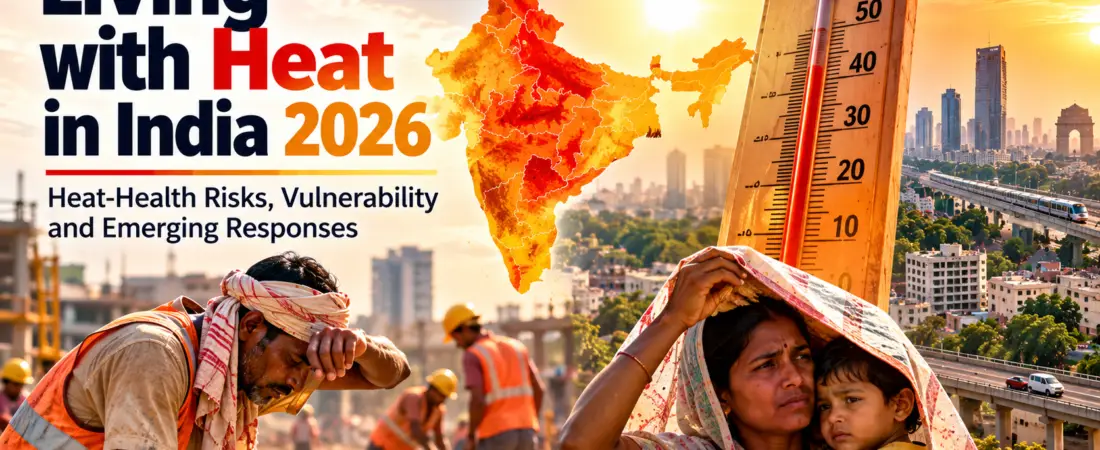
The report Living with Heat in India: Heat-Health Risks, Vulnerability and Emerging Responses, published in October 2026 by the Global Heat Health Information Network (GHHIN) South Asia Hub, examines India’s changing heat exposure, health consequences, vulnerable populations and institutional responses.
The report was prepared by Purvi Patel, Tamanna Dalal, Abhiyant Tiwari and Anshima Mishra. The GHHIN South Asia Hub is hosted by the Council on Energy, Environment and Water (CEEW), in collaboration with regional partners. CEEW+1
The central argument of the report is that India has made considerable progress in developing heat governance mechanisms, but the next stage must focus on long-term heat resilience, health-centred planning, interdepartmental coordination and sustained adaptation finance.
1. About the Report
| Particular | Details |
|---|---|
| Title | Living with Heat in India |
| Subtitle | Heat-Health Risks, Vulnerability and Emerging Responses |
| Publication | October 2026 |
| Institution | Global Heat Health Information Network South Asia Hub |
| Host institution | Council on Energy, Environment and Water (CEEW) |
| Authors | Purvi Patel, Tamanna Dalal, Abhiyant Tiwari and Anshima Mishra |
| Primary focus | Heat exposure, health risks, vulnerability and governance |
| Geographical coverage | India |
About the Global Heat Health Information Network
The Global Heat Health Information Network (GHHIN) is an international multidisciplinary network established in 2016 with support from the World Meteorological Organization (WMO), World Health Organization (WHO) and the United States National Oceanic and Atmospheric Administration (NOAA).
It brings together policymakers, scientists, health professionals and other stakeholders to strengthen evidence-based responses to extreme heat.
The GHHIN South Asia Hub works towards translating global knowledge into region-specific policies and interventions.
Hosted by CEEW, the South Asia Hub collaborates with organisations including:
- Natural Resources Defense Council (NRDC).
- Sustainable Futures Collaborative (SFC).
- United Nations Economic and Social Commission for Asia and the Pacific (UNESCAP).
- BRAC James P. Grant School of Public Health.
Its objective is to strengthen research, policy coordination, capacity building and community-level interventions relating to heat and health. CEEW
2. Rising Temperatures in India: The Changing Heat Risk
The report highlights that India’s historical relationship with its warm climate is changing because of anthropogenic climate change.
According to the report, India’s average temperature during 2015–2024 was approximately 0.89°C higher than the 1901–1930 baseline. The year 2024 was recorded as the warmest year since 1901.
However, the increase in temperature is not geographically or seasonally uniform.
2.1 Regional variations in warming
- Northwestern and central India are experiencing frequent heatwaves.
- The Indo-Gangetic plains are witnessing significant summer warming.
- The pre-monsoon season is experiencing pronounced warming in northern India.
- The southern peninsula, historically less affected by severe heatwaves, is emerging as a future heat-risk region.
- Humid heat is becoming an increasingly important concern.
The report also highlights the increasing frequency of very warm nights, scorching days and prolonged warm spells.
An important concern is the projected expansion of long-duration and large-area heatwaves.
At 1.5°C of global warming, long-duration, large-area heatwave events across India are projected to increase approximately threefold compared with the historical reference conditions used in the underlying assessment. CEEW+1
2.2 Future heat exposure
The report draws attention to the increasing population exposure under different global warming scenarios.
| Global warming scenario | Estimated Indian population exposed to extreme heat |
|---|---|
| 1.5°C warming | Approximately 90 million |
| 2.7°C warming | Approximately 600 million |
These are scenario-based estimates cited in the report, not projections of the number of people who will necessarily suffer heat-related illness.
The expansion of heat exposure towards southern India and the increasing incidence of humid heat make adaptation particularly important.
3. Extreme Heat as a Public Health Threat
One of the most important contributions of the report is its treatment of extreme heat as a public health threat multiplier.
Heat exposure can directly cause heat-related illnesses and can also aggravate existing health conditions.
3.1 Direct health consequences
Prolonged exposure to extreme heat can cause:
- Heat cramps.
- Heat exhaustion.
- Heatstroke.
- Severe dehydration.
- Electrolyte imbalance.
- Acute kidney injury.
Heatstroke is particularly dangerous because it can result in multi-organ dysfunction and death if not treated promptly.
3.2 Indirect health consequences
Extreme heat can also aggravate pre-existing medical conditions.
The report highlights emerging evidence linking heat exposure with:
Cardiovascular diseases: High temperatures place additional stress on the cardiovascular system and can increase the risk of cardiovascular morbidity.
Kidney diseases: Dehydration and prolonged occupational exposure to heat may contribute to kidney damage, particularly among agricultural and outdoor workers.
Respiratory health: Heat can interact with air pollution and aggravate respiratory risks.
Maternal and reproductive health: Antenatal exposure to high temperatures has been associated with adverse pregnancy outcomes, including preterm birth and low birth weight.
Mental health: Extreme heat can disrupt sleep, increase psychological stress and affect overall mental well-being.
These impacts demonstrate that heat-related health risks extend beyond conventional heatstroke cases. CEEW+1
3.3 Heat-related mortality and surveillance
The report highlights the limitations of India’s heat-related illness and mortality data.
Between 2021 and 2024, approximately 71,880 suspected heatstroke cases and 381 heatstroke deaths were reported under the National Heat-Related Illness and Death Surveillance system.
For the period 1 March–26 July 2026, the reported figures were 4,853 heatstroke cases and 20 deaths.
These figures should not be interpreted as the complete health burden of extreme heat. Many heat-related deaths may be recorded under underlying cardiovascular, renal or other medical conditions rather than being directly attributed to heat exposure. CEEW
4. Occupational Heat Exposure and Economic Consequences
Extreme heat is not merely a health concern. It also affects labour productivity, household income and economic output.
Workers engaged in outdoor and physically demanding occupations are particularly vulnerable.
These include:
- Agricultural labourers.
- Construction workers.
- Street vendors.
- Transport and delivery workers.
- Sanitation workers.
- Industrial workers exposed to high temperatures.
4.1 Impact on labour productivity
The report cites research indicating that outdoor heat exposure and workload can produce significant productivity losses.
One cited estimate suggests productivity losses of up to 5% for every 1°C increase in Wet Bulb Globe Temperature (WBGT) above 26°C.
Another cited estimate indicates substantial earning losses associated with increases in wet-bulb temperature.
The report therefore emphasises the importance of calibrated work-rest schedules and access to basic protective facilities.
4.2 Economic consequences
The report cites an International Labour Organization projection that South Asia could lose 5.3% of its total working hours to heat stress by 2030 under the relevant warming scenario.
It also refers to a World Bank estimate that extreme heat could result in productivity losses equivalent to nearly 31 million full-time jobs annually across the region, with economic output projected to decline by almost 7% by 2050.
These figures illustrate how climate change can undermine economic growth through reduced labour productivity. CEEW
4.3 Measures to protect outdoor workers
The report highlights the importance of:
- Calibrated work-rest schedules.
- Availability of drinking water.
- Shaded resting facilities.
- Appropriate cooling arrangements.
- Adjustment of working hours during peak heat periods.
- Occupational health surveillance.
- Social protection for workers experiencing income losses.
Such interventions should be incorporated into labour regulations, urban planning and occupational safety frameworks.
5. Unequal Vulnerability to Extreme Heat
Exposure to extreme heat does not affect all individuals and communities equally.
The report identifies several factors that determine vulnerability:
- Age and physiological conditions.
- Existing health conditions.
- Occupation and nature of work.
- Housing conditions.
- Income and access to cooling.
- Migration status.
- Gender inequalities.
- Urbanisation and land-use patterns.
5.1 Vulnerable population groups
| Population group | Major vulnerabilities |
|---|---|
| Elderly persons | Reduced ability to regulate body temperature and higher prevalence of chronic diseases |
| Children | Greater physiological vulnerability and dependence on caregivers |
| Pregnant women | Risks associated with maternal heat exposure |
| Outdoor workers | Prolonged exposure and occupational heat stress |
| Urban poor | Poor housing, inadequate ventilation and limited access to cooling |
| Migrant workers | Limited social protection and insecure working conditions |
| Rural women | Occupational exposure and unequal access to resources |
5.2 Gender dimensions of heat vulnerability
Women may face multiple forms of heat exposure arising from domestic responsibilities, agricultural work and limited access to cooling facilities.
Women engaged in unpaid care work may also experience prolonged exposure while undertaking household activities.
Therefore, heat adaptation policies must incorporate gender-sensitive planning.
6. Urban Heat Islands: Why Cities Experience Greater Heat Stress
The report gives considerable importance to the relationship between urbanisation and heat exposure.
The Urban Heat Island (UHI) effect refers to the phenomenon in which urban areas experience higher temperatures than surrounding rural areas.
It results from changes in land use, built environments and the concentration of heat-absorbing surfaces.
Major causes
- Extensive concrete and asphalt surfaces.
- Reduction in vegetation and tree cover.
- High-density construction.
- Limited ventilation between buildings.
- Waste heat from vehicles and air-conditioning systems.
- Industrial activity.
- Changes in natural drainage and surface characteristics.
The report cites a study of 44 major Indian cities in which the difference in land-surface temperatures between urban areas and surrounding rural areas exceeded 2°C for most cities across seasons.
It also highlights how household built environments can retain significantly higher temperatures in urban settings.
Implications for urban planning
Urban heat management should become an integral part of urban development policies.
Important interventions include:
- Urban afforestation.
- Protection of lakes and wetlands.
- Cool roofs and reflective surfaces.
- Green buildings.
- Urban ventilation corridors.
- Climate-sensitive land-use planning.
- Public cooling centres.
- Accessible drinking-water facilities.
Urban planning must move beyond conventional infrastructure development and incorporate thermal comfort and climate resilience.
7. India’s Heat-Health Governance Framework
The report recognises that India has made important progress in developing institutional mechanisms for heat-risk management.
The country’s approach has gradually shifted from reactive disaster response towards proactive risk reduction.
7.1 Heat Action Plans
Heat Action Plans (HAPs) are important instruments for reducing heat-related risks.
They generally include:
- Heat-risk assessment.
- Early warning systems.
- Public awareness campaigns.
- Identification of vulnerable populations.
- Healthcare preparedness.
- Interdepartmental coordination.
- Emergency response measures.
According to the October 2026 report, Heat Action Plans based on NDMA guidelines have been prepared for:
23
States
195
Districts
64
Cities
The report also notes that heatwaves were declared a notified natural disaster in August 2026. CEEW
7.2 National Programme on Climate Change and Human Health
The Ministry of Health and Family Welfare implements the National Programme on Climate Change and Human Health (NPCCHH).
Its broader objectives include:
- Building healthcare-system preparedness for climate-related health risks.
- Strengthening health surveillance.
- Developing institutional capacity.
- Training healthcare professionals.
- Improving awareness of climate-sensitive diseases.
- Supporting climate-resilient healthcare infrastructure.
The programme provides an important institutional foundation for integrating climate adaptation into public health policy.
7.3 National Heat-Related Illness and Death Surveillance
The report highlights the digitisation and expansion of heat-related illness and death surveillance.
Improved surveillance can help governments:
- Identify emerging heat-related health risks.
- Monitor geographical patterns.
- Identify vulnerable population groups.
- Assess the effectiveness of interventions.
- Improve healthcare preparedness.
7.4 Heatstroke management units
The report highlights the operationalisation of heatstroke management units in healthcare facilities.
It refers to the principle of “cool first, transport second”, which emphasises the importance of initiating rapid cooling measures for severe heatstroke patients rather than delaying treatment during transportation.
7.5 Role of the India Meteorological Department
The India Meteorological Department (IMD) plays a crucial role in heat-risk management.
Its interventions include:
- High-resolution GIS-based forecasting.
- Colour-coded heat warnings.
- Heat-index forecasting.
- Early warning communication.
- Meteorological support to Heat Action Plans.
These measures help authorities initiate preventive interventions before extreme heat conditions intensify. CEEW
8. Heat Adaptation: Technological and Nature-Based Solutions
The report discusses several adaptation measures being implemented or tested across India.
| Intervention | Potential contribution |
|---|---|
| Cool roofs | Reduce indoor temperatures |
| Cooling stations | Provide relief to vulnerable populations |
| Urban green spaces | Reduce local heat exposure |
| Urban afforestation | Improve shade and thermal comfort |
| Passive cooling | Reduce dependence on energy-intensive cooling |
| Early warning systems | Enable timely preventive action |
| Climate-sensitive housing | Reduce household heat exposure |
The report cites demonstrations indicating that cool roofs can reduce temperatures by up to 5°C, cooling stations by up to 12°C and green spaces by approximately 6–8°C in specific settings.
These are reported intervention-specific estimates, not guaranteed temperature reductions in every location.
8.1 Cool roofs
Cool roofs use reflective materials and appropriate construction techniques to reduce the absorption of solar radiation.
They can improve indoor thermal comfort, particularly in low-income housing.
8.2 Urban green spaces
Trees, parks and other green infrastructure provide shade and help moderate local temperatures through evapotranspiration.
8.3 Cooling centres
Public cooling centres can provide temporary relief to vulnerable populations who lack access to air-conditioning or other cooling facilities.
8.4 Passive cooling
Traditional architectural practices such as courtyards, shading, natural ventilation and appropriate building orientation can reduce heat exposure without increasing electricity consumption.
The report identifies an important weakness in India’s adaptation strategy: many interventions have been documented in terms of exposure reduction, but their actual impact on health outcomes has not been adequately evaluated. CEEW
9. Major Gaps in India’s Heat Governance
Despite improvements in policy and institutional preparedness, the report identifies several shortcomings.
9.1 Fragmented institutional coordination
Heat-related risks involve several sectors:
- Health.
- Disaster management.
- Urban development.
- Labour.
- Agriculture.
- Water resources.
- Electricity and energy.
However, institutional responses often remain fragmented.
A comprehensive heat governance framework requires coordination across these departments.
9.2 Inadequate adaptation finance
Heat adaptation requires sustained financial investments.
Many interventions depend on short-term project funding rather than long-term institutional budgets.
The report calls for better coordination among central funds, municipal budgets, private finance and climate finance.
9.3 Inadequate health-outcome assessment
The existence of a Heat Action Plan does not necessarily demonstrate that heat-related illness and mortality have declined.
Governments need to evaluate whether interventions actually protect vulnerable populations.
9.4 Data fragmentation
Health surveillance, meteorological observations, civil registration, census information and expenditure data are often maintained through separate systems.
Inadequate interoperability makes it difficult to develop comprehensive heat-health risk assessments.
9.5 Underfunding of health-related adaptation
State Action Plans on Climate Change and Human Health and associated Heat-Health Action Plans require stronger financial and institutional support.
9.6 Limited attention to humid heat
Traditional temperature-based warnings may not adequately capture the risks associated with high humidity.
India must strengthen its capacity to assess humid heat, chronic heat exposure and individual vulnerability.
10. Recommendations of the Report
The report identifies several priorities for strengthening India’s long-term heat resilience.
10.1 Mainstream heat action across sectors
Heat adaptation should not remain restricted to disaster management and health departments.
It must be integrated into urban planning, housing, labour, agriculture, water management and energy policies.
10.2 Strengthen local governance
Municipal bodies, district administrations and local health institutions should have clearly defined responsibilities.
Local governments must be equipped with adequate financial resources, trained personnel and technical capabilities.
10.3 Adopt health-centred Heat Action Plans
The effectiveness of Heat Action Plans should be measured through health outcomes rather than merely the number of activities undertaken.
Monitoring frameworks should include:
- Heat-related morbidity.
- Heat-related mortality.
- Healthcare preparedness.
- Vulnerable population coverage.
- Effectiveness of early warnings.
- Access to cooling and drinking water.
10.4 Strengthen climate and health data systems
India needs integrated data systems linking:
- Meteorological observations.
- Health surveillance.
- Civil registration.
- Population vulnerability.
- Urban infrastructure.
- Climate adaptation expenditure.
10.5 Ensure sustained adaptation finance
Heat resilience requires predictable and long-term financing.
Governments should explore convergent financing involving disaster management funds, municipal budgets, public expenditure and private climate finance.
10.6 Strengthen health-system capacity
Hospitals, primary healthcare centres and emergency services must be prepared to deal with rising heat-related illnesses.
This requires trained healthcare professionals, standard treatment protocols, surveillance systems and adequate medical infrastructure.
10.7 Complement adaptation with mitigation
Adaptation measures can reduce immediate vulnerability, but they cannot indefinitely compensate for rising global temperatures.
Long-term heat-risk reduction requires sustained greenhouse gas emission reductions alongside local adaptation.CEEW+1
11. Critical Analysis: From Heatwave Management to Heat Resilience
The report makes an important conceptual contribution by shifting the discussion from heatwave management to long-term heat resilience.
Traditional disaster management approaches tend to focus on immediate preparedness, warnings and emergency response.
However, the health impacts of extreme heat are shaped by structural factors such as housing, employment, urban design, access to water, healthcare and socioeconomic inequality.
Consequently, issuing a heatwave warning is only one component of an effective heat governance framework.
Several broader issues deserve attention.
First, the developmental dimension of heat: Extreme heat can undermine labour productivity, agricultural output, household incomes and urban economic activity.
Second, environmental justice: Poorer communities frequently experience higher exposure and possess fewer resources to protect themselves.
Third, urban planning: Unplanned urbanisation can intensify heat exposure through the urban heat island effect.
Fourth, public health preparedness: Healthcare systems must recognise heat as a risk factor for multiple diseases, not merely heatstroke.
Fifth, institutional accountability: Governments need measurable indicators to evaluate whether Heat Action Plans reduce health risks.
Sixth, the adaptation–mitigation relationship: Adaptation can reduce vulnerability, but sustained mitigation remains essential to limit future warming.
The report’s central message is that India must move from fragmented, event-based interventions towards a coordinated, health-centred and adequately financed heat-resilience strategy.
12. UPSC Examination Relevance
Prelims: Important Facts
- The Global Heat Health Information Network was established in 2016 with support from WMO, WHO and NOAA.
- The GHHIN South Asia Hub is hosted by CEEW.
- The Wet Bulb Globe Temperature (WBGT) is an indicator of environmental heat stress.
- The Urban Heat Island effect refers to higher temperatures in urban areas compared with surrounding rural areas.
- Heat Action Plans are important instruments for heat-risk reduction.
- The NPCCHH functions under the Ministry of Health and Family Welfare.
- IMD provides meteorological forecasts and heat warnings.
- Heatstroke is a severe heat-related illness requiring urgent cooling and medical attention.
- Cool roofs, green spaces and cooling centres are adaptation measures.
- Heat resilience requires coordination among health, labour, urban development, water and disaster management institutions.
Mains: Syllabus Linkage
| GS Paper | Relevant syllabus area |
|---|---|
| GS II | Issues relating to development and management of health |
| GS II | Government policies and interventions |
| GS II | Centre–State coordination and governance |
| GS III | Environmental pollution and degradation |
| GS III | Climate change and environmental conservation |
| GS III | Disaster management |
| GS III | Inclusive growth and employment |
| Essay | Climate justice, sustainable development and human security |
Mains Practice Questions
1. Extreme heat is emerging as a public health and developmental challenge rather than merely a meteorological phenomenon. Discuss in the context of India’s increasing heat vulnerability.
2. Examine the role of Heat Action Plans in reducing India’s vulnerability to extreme heat. What institutional and implementation challenges remain?
3. Urbanisation and socioeconomic inequality intensify the health impacts of extreme heat. Analyse the statement with suitable examples.
4. Discuss the need for integrating climate adaptation into India’s public health system.
5. Climate resilience requires coordinated action across multiple sectors rather than isolated disaster-management interventions. Critically examine.
13. Conclusion
Extreme heat is emerging as one of the most consequential manifestations of climate change for India. Its impacts extend beyond immediate heat-related illnesses to encompass occupational productivity, household incomes, urban infrastructure, public health and social inequality.
The 2026 report Living with Heat in India recognises the progress made in developing Heat Action Plans, strengthening early warning systems and improving health-sector preparedness. However, it also highlights the need for stronger institutional coordination, reliable data systems, health-centred planning and sustained adaptation finance.
India must increasingly treat heat resilience as an integral component of its development strategy.
The ultimate objective should not merely be to respond to heatwaves when they occur, but to build cities, workplaces, healthcare institutions and communities capable of anticipating, preventing and reducing the health and socioeconomic consequences of extreme heat.
Original Report and Reference Documents
Students should refer to the following original documents for further reading:
- Living with Heat in India: Heat-Health Risks, Vulnerability and Emerging Responses (2026) – Download the full report (PDF).
- Global Heat Health Information Network – Official website.
- Council on Energy, Environment and Water – Official research and publications.
- National Disaster Management Authority – Official website.
- India Meteorological Department – Official website.
- National Programme on Climate Change and Human Health – Ministry of Health and Family Welfare.
Primary source: Global Heat Health Information Network South Asia Hub, October 2026.