
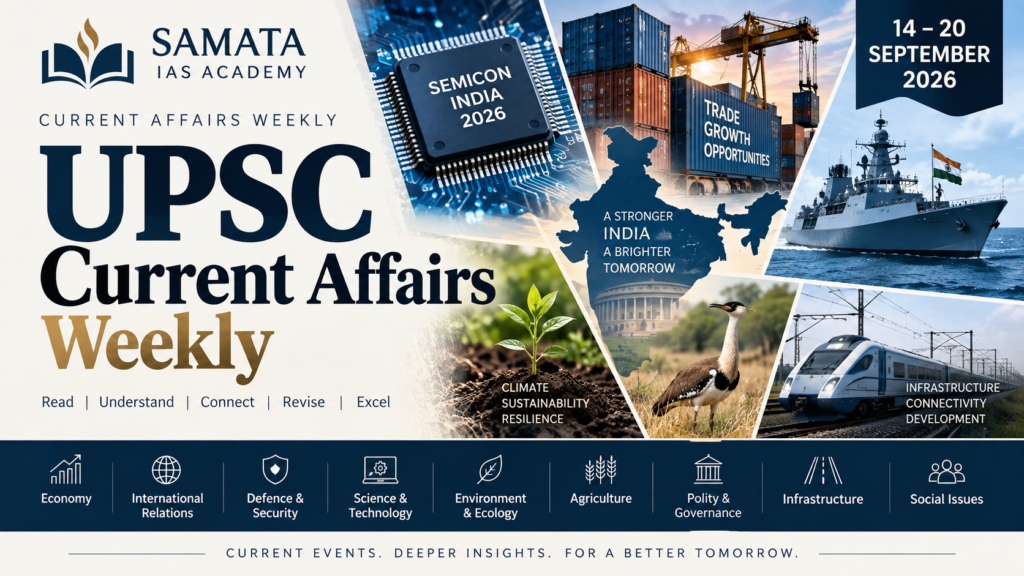
UPSC Current Affairs Weekly: 14–20 September 2026
Editorial Theme
From Strategic Autonomy to Economic Resilience
CONTENTS
I. Polity & Governance
- UAPA and the Shahzad Bhatti Network
- 20th Rozgar Mela
- Bankers’ Books Evidence Act, 2026
- Governance and administrative reforms
II. Economy
- India’s August 2026 trade performance
- India–MERCOSUR trade negotiations
- India–New Zealand FTA implementation
- RCMC requirement eased for small export consignments
- UPI and digital payments
- State Finance Ministers’ Conference
III. International Relations
- India–Nepal trade and transit cooperation
- SCO economic and trade cooperation
- India–UAE engagement
- India’s wider Global South economic strategy
IV. Defence & Internal Security
- Next Generation Missile Vessels
- CORE Programme 2026
- Indian Coast Guard and emerging maritime challenges
- India–Russia defence engagement
V. Science & Technology
- Semicon India 2026
- Semicon 2.0
- AI and scientific research
- Emerging heat-transport technology
- Data centres and digital infrastructure
VI. Environment & Ecology
- World Circular Economy Forum 2026
- India’s Net Zero Portal
- NAPCC Dashboard
- Great Indian Bustard conservation
- Delhi-NCR air pollution
- Ozone-layer protection
VII. Agriculture
- India’s first soil-carbon payments
- Southern Regional Agriculture Conference
- Regenerative agriculture
- Agricultural carbon markets
VIII. Health & Social Development
- World Patient Safety Day 2026
- Safe care for NCDs
- Pharmacovigilance
- Stem-cell therapy regulation
IX. Infrastructure & Transport
- Railway expansion
- Kavach 4.0
- Gati Shakti Cargo Terminals
X. Prelims Corner
- Important facts
- Places in news
- Organisations
- Schemes
- Reports
- 25 MCQs
XI. Mains Corner
- GS-II questions
- GS-III questions
- Essay themes
- Answer-writing frameworks
XII. One-Page Master Revision
I. POLITY & GOVERNANCE
1. Shahzad Bhatti Network Declared a Terrorist Organisation under UAPA
The Ministry of Home Affairs declared the Shahzad Bhatti Network a terrorist organisation under the Unlawful Activities (Prevention) Act, 1967.
According to the Ministry, the network was involved in cross-border smuggling of arms, explosives and narcotics, recruitment/incitement of vulnerable youth and the dissemination of extremist digital content.
Why is this important for UPSC?
The issue connects directly with:
- UAPA
- Counter-terrorism framework
- Terror financing
- Cross-border organised crime
- Cyber radicalisation
- National security
Static Link
GS-II: Internal Security institutions and legislation
GS-III: Internal security, terrorism and organised crime
Concept Box: UAPA
The Unlawful Activities (Prevention) Act, 1967 is India’s principal legislation dealing with unlawful associations and terrorism-related activities.
Its evolution reflects India’s attempt to address:
Terrorism → Terror financing → Recruitment → Radicalisation → Organised networks
II. ECONOMY
2. India’s Exports Rise Strongly During April–August 2026
India’s total exports of merchandise and services during April–August 2026–27 were estimated at US$399.27 billion, compared with US$345.55 billion during the corresponding period of 2025–26.
This represents growth of 15.55%.
Merchandise exports during the period reached US$215.91 billion, registering growth of 17.85%.
August 2026
| Indicator | August 2026 |
|---|---|
| Total exports | US$82.68 bn |
| Total imports | US$92.09 bn |
| Trade balance | -US$9.41 bn |
| Merchandise exports | US$43.81 bn |
| Merchandise imports | US$70.67 bn |
Important export-growth sectors included:
- Electronic goods
- Petroleum products
- Engineering goods
- Organic and inorganic chemicals
- Cotton yarn and textiles
- Handloom products
Electronic goods exports increased by approximately 89.82% year-on-year in August 2026.
UPSC Analysis
The numbers illustrate an important structural development:
Manufacturing capability → Electronics → Export diversification → Global value-chain integration
However, the merchandise trade deficit remains substantial.
Therefore, India’s trade strategy has two simultaneous objectives:
Increase export competitiveness + Reduce critical import dependence
3. India–MERCOSUR: Expansion of Preferential Trade Agreement Negotiations
India and MERCOSUR launched negotiations for expansion of their existing Preferential Trade Agreement (PTA).
India and MERCOSUR also signed the first Additional Protocol facilitating electronic Certificates of Origin.
What is MERCOSUR?
MERCOSUR — Southern Common Market
Major members include:
- Argentina
- Brazil
- Paraguay
- Uruguay
It is one of the important regional economic blocs of South America.
Why does this matter?
For India, deeper engagement with MERCOSUR can contribute to:
- Export diversification
- Market access
- South–South cooperation
- Agricultural trade
- Pharmaceuticals
- Engineering goods
- Chemicals
- Automotive products
UPSC Link
GS-II: International groupings
GS-III: External trade, FTAs and export competitiveness
4. RCMC Requirement Eased for Small Export Consignments
The government eased the requirement for Registration-Cum-Membership Certificate (RCMC) for export consignments valued up to ₹3 lakh.
Significance
This is particularly relevant to:
- MSMEs
- Small exporters
- First-time exporters
- E-commerce exporters
- Small-scale handicraft producers
It represents a shift toward:
Ease of doing business + Lower compliance costs + Export participation
III. INTERNATIONAL RELATIONS
5. India–Nepal Trade, Transit and Cooperation
The India–Nepal Inter-Governmental Sub-Committee on trade, transit and cooperation to control unauthorised trade met in New Delhi on 18 September 2026.
Why important?
India–Nepal relations have a distinctive character because of:
- Open border
- Deep social linkages
- Trade dependence
- Labour mobility
- Transit dependence
- Energy cooperation
- Cross-border infrastructure
Core challenge
The open border provides enormous social and economic benefits but also creates vulnerabilities related to:
Unauthorised trade + smuggling + customs evasion + security concerns
Hence, India–Nepal relations require a balance between:
Open-border connectivity and effective border management.
6. SCO Economic Cooperation
The 25th Meeting of SCO Ministers responsible for Economic and Foreign Trade Activities was held in Tajikistan on 18 September 2026.
For India, SCO economic engagement is relevant to:
- Eurasian connectivity
- Trade facilitation
- Energy security
- Transport corridors
- Regional economic integration
Static Connection
SCO → Eurasia → Central Asia → Connectivity → Energy → India’s extended neighbourhood
IV. DEFENCE & INTERNAL SECURITY
7. Next Generation Missile Vessels
The first Next Generation Missile Vessel (NGMV) for the Indian Navy had its keel laid at Cochin Shipyard Limited, Kochi, on 19 September 2026.
The development is part of India’s continuing effort toward naval modernisation and indigenous shipbuilding.
Significance
The NGMV programme is relevant to:
- Coastal defence
- Maritime strike capability
- Anti-surface warfare
- Indigenous shipbuilding
- Maritime security
The development also supports the broader objective of Atmanirbhar Bharat in defence manufacturing.
V. SCIENCE & TECHNOLOGY
8. SEMICON INDIA 2026
One of the biggest Science & Technology developments of the week is SEMICON India 2026, held in New Delhi from 17–19 September 2026.
The event was organised under the theme:
“Silicon to Systems: Building the Ecosystem”
The government has positioned semiconductor capability as a strategic requirement because chips underpin:
AI + telecommunications + defence + electric mobility + data centres + advanced manufacturing.
9. Semicon 2.0
The Union Cabinet approved Semicon 2.0 with an outlay of ₹1,27,500 crore.
The programme focuses on six broad pillars:
- Research and development
- Chip design
- Machines and equipment
- Materials
- Semiconductor fabrication
- ATMP/OSAT and talent development
Why semiconductors matter for India
The semiconductor question is no longer merely an industrial-policy issue.
It has become a question of:
Economic security + technological sovereignty + national security + supply-chain resilience.
UPSC Mains Connection
“Semiconductor self-reliance is increasingly becoming a component of strategic autonomy.” Discuss.
VI. ENVIRONMENT & ECOLOGY
10. World Circular Economy Forum 2026
India hosted the World Circular Economy Forum 2026 at Gandhinagar from 15–18 September 2026.
The theme was:
“Circular Economy: Transition for People and Prosperity”
The forum brought together participants from more than 60 countries and focused on:
- Circular finance
- Sustainable production
- Resource efficiency
- Innovation
- Digital technologies
- Employment
- Inclusive transition
- Industrial circularity
Why important?
The traditional economic model is:
Take → Make → Use → Dispose
Circular economy seeks:
Reduce → Reuse → Repair → Remanufacture → Recycle → Recover
UPSC Link
GS-III: Environment, waste management, sustainable development and resource efficiency.
11. India’s Net Zero Portal
India launched the Net Zero Portal and NAPCC Dashboard during World Ozone Day-related events.
The platforms are relevant to:
- Climate-policy monitoring
- Tracking mitigation measures
- National climate programmes
- Data-driven climate governance
12. Great Indian Bustard Conservation
The Environment Minister visited the Great Indian Bustard (GIB) habitat at Naliya, Kachchh, Gujarat, on 14 September.
A GIB Soft Release Centre was inaugurated.
Conservation measures include:
- Grassland restoration
- Predator-proof fencing
- Conservation breeding
- Habitat management
- Community participation
The government reported that a chick emerging from a conservation intervention had survived beyond the critical first three months in the wild.
UPSC Static
Great Indian Bustard
- Scientific name: Ardeotis nigriceps
- Grassland species
- Critically endangered
- India is its principal remaining natural range
Important Concept
GIB conservation demonstrates why species conservation cannot be separated from:
Grassland ecology + power infrastructure + pastoral communities + habitat management.
VII. AGRICULTURE
13. India’s First Soil-Carbon Payments
This is one of the most important agricultural developments of the week.
More than 2,500 farmers in Punjab and Haryana became the first group to receive payments linked to carbon stored in agricultural soils.
Around ₹2.9 crore was to be distributed.
The first issuance covered approximately:
- 30,000 acres
- More than 50,000 carbon credits
Individual farmers received approximately ₹3,000–₹15,000.
What is soil carbon?
Soil contains significant quantities of organic carbon.
Agricultural practices can either:
Release carbon → atmospheric emissions
or
Store carbon → soil carbon sequestration
Regenerative agricultural practices
The initiative is associated with practices such as:
- Crop-residue retention
- Minimum soil disturbance
- Direct-seeded rice
- Crop diversification
- Improved soil biology
- Efficient water use
Why this matters
This creates a potential link between:
Climate action → Farmer income → Sustainable agriculture
It also demonstrates how carbon markets can potentially operate at farm level.
VIII. HEALTH & SOCIAL DEVELOPMENT
14. World Patient Safety Day 2026
India observed World Patient Safety Day 2026 with the theme:
“Safe Care for Noncommunicable Diseases (NCDs)”
The focus was on:
- Quality healthcare
- Patient safety
- Safe NCD treatment
- Health-system strengthening
- Universal Health Coverage
UPSC Connection
Patient safety should be understood as part of:
Quality of healthcare → Universal Health Coverage → Health-system capacity → Human capital
15. Regulation of Stem Cell Therapy
The Health Ministry issued an advisory concerning the regulation of stem-cell therapy.
This is significant because advances in biotechnology create both:
Therapeutic opportunities + ethical/regulatory challenges.
UPSC S&T Connection
- Stem cells
- Regenerative medicine
- Biomedical ethics
- Clinical trials
- Evidence-based medicine
- Healthcare regulation
IX. INFRASTRUCTURE & TRANSPORT
16. Kavach 4.0
Indian Railways approved ₹252 crore for deployment of Kavach 4.0 over 607.7 route kilometres in the Lucknow Division.
What is Kavach?
Kavach is India’s indigenous Automatic Train Protection (ATP) system.
It aims to reduce risks associated with:
- Signal passing at danger
- Train collisions
- Excessive speed
Static Link
Kavach → Railway safety → Indigenous technology → Digital infrastructure
X. IMPORTANT WEEKLY THEME
ECONOMIC RESILIENCE AND STRATEGIC AUTONOMY
A major connecting theme across this week’s developments is the effort to strengthen India’s resilience in critical sectors.
Consider the connections:
Semiconductors
↓
Technological resilience
Exports and FTAs
↓
Market diversification
Soil carbon
↓
Climate-resilient agriculture
Circular economy
↓
Resource efficiency
Defence shipbuilding
↓
Strategic autonomy
Digital payments
↓
Financial infrastructure
Kavach
↓
Indigenous technological capability
Thus, the week’s developments can be studied under a common UPSC framework:
Strategic Autonomy = Security + Technology + Economy + Energy + Food + Environment
PRELIMS QUICK REVISION
Remember These
MERCOSUR → South American regional economic bloc
Semicon 2.0 → ₹1,27,500 crore
SEMICON India 2026 → “Silicon to Systems: Building the Ecosystem”
WCEF 2026 → Gandhinagar
GIB Soft Release Centre → Naliya, Kachchh
Soil-carbon payments → Punjab and Haryana
Kavach 4.0 → Automatic Train Protection
World Patient Safety Day 2026 → Safe Care for Noncommunicable Diseases
Net Zero Portal → Climate-policy monitoring
India–MERCOSUR → PTA expansion negotiations
MAINS QUESTIONS
GS-II
Q1. India’s neighbourhood policy increasingly requires balancing connectivity with security. Discuss with reference to India–Nepal relations.
GS-II/III
Q2. Examine the role of trade diversification in strengthening India’s strategic autonomy.
GS-III
Q3. Semiconductor capability has emerged as an essential component of national economic security. Discuss India’s strategy.
GS-III
Q4. Can agricultural carbon markets simultaneously improve farmer incomes and climate resilience? Discuss the opportunities and challenges.
GS-III
Q5. Circular economy requires a transformation of production and consumption patterns rather than merely improved waste management. Examine.
GS-III
Q6. Conservation of the Great Indian Bustard demonstrates the importance of integrating species protection with landscape-level ecological management. Discuss.
THIS WEEK IN 10 LINES
- India expanded its engagement with MERCOSUR.
- India’s April–August exports grew 15.55% in combined merchandise and services.
- Semicon India 2026 highlighted India’s semiconductor ambitions.
- Semicon 2.0 has an outlay of ₹1,27,500 crore.
- India hosted the World Circular Economy Forum 2026.
- India’s first soil-carbon payments reached farmers in Punjab and Haryana.
- Great Indian Bustard conservation received a new institutional push in Gujarat.
- Kavach 4.0 deployment expanded.
- India intensified regional economic engagement through Nepal and SCO mechanisms.
- The week reinforced the broader theme of economic and technological resilience.