
Introduction
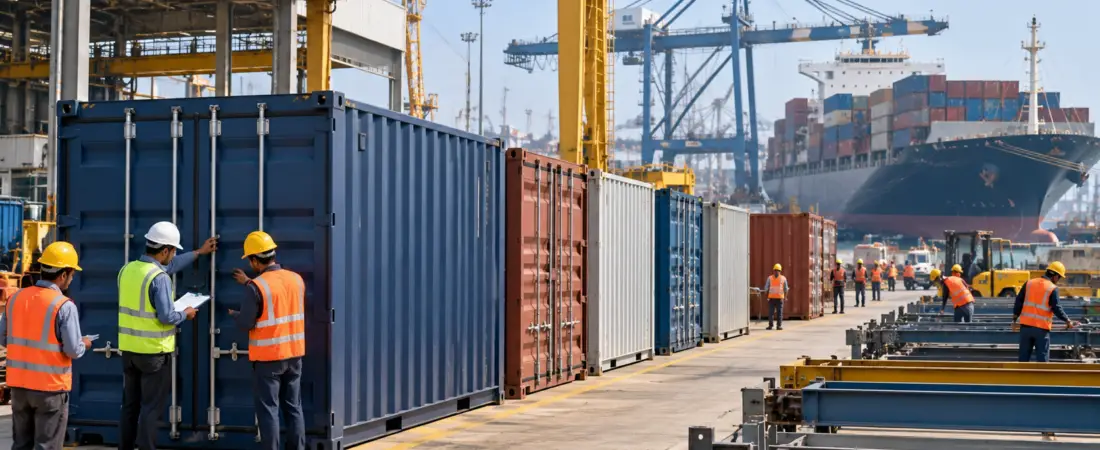
International trade depends not only on the production of goods but also on the infrastructure required to transport them efficiently. Shipping containers are an essential part of this infrastructure. They enable goods to move seamlessly between ships, trains and trucks without repeated unloading and repacking.
Although India is a major participant in global maritime trade, its domestic shipping container manufacturing capacity remains limited. Dependence on imported containers can expose the country’s logistics ecosystem to external supply disruptions, price fluctuations and geopolitical uncertainties.
Against this background, the Union Cabinet approved the Container Manufacturing Promotion Scheme (CMPS) on 28 October 2026, with a budgetary outlay of ₹10,000 crore up to FY 2039–40. The scheme aims to establish a globally competitive container manufacturing ecosystem, reduce import dependence and strengthen India’s maritime supply chains.
The government expects domestic annual manufacturing capacity to increase approximately ten-fold, from around 70,000 Twenty-foot Equivalent Units (TEUs) to 7.5 lakh TEUs.
The initiative raises an important economic question: Can India transform its growing maritime trade into a competitive domestic manufacturing ecosystem for shipping containers?
1. Why Are Shipping Containers Important for Global Trade?
Shipping containers are standardised freight units used to transport goods through ships, railways and road networks. They are manufactured according to international specifications, including standards developed by the International Organization for Standardization (ISO).
Their standardised dimensions allow containers to be transferred between different modes of transport without unloading the cargo.
The two most common sizes are:
- 20-foot container: The basic unit used for measuring container capacity.
- 40-foot container: Equivalent to two 20-foot units.
The standard measurement is known as the Twenty-foot Equivalent Unit (TEU).
Containers have transformed international logistics by reducing cargo handling time, improving security and supporting large-scale movement of goods.
According to the government backgrounder, approximately 80% of global merchandise trade by volume is transported by sea. This demonstrates the importance of maritime transport and containerisation to international commerce.
For India, the importance is particularly significant. As of February 2026, the country’s maritime sector handled approximately 95% of trade by volume and 70% by value. The sector also contributes around 4–5% to India’s GDP.
Therefore, the availability of reliable and competitively priced shipping containers is important for India’s export competitiveness and logistics efficiency.
2. Why Does India Need a Domestic Container Manufacturing Industry?
India has invested considerably in ports, highways, railways and multimodal logistics infrastructure. However, the development of transport infrastructure must be supported by a strong manufacturing ecosystem.
Several factors explain the need to strengthen domestic container production.
Dependence on imported containers
Limited domestic production makes shipping companies and logistics operators dependent on international suppliers.
External disruptions, trade restrictions and fluctuations in international prices can affect the availability and cost of containers.
Developing domestic manufacturing capacity can reduce this vulnerability.
Growing international trade
As India’s manufacturing and export sectors expand, the demand for efficient cargo transportation is likely to increase.
Industries such as engineering goods, textiles, pharmaceuticals, chemicals, automobiles and agricultural products depend on reliable logistics infrastructure.
A stronger domestic container industry can support this expanding trade base.
Supply-chain resilience
The COVID-19 pandemic and subsequent disruptions in global shipping demonstrated the vulnerability of international supply chains.
Shortages of containers, congestion at ports and fluctuations in freight rates affected businesses across countries.
Domestic production can improve India’s ability to respond to external disruptions, although supply-chain resilience also requires access to raw materials, components, technology and international markets.
Development of supporting industries
Container manufacturing requires specialised steel, corner castings, flooring materials, paints, locking systems and other components.
Expanding production can create opportunities for domestic suppliers and ancillary industries, generating wider industrial linkages.
3. Container Manufacturing Promotion Scheme: Key Features
The Union Cabinet approved the scheme on 28 October 2026 with a total budgetary outlay of ₹10,000 crore up to FY 2039–40.
It is intended to support both new manufacturing facilities and the expansion of existing units.
The scheme has three major components.
A. Interest Subvention Assistance
An allocation of ₹859 crore has been made for Interest Subvention Assistance.
Under this component, eligible manufacturers can receive an interest subsidy of 3% per annum on qualifying term loans used for setting up new manufacturing facilities or expanding existing production capacity.
The eligibility conditions include:
- New or greenfield facilities must have an annual capacity of at least 1,00,000 TEUs.
- Existing or brownfield facilities must add at least 25,000 TEUs of annual capacity.
- Brownfield expansion projects must be commissioned within three years of in-principle approval and comply with global container standards.
A greenfield project involves establishing a new manufacturing facility, while a brownfield project involves expanding or upgrading an existing facility.
Why it matters: Container manufacturing requires substantial capital investment in industrial facilities, equipment, production systems and quality-control infrastructure. Interest support can reduce the cost of investment and encourage manufacturers to expand capacity.
B. Operational Expenditure Assistance
The largest component of the scheme is Operational Expenditure Assistance, with an allocation of ₹8,891 crore.
It provides financial assistance for eligible containers manufactured according to global shipping standards and sold by eligible manufacturers.
The assistance is intended to bridge the cost difference between domestic production and competing international products.
The government has specified the following assistance:
- 20-foot standard container: ₹49,500 per container.
- 40-foot standard container: ₹86,625 per container.
- 20-foot specialised container: ₹37,125 to ₹74,250 per container.
An important condition relates to domestic value addition.
Manufacturers must meet a minimum local-content requirement of 70% through FY 2031–32. This requirement will increase to 90% from FY 2032–33.
Why it matters: Financial support linked to actual production and sales can improve the competitiveness of domestic manufacturers. Increasing local-content requirements can also encourage the development of domestic component suppliers.
However, the effectiveness of this component will depend on whether manufacturers can achieve international quality standards while maintaining competitive production costs.
C. Testing and Certification Assistance
The scheme allocates ₹150 crore for testing and certification infrastructure.
It proposes support for common testing facilities, including specialised tests such as dynamic longitudinal impact testing.
International shipping containers must comply with technical and safety requirements. Manufacturers need access to reliable testing and certification facilities to demonstrate that their products meet applicable standards.
Why it matters: Manufacturing capacity alone does not guarantee international competitiveness. Quality assurance, durability, safety and compliance with international standards are essential for accessing global markets.
4. What Does the Government Expect from the Scheme?
The scheme aims to expand India’s annual container manufacturing capacity approximately ten-fold, reaching 7.5 lakh TEUs.
Its expected outcomes include:
Expansion of manufacturing capacity
Greater domestic production can reduce dependence on imported containers and support the growth of India’s maritime and logistics industries.
Export opportunities
A competitive domestic industry could supply containers to international shipping companies and logistics operators.
India may gradually develop into an export hub for quality shipping containers if manufacturers achieve competitive costs, reliable delivery and international certification.
Employment generation
The government estimates that the scheme could generate approximately 3,000 direct jobs and more than 50,000 indirect jobs.
Indirect employment may emerge in steel processing, component manufacturing, logistics, transportation, maintenance and other supporting services.
Development of ancillary industries
The scheme is expected to benefit industries producing specialised steel, corner castings, wooden frames, paints and other components.
This can strengthen industrial linkages and encourage domestic value addition.
Stronger supply-chain resilience
Domestic production can improve the availability of containers and reduce vulnerability to disruptions in international supply networks.
These are expected outcomes rather than achievements already realised. Their actual impact will depend on investment, production capacity, market demand and implementation.
5. How Does the Scheme Fit into India’s Maritime and Logistics Strategy?
The Container Manufacturing Promotion Scheme is part of a broader effort to strengthen India’s maritime and logistics ecosystem.
Several complementary initiatives are relevant.
Maritime Amrit Kaal Vision 2047
The vision aims to develop India’s maritime infrastructure and strengthen its position in global shipping, port development and maritime services.
Domestic container production can complement investments in ports, shipping and coastal infrastructure.
Sagarmala Programme
The Sagarmala Programme focuses on port-led development, port modernisation, port connectivity and coastal economic development.
Better integration between ports, manufacturing facilities and inland markets can improve the efficiency of containerised cargo movement.
National Logistics Policy
The National Logistics Policy seeks to improve logistics efficiency, reduce logistics costs and promote better coordination among different transport modes.
A stronger domestic container industry can support multimodal transport by improving the availability of standardised cargo units.
PM Gati Shakti
PM Gati Shakti promotes integrated infrastructure planning through coordination among different ministries and infrastructure sectors.
Container manufacturing facilities will benefit from efficient connectivity to ports, industrial clusters, railway networks and highways.
Bharat Container Shipping Line
A Memorandum of Understanding was signed in February 2026 to establish the Bharat Container Shipping Line.
The initiative brings together the Shipping Corporation of India, Container Corporation of India, Jawaharlal Nehru Port Authority, V.O. Chidambaranar Port Authority, Chennai Port Authority and Sagarmala Finance Corporation Limited.
It aims to strengthen an Indian-anchored container shipping ecosystem connecting ports with inland markets.
Together, domestic manufacturing, shipping capacity, port infrastructure and inland connectivity can support a more integrated maritime logistics system.
6. Challenges in Building a Globally Competitive Container Industry
Despite the potential benefits, establishing a globally competitive container manufacturing ecosystem will require addressing several structural challenges.
Access to raw materials and components
Container manufacturing depends on specialised steel and several precision-engineered components.
Domestic manufacturers must have access to consistent-quality raw materials at competitive prices. Weaknesses in the supply of specialised inputs could increase production costs and limit domestic value addition.
International competition
Established manufacturing centres have developed large production capacities, supplier networks, technical expertise and economies of scale.
Indian manufacturers will have to compete on price, quality, reliability and delivery timelines.
Government incentives can support initial investment, but long-term competitiveness must come from productivity and technological efficiency.
Technology and quality standards
Shipping containers are exposed to harsh environmental conditions and repeated handling during transportation.
Manufacturers must ensure structural strength, corrosion resistance, durability and compliance with international standards.
Access to testing facilities and advanced manufacturing technology will therefore be important.
Availability of skilled workers
The industry requires workers with skills in metal fabrication, welding, industrial design, quality inspection, automation and production management.
Skill development must be aligned with actual industry requirements.
Demand uncertainty
Manufacturers need predictable demand to justify large investments in production capacity.
The growth of exports, domestic shipping and container leasing markets will influence the commercial viability of new facilities.
Effective implementation of incentives
Production-linked assistance must be accompanied by transparent eligibility criteria, timely payments and effective monitoring.
The scheme must also ensure that public support results in additional domestic manufacturing capacity rather than merely subsidising production that would have taken place anyway.
7. Way Forward
India should approach container manufacturing as part of a wider industrial and maritime strategy rather than treating it as an isolated production activity.
1. Develop integrated manufacturing clusters: Locate facilities with access to ports, railway connectivity, industrial infrastructure and supporting suppliers.
2. Strengthen domestic component manufacturing: Encourage investment in specialised steel, corner castings, flooring materials and other essential components.
3. Promote technology and innovation: Support automation, advanced fabrication techniques, product design and quality-control systems.
4. Expand testing and certification capacity: Ensure that manufacturers can obtain reliable testing services and meet international technical standards.
5. Develop skilled manpower: Work with industrial training institutions and technical institutes to provide training in fabrication, welding, automation and quality assurance.
6. Improve logistics connectivity: Connect manufacturing clusters with major ports and inland logistics hubs to reduce transportation costs.
7. Encourage export market development: Support manufacturers in establishing international partnerships, meeting buyer requirements and building a reputation for reliable quality.
8. Monitor outcomes: Evaluate additional investment, domestic value addition, export performance, employment generation and the competitiveness of Indian manufacturers.
Conclusion
The Container Manufacturing Promotion Scheme represents an important step towards strengthening India’s maritime manufacturing capabilities.
Its ₹10,000 crore outlay, investment support, production assistance and testing infrastructure are intended to create a competitive domestic container manufacturing ecosystem.
However, the success of the initiative will not be determined by manufacturing capacity alone. India must develop reliable suppliers, improve productivity, meet international quality standards and integrate container production with ports, shipping networks and inland logistics.
A stronger domestic container industry can contribute to import substitution, employment generation, industrial development and supply-chain resilience.
The broader objective should be to transform India’s maritime trade advantage into a durable manufacturing and logistics advantage.
UPSC Examination Relevance
Prelims: Container Manufacturing Promotion Scheme, TEU, ISO standards, Sagarmala Programme, National Logistics Policy, PM Gati Shakti and Bharat Container Shipping Line.
Mains — GS Paper III: Indian Economy, industrial policy, manufacturing, infrastructure, logistics, exports, employment generation and supply-chain resilience.
Mains — GS Paper II: Government policies, institutional coordination and ease of doing business.
Practice Question for Prelims
Consider the following statements:
- TEU is a standard unit used to measure container capacity.
- A 40-foot shipping container is equivalent to two TEUs.
- The Container Manufacturing Promotion Scheme provides support for testing and certification infrastructure.
Which of the statements given above are correct?
(a) 1 and 2 only
(b) 2 and 3 only
(c) 1 and 3 only
(d) 1, 2 and 3
Answer: (d) 1, 2 and 3.
A Twenty-foot Equivalent Unit is the standard measurement based on a 20-foot container. A 40-foot container is equivalent to two TEUs.
Practice Question for Mains
“Strengthening domestic manufacturing of shipping containers is not merely an industrial policy measure; it is also a strategy for improving India’s maritime logistics and supply-chain resilience.” Discuss with reference to the Container Manufacturing Promotion Scheme.
External and internal links
Add these links contextually in the article:
- PIB: Cabinet approves Container Manufacturing Promotion Scheme
- PIB: Detailed backgrounder on the Container Manufacturing Promotion Scheme
- UNCTAD — Review of Maritime Transport
- Ministry of Ports, Shipping and Waterways