
Introduction
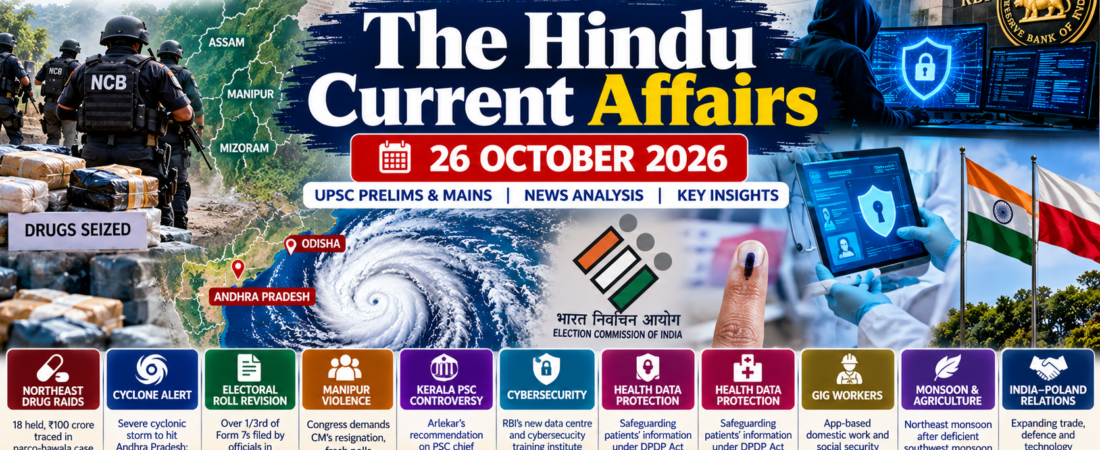
The The Hindu Delhi edition of 26 October 2026 highlights several issues important for the Civil Services Examination: a major anti-narcotics operation in Northeast India, preparations for a severe cyclonic storm over the Bay of Bengal, concerns about electoral-roll revision, continuing violence in Manipur, cybersecurity and financial stability, the rights of app-based workers, digital protection of health information, and India’s engagement with Poland.
These developments connect to important UPSC themes, including internal security, disaster management, electoral integrity, federalism, the digital economy, social security, international relations and environmental governance.
1. Internal Security: Anti-Narcotics Operation in Northeast India
1.1 What happened?
According to the newspaper report, Central agencies and the police forces of Assam, Mizoram and Manipur conducted coordinated raids at 38 locations on 23 October under Operation Trident. The operation reportedly resulted in:
- 18 arrests.
- The detection of approximately ₹100 crore in suspected hawala transactions linked to a narcotics network.
- The freezing of 1,424 bank accounts.
- The attachment of assets estimated at ₹17.82 crore.
- The seizure of 500 detonators and ₹12 lakh in cash.
The operation was led by the Narcotics Control Bureau (NCB), in coordination with State police forces and the Directorate of Enforcement. The reported locations included Aizawl, Champhai and Zokhawthar in Mizoram, Churachandpur in Manipur, and the Cachar region of Assam.
The authorities described the alleged network as operating across India’s borders with Myanmar and Bangladesh, linking narcotics trafficking with hawala-based financial channels. These are reported allegations and investigative findings, not a final judicial determination of guilt.
th.th_delhi.26_10_2026.pdf
1.2 Why is this important for India’s internal security?
Drug trafficking is not merely a law-and-order problem. Organised narcotics networks can intersect with money laundering, illegal cross-border trade, insurgent financing and other forms of organised crime.
The Northeast presents particular enforcement challenges because of its international borders, difficult terrain and established transit routes. Effective action requires more than seizures and arrests: investigators must identify suppliers, transporters, financial intermediaries and the people who control the proceeds.
1.3 What is the significance of hawala?
Hawala is an informal system of transferring value through intermediaries, often without the conventional movement of money through regulated banking channels. Although informal value-transfer systems can have legitimate uses in some contexts, they can also be exploited to conceal the origin, ownership or destination of illicit proceeds.
Investigators can therefore follow both the physical movement of drugs and the financial movement of their proceeds. Bank-account analysis, financial intelligence, cross-border cooperation and the investigation of beneficial ownership are essential to dismantling such networks.
1.4 Challenges and way forward
- Strengthen intelligence-sharing between Central agencies and State police.
- Improve coordination with neighbouring countries on trafficking routes and criminal networks.
- Investigate the financial infrastructure supporting narcotics trafficking.
- Combine enforcement with treatment, rehabilitation and prevention of substance abuse.
- Ensure due process, evidence-based investigations and prosecution.
UPSC relevance: GS Paper III — Internal Security; money laundering; organised crime; border management; India’s neighbourhood.
2. Disaster Management: Cyclone Threat to Andhra Pradesh and Odisha
2.1 What does the newspaper report?
The newspaper reports that a weather system over the Bay of Bengal intensified into a deep depression on Sunday, 25 October. The India Meteorological Department (IMD) expected it to develop into a very severe cyclonic storm, with landfall anticipated on 28 October.
Andhra Pradesh began evacuation preparations in areas considered vulnerable, while Odisha instructed Ministers to supervise disaster-management efforts. The report emphasises the need for advance preparation in the likely impact zones.
th.th_delhi.26_10_2026.pdf
Important: These are forecasts reported in the 26 October newspaper. The storm’s subsequent track, intensity and landfall location must be checked against the latest IMD bulletins before publication or operational use.
2.2 Why is the eastern coast vulnerable?
The Bay of Bengal is a major region of tropical cyclone formation. Coastal populations may face several hazards simultaneously:
- Destructive winds and damage to houses and infrastructure.
- Storm surges and coastal inundation.
- Heavy rainfall, flooding and urban waterlogging.
- Disruption to electricity, communications, transport and fisheries.
- Damage to standing crops, livestock and local livelihoods.
The degree of damage depends not only on the storm’s intensity but also on the vulnerability of settlements, the quality of infrastructure and the effectiveness of evacuation.
2.3 What makes disaster preparedness effective?
A robust response should integrate forecasting, public communication, evacuation, shelters, emergency healthcare and restoration of essential services. Particular attention is needed for older persons, persons with disabilities, children, pregnant women, fishing communities and people living in low-lying settlements.
State and district authorities must also ensure that evacuation instructions are communicated in accessible local languages and that shelters have drinking water, sanitation, medicines and adequate protection.
2.4 UPSC perspective
India’s disaster-management framework emphasises preparedness and risk reduction, rather than relying exclusively on relief after a disaster. Cyclone management also illustrates the importance of coordination between the IMD, the National Disaster Management Authority, State disaster-management authorities, district administrations and local communities.
UPSC relevance: GS Paper III — Disaster management; tropical cyclones; early-warning systems; coastal vulnerability; climate adaptation.
3. Electoral Integrity: Concerns over Form 7 in Karnataka’s Electoral-Roll Revision
3.1 What was reported?
A report in the newspaper raises questions about the use of Form 7 during the claims-and-objections stage of the ongoing Special Intensive Revision (SIR) of electoral rolls in Karnataka.
According to the report, more than one-third of approximately 1.82 lakh Form 7 applications seeking deletion of names from the draft electoral rolls were filed in the names of officials. Of 61,509 forms in which an official was identified as the objector, more than 53,000 were reportedly filed during the final week of the notice-disposal period.
Officials quoted in the report said that some forms were auto-generated by software for individuals marked as ineligible after notices concerning logical discrepancies or the absence of a match with older electoral rolls.
th.th_delhi.26_10_2026.pdf
3.2 Why does Form 7 matter?
Form 7 is used to object to the inclusion of a name in an electoral roll or to seek deletion on prescribed grounds. Because deletion directly affects an individual’s ability to vote at a particular polling station, objections must be handled transparently and in accordance with electoral law and due process.
The central issue is not simply how many forms were filed. It is whether each proposed deletion is supported by a valid reason, whether the person concerned has an opportunity to respond, and whether officials can explain and audit the decisions.
3.3 Balancing accurate rolls and universal adult suffrage
Accurate electoral rolls are essential for free and fair elections. Duplicate, deceased or otherwise ineligible entries must be addressed through lawful procedures. However, errors in documentation, migration, spelling, database matching or administrative processing can also place eligible voters at risk of exclusion.
A credible revision process therefore needs:
- Clear and legally valid grounds for proposed deletions.
- Individual notice and a meaningful opportunity to respond.
- Transparent documentation of the reasons for decisions.
- Accessible grievance-redress mechanisms.
- Independent scrutiny and audit trails for automated processing.
Analytical point: Technology can help identify inconsistencies, but an automated flag should not automatically be treated as proof that a voter is ineligible. Human review and procedural safeguards remain essential.
UPSC relevance: GS Paper II — Election Commission of India; electoral reforms; democratic participation; transparency and accountability.
4. Manipur: Renewed Violence and the Demand for Political Intervention
4.1 Developments reported
The newspaper reports that the Congress demanded the resignation of Manipur Chief Minister Y. Khemchand Singh, dissolution of the State Assembly and fresh elections, citing renewed violence and the government’s alleged failure to restore security.
The party referred to the killing of three Meitei civilians on 19 October and clashes in Kamjong district in which Kuki and Naga civilians were reportedly killed. It also called for time-bound investigations and prosecution in cases involving killings, firing, arson and destruction of civilian property. These demands and accusations represent the Opposition’s position as reported in the newspaper.
th.th_delhi.26_10_2026.pdf
4.2 Why is the situation significant?
Manipur’s conflict has demonstrated how ethnic tensions, displacement, distrust between communities, weapons proliferation and perceived failures of governance can reinforce one another. Renewed violence can undermine rehabilitation, education, livelihoods and the functioning of public institutions.
The restoration of peace requires both immediate security measures and sustained political engagement. Investigations into crimes against civilians must be credible and impartial, regardless of the identity of the accused or victims.
4.3 What should a durable peace process include?
- Protection of civilians and prevention of retaliatory violence.
- Impartial investigation and prosecution of serious crimes.
- Dialogue involving affected communities, civil society and elected representatives.
- Rehabilitation and assistance for displaced people.
- Measures to rebuild trust and ensure fair access to public services.
- Accountability for the conduct of security and administrative institutions.
The use of force may be necessary to prevent imminent violence, but long-term peace cannot be achieved through enforcement alone. A durable settlement needs legitimate institutions, dialogue and confidence-building measures.
UPSC relevance: GS Paper III — Internal security and insurgency; GS Paper II — Federalism, governance, human rights and conflict resolution.
5. Constitutional Institutions: Controversy over the Kerala Public Service Commission
5.1 What is the issue?
The newspaper reports that former Kerala Governor Rajendra Vishwanath Arlekar had reportedly recommended to the President the removal of Kerala Public Service Commission (KPSC) chairperson M.R. Baiju over alleged irregularities in the recruitment process.
A Crime Branch investigation into alleged irregularities in a Public Service Commission examination was reported to be ongoing. Political leaders disagreed over the recommendation, with critics questioning its constitutional validity and others supporting action against alleged wrongdoing. The allegations and the legality of the recommendation must be distinguished from any final finding by a competent authority.
th.th_delhi.26_10_2026.pdf
5.2 What does Article 317 provide?
Article 317 of the Constitution deals with the removal and suspension of members of Public Service Commissions.
In cases of removal for misbehaviour, the President may remove a member after the Supreme Court, on a reference made by the President, conducts an inquiry and reports that the member ought to be removed. Article 317 also provides for certain specified grounds and procedures.
The constitutional procedure is intended to protect the independence of Public Service Commissions from arbitrary political interference while preserving accountability for misconduct.
5.3 Why does PSC independence matter?
Public Service Commissions are central to merit-based recruitment in government. Their credibility depends on impartial selection, transparent examination processes and institutional autonomy.
Where allegations of recruitment irregularities arise, investigations should establish the facts and responsibility. At the same time, remedial action must follow the constitutional procedure applicable to the office concerned.
UPSC relevance: GS Paper II — Constitutional bodies; Article 317; independence of recruitment institutions; accountability and rule of law.
6. Cybersecurity: RBI’s Data Centre and Cybersecurity Training Institute
6.1 What was inaugurated?
According to the newspaper, Prime Minister Narendra Modi inaugurated the Reserve Bank of India’s new data centre and Cybersecurity Training Institute in Bhubaneswar. The report puts the cost of the data centre at ₹169 crore and quotes the Prime Minister emphasising the importance of protecting financial institutions against cybercriminals and cyberterrorists.
th.th_delhi.26_10_2026.pdf
The inauguration highlights the growing importance of secure digital infrastructure as banking, payments and financial services become increasingly technology-dependent.
6.2 Why is financial-sector cybersecurity a national-security issue?
A cyberattack on a bank or financial institution can affect more than one organisation. It may disrupt payment services, expose confidential customer information, undermine public confidence and cause wider economic harm.
Cyber threats include phishing, ransomware, credential theft, data breaches, malicious software and attacks on critical systems. The threat can also involve sophisticated actors seeking to disrupt essential services rather than merely steal money.
6.3 Why are infrastructure and training both necessary?
Secure facilities and modern technology are important, but cybersecurity also depends on trained personnel, incident-response procedures, system testing and coordination among institutions.
Financial institutions need to be able to detect attacks early, isolate compromised systems, preserve evidence, communicate with affected customers and restore essential services. Training is especially important because cybercriminals continually change their techniques.
6.4 Way forward
- Strengthen security testing and continuous monitoring.
- Improve information-sharing among financial institutions and relevant agencies.
- Conduct regular cyber drills and incident-response exercises.
- Build specialised expertise in digital forensics and threat analysis.
- Improve customer awareness about phishing and financial fraud.
- Protect sensitive data while maintaining the reliability of digital payments.
UPSC relevance: GS Paper III — Cybersecurity; critical information infrastructure; banking and financial stability; digital governance.
7. Cybercrime Investigation: Delhi Police’s Cyber Commandos
The newspaper also examines the role of specialised cyber personnel working with the Delhi Police’s Intelligence Fusion and Strategic Operations unit. Their reported work includes tracing online fraud, investigating cryptocurrency-related transactions, examining digital evidence and identifying manipulated content circulating on social media.
The report says that investigators may seek records from email providers and cryptocurrency exchanges and analyse publicly visible blockchain transactions. It also discusses the challenges posed by virtual private networks (VPNs) and the Tor network, which can complicate attempts to identify a user’s actual connection or location.
th.th_delhi.26_10_2026.pdf
7.1 What is the significance?
Cybercrime investigations increasingly require technical skills that differ from traditional policing. Digital evidence may be distributed across several jurisdictions and held by private platforms or service providers.
However, an IP address, online account or cryptocurrency wallet does not by itself establish who committed an offence. Investigators must corroborate digital traces with other evidence and follow lawful procedures for obtaining and using records.
7.2 Key challenges
- Cross-border access to electronic evidence.
- Encryption and anonymisation technologies.
- Rapid movement of stolen funds.
- Manipulated videos, impersonation and coordinated misinformation.
- Protection of privacy and due process during investigations.
UPSC relevance: GS Paper III — Cybercrime, digital forensics, cryptocurrency-related fraud and internal security.
8. Digital Personal Data Protection: Safeguarding Patients’ Health Information
8.1 The central issue
A science-page article in the newspaper examines the challenges of implementing data-protection requirements in hospitals. Healthcare institutions collect highly sensitive information, including clinical notes, diagnostic images, laboratory results, prescriptions and patient-monitoring records. At the same time, different professionals need access to different parts of a patient’s record to provide timely care.
th.th_delhi.26_10_2026.pdf
The article discusses the Digital Personal Data Protection (DPDP) Act, 2023, and the implementation timeline described in the newspaper. It reports that the Rules were notified on 13 November 2025, with provisions relating to consent managers scheduled to take effect on 13 November 2026 and the remaining substantive obligations described as commencing on 13 May 2027. Readers should consult the official notification for the precise commencement provisions applicable to each requirement.
8.2 Who are the principal actors?
The framework distinguishes among:
- Data principal: The individual to whom personal data relates — in this context, the patient.
- Data fiduciary: The entity that determines the purpose and means of processing personal data — often the hospital.
- Data processor: A third party processing personal data on behalf of the fiduciary, such as a software or cloud-service provider.
This distinction matters because outsourcing a hospital’s information systems does not eliminate the need to establish who is responsible for safeguarding patient information.
8.3 Why are hospitals particularly challenging?
Healthcare is a high-sensitivity environment. A patient may need urgent treatment, and multiple clinicians may need access to information within a short period. Excessively restrictive access can delay treatment, while unrestricted access can expose intimate medical details to unauthorised persons.
There is also a distinction between consent to medical treatment and consent to every subsequent use of information generated during that treatment. For instance, agreeing to a scan does not automatically imply agreement to every unrelated future use of the resulting data.
8.4 Practical safeguards
Hospitals need to consider:
- Role-based access controls.
- Encryption or masking of data where appropriate.
- Audit logs and secure backups.
- Vendor contracts and controls over third-party access.
- Breach-response and grievance-redress procedures.
- Staff training and clearly assigned responsibility for data governance.
- Procedures for correction or erasure where legally permissible.
The newspaper notes that failure to take reasonable safeguards can attract substantial penalties under the Act. The precise liability depends on the applicable statutory provision and facts of the case.
UPSC relevance: GS Paper II — Governance and privacy; GS Paper III — Cybersecurity and data protection; ethics of medical information and digital health.
9. Digital Gig Economy: App-Based Domestic Workers and Social Security
9.1 What is changing?
A newspaper report describes the expansion of app-based domestic-help services, through which customers can book workers for cleaning and other household tasks for short periods. The model offers convenience and flexible booking, but the report also documents concerns about working hours, rating-based remuneration, deductions, cancellations and the lack of adequate social-security coverage.
th.th_delhi.26_10_2026.pdf
The report draws attention to a basic tension: a platform may present workers as independent partners, while exercising substantial control over the allocation of jobs, ratings, payment and access to future work.
9.2 The rating system and worker vulnerability
Customer ratings can influence a worker’s access to assignments and earnings. If low ratings, cancellations or alleged failures to meet platform requirements lead to reduced pay or fewer bookings, workers may have limited bargaining power.
A system designed to reward service quality can therefore become problematic when workers lack transparent explanations, a fair appeal mechanism or protection against unreasonable customer demands.
The newspaper also reports concerns about personal safety, including the difficulties workers may face inside customers’ homes. Safety mechanisms such as emergency buttons can help, but they are not substitutes for effective complaint handling and accountability.
9.3 Why does employment classification matter?
The classification of a worker as an employee, independent contractor or platform partner can affect access to social-security schemes, responsibility for workplace safety and the allocation of employment-related obligations.
The Code on Social Security, 2020, provides a statutory framework that recognises gig and platform workers. However, the availability of particular benefits depends on applicable provisions, schemes, eligibility conditions and implementation.
The e-Shram portal provides a national database for unorganised workers and can facilitate access to eligible social-security schemes. Registration alone, however, should not be confused with automatic entitlement to every benefit.
9.4 Policy priorities
- Clarify platform responsibilities and worker classification.
- Improve transparency in ratings, deductions and deactivation.
- Provide accessible grievance-redress mechanisms.
- Strengthen occupational safety and emergency support.
- Expand social-security coverage and effective registration.
- Ensure that algorithmic management does not prevent workers from challenging unfair decisions.
UPSC relevance: GS Paper II — Social justice and welfare schemes; GS Paper III — Employment, the digital economy and inclusive growth.
10. Climate and Agriculture: The Northeast Monsoon after a Deficient Southwest Monsoon
10.1 The rainfall situation
The newspaper’s editorial discussion highlights concerns about the northeast monsoon following a deficient southwest monsoon. It reports southwest monsoon rainfall of 759.4 mm against a normal of 868.6 mm — a deficit of 12.6%, described as the driest in 11 years.
The northeast monsoon, extending broadly from October to December, is especially important for Tamil Nadu, Puducherry, coastal Andhra Pradesh, Rayalaseema, south interior Karnataka and parts of Kerala. The newspaper notes that the IMD expected northeast monsoon rainfall to be broadly normal nationally, while also warning that regional outcomes could differ considerably.
th.th_delhi.26_10_2026.pdf
10.2 How does El Niño affect Indian rainfall?
El Niño involves abnormal warming of the central and eastern equatorial Pacific Ocean. It can influence atmospheric circulation and is often associated with a weaker Indian southwest monsoon, although the strength of the relationship varies between years.
Its relationship with the northeast monsoon is more complex. Some El Niño years have coincided with above-normal northeast monsoon rainfall in Tamil Nadu, while others have experienced deficient rainfall. Therefore, El Niño should be treated as an important influence, not as a deterministic forecast of rainfall in any particular district.
10.3 Why is this important for agriculture and food prices?
A deficient monsoon can reduce soil moisture, affect sowing and crop yields, increase demand for irrigation and place pressure on reservoirs. These effects can influence farm incomes and food prices.
However, the impact varies by crop, region, irrigation access, water storage, procurement and the timing of rainfall. A strong northeast monsoon may provide relief to some southern regions, but excessive rainfall can also cause flooding and crop damage.
10.4 Policy priorities
- Improve district-level rainfall forecasting and early warnings.
- Maintain reservoirs and urban stormwater infrastructure.
- Support water-efficient irrigation and crop diversification.
- Improve crop-weather advisories for farmers.
- Prepare for both drought and extreme rainfall.
- Strengthen climate-resilient agricultural planning.
UPSC relevance: GS Paper I — Indian monsoon and climatology; GS Paper III — Agriculture, food inflation, irrigation and climate adaptation.
11. International Relations: India–Poland Cooperation and Strategic Constraints
11.1 What did the editorial highlight?
The newspaper’s editorial examines Polish Prime Minister Donald Tusk’s recent engagement with India and the prospects for expanding bilateral cooperation. It reports that the two countries sought to increase bilateral trade, described as approximately $6 billion, with a stated ambition to double it by 2030.
Areas identified for cooperation include technology, artificial intelligence, defence manufacturing, critical minerals, renewable and nuclear energy, and counter-terrorism. The report also discusses the proposed Defence Industry Dialogue and efforts to translate agreements into practical business partnerships.
th.th_delhi.26_10_2026.pdf
11.2 Why is Poland important to India?
Poland is a significant European economy and can offer India opportunities to deepen trade, technology and industrial partnerships. India, in turn, offers a large market, manufacturing capabilities and scope for collaboration in areas such as digital technologies and clean energy.
Stronger India–Poland relations can also complement India’s wider engagement with the European Union.
11.3 What are the constraints?
The editorial points to differences in strategic outlook, including India’s defence relationship with Russia and Poland’s security relationships with other countries. These differences can complicate defence cooperation and the exchange of sensitive information.
Trade agreements and diplomatic statements do not automatically produce investment. Companies also need predictable rules, trust, viable projects, financing and effective mechanisms for protecting confidential information.
11.4 Way forward
India and Poland can build a more durable partnership by:
- Developing commercially viable joint ventures.
- Expanding cooperation in advanced manufacturing and technology.
- Establishing clear arrangements for defence-industry collaboration.
- Strengthening counter-terrorism dialogue.
- Identifying areas where strategic differences can be managed without preventing cooperation.
- Working through India–EU economic and diplomatic engagement.
UPSC relevance: GS Paper II — Bilateral relations; India–EU relations; strategic autonomy; defence diplomacy and economic cooperation.
12. Federalism and Territorial Disputes: The Kotia Villages Issue
12.1 What is the dispute?
The newspaper reports that the Biju Janata Dal sought Prime Ministerial intervention in the long-running dispute between Odisha and Andhra Pradesh over the Kotia cluster of villages. The issue became politically contentious after Andhra Pradesh notified panchayat elections in three disputed villages for 3 November.
The report states that the dispute is before the Supreme Court and that residents of the villages have dual voting rights in both States. The precise legal and administrative position must be understood in light of the relevant court proceedings and official records.
th.th_delhi.26_10_2026.pdf
12.2 Why does this matter for federalism?
Inter-State boundary and jurisdictional disputes can affect the delivery of public services, local representation, taxation, welfare administration and electoral processes. When competing State authorities operate in the same area, residents may face uncertainty about which administration is responsible for particular services.
The interests and rights of residents should remain central. Political competition between State governments should not result in disruption of public services or uncertainty over legal entitlements.
12.3 Way forward
- Respect the judicial process and applicable court directions.
- Maintain administrative coordination between the States.
- Avoid unilateral steps that could aggravate tensions.
- Ensure continuity of welfare services and lawful local governance.
- Protect residents’ voting rights and access to public services.
UPSC relevance: GS Paper II — Indian federalism; inter-State disputes; local self-government; constitutional governance.
13. Electoral Trust and Accountability: Voter ID Cards Found on the Narmada Riverbank
The newspaper reports that 343 voter ID cards were found abandoned on the banks of the Narmada in Mandleshwar town, Madhya Pradesh. Preliminary information reportedly suggested that the cards belonged to the Rau Assembly constituency in Indore district. The Congress demanded an FIR and an impartial investigation.
th.th_delhi.26_10_2026.pdf
The discovery of voter identity documents raises questions about their custody, handling and disposal. However, the discovery alone does not establish how the cards reached the riverbank, whether they were associated with any electoral offence, or who was responsible.
A credible investigation should establish the origin of the cards, the chain of custody, the circumstances of their abandonment and whether any applicable rules were violated. Public communication should avoid drawing conclusions before the facts are established.
UPSC relevance: GS Paper II — Electoral integrity, election administration, public accountability and trust in democratic institutions.
14. Delhi’s Winter Air Pollution: Coordinated Action Across the NCR
14.1 What was reported?
According to the newspaper, the Delhi government reviewed coordination with neighbouring National Capital Region districts to reduce winter air pollution. The meeting focused on congestion near State borders, polluting vehicles and the implementation of measures under the Graded Response Action Plan (GRAP) and directions issued by the Commission for Air Quality Management (CAQM).
The report put Delhi’s 24-hour average Air Quality Index at 153 at 4 p.m. on Sunday, compared with 191 on Saturday. It said the air-quality forecast then anticipated deterioration to the ‘poor’ category over the following days. These figures are a snapshot reported on 26 October, not a statement of current air quality.
th.th_delhi.26_10_2026.pdf
14.2 Why is regional coordination essential?
Air pollution does not stop at administrative boundaries. Vehicular emissions, road dust, industrial activity, construction, waste burning and regional meteorological conditions can all contribute to poor air quality.
Measures confined to Delhi may have limited impact if polluting activities continue in neighbouring areas. Coordinated enforcement, transport planning and emissions reduction across the NCR are therefore important.
14.3 Policy priorities
- Enforce vehicle-emission and pollution-control rules.
- Improve public transport and reduce congestion.
- Control road and construction dust.
- Prevent open burning of waste.
- Coordinate pollution-control measures across NCR districts.
- Publish timely, accessible air-quality information.
UPSC relevance: GS Paper III — Environmental pollution; urban governance; public health; regional coordination.
15. Delhi Governance: Medical Rooms in Government Schools
The newspaper reports that the Delhi government plans to establish medical rooms in 1,086 government schools at a reported cost of ₹48.87 crore. A trained health worker would provide first aid, oral rehydration solution (ORS) and adolescent health support. The report states that diagnostic services and prescription medicines would not be provided through these rooms.
th.th_delhi.26_10_2026.pdf
Why is this important?
Schools are an important setting for early identification of health concerns and for ensuring that children receive timely first aid. A school-based health facility can also help students access information on nutrition, hygiene and adolescent health.
However, the effectiveness of such a programme will depend on the availability of trained personnel, referral arrangements with nearby health facilities, maintenance of equipment and clear emergency-response protocols.
UPSC relevance: GS Paper II — Health, education, human development and public-service delivery.
16. Child Safety and Mental Health in Educational Institutions
The newspaper reports that the Delhi Commission for Protection of Child Rights issued notices to education authorities, a school principal and the police following the death of a Class 12 student at a government school in Krishna Nagar. Police were investigating the circumstances, and the commission sought an inquiry report. The facts and circumstances remained under investigation in the report.
th.th_delhi.26_10_2026.pdf
The broader policy issue concerns safety within educational institutions and the availability of accessible mental-health support for students.
Schools need clear procedures for identifying students in distress, responding to emergencies, reporting safety risks and connecting students with qualified professionals. At the same time, investigations into individual incidents must be conducted sensitively and without speculation about the circumstances or motivations of the person involved.
UPSC relevance: GS Paper II — Child rights, education and public health; GS Paper IV — Empathy, responsibility and ethical public administration.
17. Youth Leaving Child Care Institutions: Delhi’s Proposed Aftercare Scheme
The newspaper reports that the Delhi government is preparing an aftercare scheme for young people leaving Child Care Institutions upon turning 18. The proposed assistance includes up to ₹2 lakh for higher education and ₹60,000 for vocational training, along with possible referrals to internships, contractual roles or outsourced employment opportunities.
th.th_delhi.26_10_2026.pdf
The transition to adulthood can be especially difficult for young people without stable family support. Education, housing, employment, financial literacy and access to counselling can determine whether they are able to live independently.
The scheme’s effectiveness will depend on eligibility rules, sustained mentoring, the quality of training, access to jobs and monitoring of outcomes. Financial assistance is important, but it works best when combined with long-term support.
UPSC relevance: GS Paper II — Vulnerable sections, child protection, social justice and welfare policy.
18. UPSC Editorial Analysis: Three Major Themes
The editorial and analytical content in the 26 October edition offers three particularly useful themes for Mains preparation.
18.1 India–Poland relations: Cooperation despite strategic differences
India and Poland have opportunities to expand cooperation in technology, manufacturing, defence, energy and counter-terrorism. Yet, their different strategic relationships can constrain the depth of cooperation.
Analytical takeaway: Strategic autonomy does not mean avoiding partnerships. It requires identifying common interests, managing differences and building cooperation that is practical and mutually beneficial.
18.2 The northeast monsoon: Forecast uncertainty and climate resilience
The northeast monsoon is critical for southern and southeastern India, particularly after a deficient southwest monsoon. El Niño can influence rainfall patterns, but its regional effects are not uniform or fully predictable.
Analytical takeaway: Climate resilience requires preparation for multiple outcomes — drought, normal rainfall and extreme precipitation — rather than relying on a single seasonal forecast.
18.3 Digital platforms: Convenience versus worker protection
App-based domestic services can create new employment opportunities and improve convenience for customers. At the same time, opaque rating systems, deductions, weak bargaining power and uncertain social-security access can make workers vulnerable.
Analytical takeaway: Digital innovation should be evaluated not only by efficiency and consumer convenience but also by working conditions, safety, accountability and the distribution of economic gains.
19. Important Facts for UPSC Prelims
| Topic | Key fact to remember |
|---|---|
| Narcotics control | The Narcotics Control Bureau (NCB) is the principal Central agency for coordinating action against drug trafficking under India’s narcotics-control framework. |
| Hawala | An informal value-transfer mechanism that can be exploited to conceal illicit financial flows. |
| Cyclones | The IMD issues forecasts and warnings; disaster response also requires coordination among national, State and district authorities. |
| Form 7 | Used for objections to the inclusion of a name in an electoral roll or for seeking deletion on prescribed grounds. |
| Article 317 | Deals with the removal and suspension of Public Service Commission members. |
| Cybersecurity | Digital forensics, incident response, secure infrastructure and trained personnel are all important components of cyber resilience. |
| DPDP Act, 2023 | Establishes a legal framework for processing digital personal data, including responsibilities of data fiduciaries. |
| Social Security Code, 2020 | Recognises gig and platform workers within the statutory social-security framework. |
| Northeast monsoon | Particularly important for Tamil Nadu and parts of southeastern and southern peninsular India during October–December. |
| GRAP and CAQM | Important components of the air-pollution response framework for Delhi-NCR and adjoining areas. |
Exam note: For provisions, commencement dates and current operational details, consult the relevant official notifications and institutional websites before using these facts in an answer.
20. UPSC Mains Practice Questions
GS Paper II
1. “Electoral-roll accuracy must be pursued without compromising the right of eligible citizens to participate in elections.” Discuss the safeguards necessary during electoral-roll revision. (150 words)
2. Examine the constitutional significance of Article 317 in protecting the independence and accountability of Public Service Commissions. (150 words)
3. How can cooperative federalism help resolve inter-State territorial and administrative disputes? Discuss with suitable examples. (250 words)
4. Discuss the importance of aftercare and rehabilitation programmes for young people leaving Child Care Institutions. (150 words)
GS Paper III
5. Explain how narcotics trafficking and illicit financial flows can intersect with India’s internal-security challenges. Suggest a coordinated response. (250 words)
6. “Disaster preparedness must extend beyond forecasting to evacuation, resilient infrastructure and community participation.” Discuss in the context of cyclones along India’s eastern coast. (250 words)
7. Examine the cybersecurity challenges confronting India’s digital financial ecosystem. What institutional and technological measures are needed to strengthen resilience? (250 words)
8. Discuss the challenges involved in protecting sensitive personal data in healthcare institutions. How can privacy protection be balanced with timely medical care? (250 words)
9. How should India regulate platform-based work to balance innovation, consumer convenience and social security for workers? (250 words)
10. Explain the relationship between monsoon variability, agricultural production and food inflation in India. (150 words)
GS Paper IV
11. How should public officials balance technological efficiency with transparency, accountability and the rights of individuals? Illustrate with reference to digital investigations or automated administrative decisions. (150 words)
21. Conclusion
The 26 October edition highlights a common theme across internal security, governance, climate policy and the digital economy: institutions must combine operational effectiveness with accountability and public trust.
The anti-narcotics operation illustrates the importance of intelligence-led enforcement and financial investigation. Electoral-roll revision highlights the need for procedural safeguards. The cyclone forecast and monsoon discussion underline the importance of preparedness under climatic uncertainty. Cybersecurity and data protection show that digital progress requires secure infrastructure, skilled personnel and clear responsibility. Meanwhile, the experience of app-based workers raises questions about how economic innovation can be made more inclusive.
For UPSC aspirants, the most productive approach is to connect these developments to constitutional provisions, statutory frameworks, institutional responsibilities and policy choices — rather than memorising isolated headlines.