
SAMATA IAS Academy | Daily Current Affairs | UPSC CSE
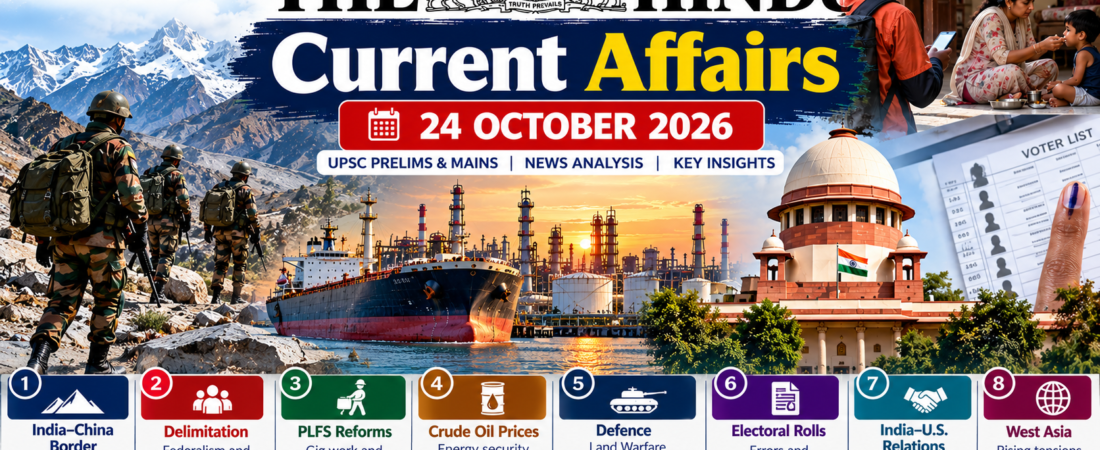
India’s policy challenges increasingly require an understanding of how constitutional principles, economic pressures, national security and international developments interact. The The Hindu Delhi edition of 24 October 2026 highlights several important issues, including proposed reforms to labour statistics, delimitation and federalism, India–U.S. relations, crude oil prices, border security and electoral-roll integrity.
This article provides a comprehensive, UPSC-oriented analysis of the major developments, explains their relevance to the examination syllabus, and concludes with Prelims revision points and Mains practice questions.
Table of Contents
- India–China relations and the Line of Actual Control
- Delimitation, federalism and parliamentary representation
- Labour statistics: measuring gig work and unpaid labour
- Crude oil prices and India’s energy security
- Defence preparedness and the Land Warfare Doctrine
- Electoral rolls and democratic integrity
- India–U.S. relations after Marco Rubio’s visit
- West Asia: regional security and the safety of Indian nationals
- Proposed changes to driving licence rules
- Urban sanitation and the right to life
- Cyber fraud and mule bank accounts
- Starlink, satellite internet and national security
- Other important international developments
- Economy and business updates
- Editorial analysis and broader implications
- UPSC Prelims revision
- UPSC Mains practice questions
- Conclusion
1. India–China relations: the Line of Actual Control remains a concern
The newspaper reported that the Ministry of External Affairs (MEA) had described the situation along the Line of Actual Control (LAC) as disturbed in the context of Chinese military behaviour and patrolling patterns. The report also referred to confrontations at several locations in Arunachal Pradesh.
India and China have continued to use diplomatic and military mechanisms to address outstanding border issues. However, differences in their perceptions of the LAC, military infrastructure and patrolling practices remain significant sources of tension.
1.1 Understanding the Line of Actual Control
The LAC is the de facto line separating areas controlled by India and China. Unlike an internationally agreed and fully demarcated boundary, it is characterised by differing perceptions of its alignment in some sectors.
These differing perceptions can lead to situations in which patrols from both countries enter areas claimed by the other. Such encounters can create tensions even when neither side intends to initiate a larger conflict.
1.2 Why border management remains difficult
Several factors complicate the management of the India–China border:
- Differing perceptions: The two countries do not agree on the alignment of the LAC in all sectors.
- Infrastructure development: Roads, bridges, airfields and logistics facilities affect the speed at which forces can be deployed.
- Patrolling patterns: Overlapping claims can produce face-offs between patrols.
- Strategic mistrust: Wider geopolitical competition influences bilateral relations.
- Escalation risks: A local confrontation can have consequences beyond the immediate location.
1.3 The way forward
India needs a combination of military preparedness and sustained diplomatic engagement. Effective communication mechanisms, adherence to existing agreements, clear procedures for handling face-offs and efforts to prevent local incidents from escalating remain important.
Border infrastructure and operational preparedness must be developed alongside confidence-building measures. Neither diplomatic dialogue alone nor military preparedness in isolation is sufficient to manage a complex boundary dispute.
UPSC relevance
- Prelims: LAC, ITBP, India–China border mechanisms and agreements.
- Mains GS Paper II: India and its neighbourhood; bilateral relations.
- Mains GS Paper III: Border management, national security and infrastructure.
2. Delimitation: federalism, population and parliamentary representation
The newspaper’s editorial analysis examined the political and constitutional implications of delimitation, including the debate over increasing the size of the Lok Sabha and distributing seats among States.
The central issue is how to balance population-based representation with the need to maintain federal confidence in the representative system. Delimitation is therefore not merely an administrative exercise involving the redrawing of constituency boundaries.
2.1 What is delimitation?
Delimitation refers to the process of determining the boundaries of electoral constituencies and, where applicable, the allocation of seats among territorial units.
Its objectives include:
- Ensuring that constituencies have reasonably comparable populations, subject to the applicable constitutional framework.
- Adjusting representation to demographic changes when constitutionally permitted.
- Redrawing constituency boundaries to reflect changes in population distribution.
- Maintaining the functioning and legitimacy of representative institutions.
The relevant constitutional provisions and legal framework determine when and how delimitation can take place.
2.2 The population-stabilisation question
One of the key issues in the debate is the relationship between population growth and political representation.
States that have experienced faster population growth may argue for representation reflecting their population. States that have invested in population stabilisation may be concerned that their relative share of parliamentary seats could decline if representation is redistributed substantially on the basis of population.
This creates a policy dilemma: how can the democratic principle of population-based representation be reconciled with the federal interest in ensuring that States do not perceive themselves as being penalised for successful social and demographic policies?
2.3 Delimitation and women’s reservation
The delimitation debate is also connected to the implementation of women’s reservation in legislative bodies. However, the two issues should not be treated as identical.
Women’s reservation concerns the representation of women within legislatures. Delimitation concerns the allocation of seats and the boundaries of constituencies. The precise relationship between these processes depends on the applicable constitutional provisions and implementation framework.
2.4 Constitutional and federal implications
Any major change in parliamentary representation should be examined through the principles of:
- Democratic equality.
- Federal balance.
- Constitutional procedure.
- Transparency and public consultation.
- Fair representation of regional interests.
The newspaper’s editorial also discussed political consequences for major parties. Such discussion represents political analysis; it should not be confused with a formally adopted government decision on the final delimitation framework.
UPSC relevance
- Prelims: Delimitation Commission, Parliament, constitutional amendments and women’s reservation.
- Mains GS Paper II: Parliament, federalism, constitutional institutions and electoral representation.
3. Labour statistics: measuring gig work and unpaid labour
The Union government has proposed changes to the Periodic Labour Force Survey (PLFS) to improve the measurement of digital platform work, unpaid household activities, caregiving, volunteer work and trainee work.
According to the newspaper, the National Sample Survey Office (NSSO), under the Ministry of Statistics and Programme Implementation (MoSPI), proposed modifications to the sampling design from January 2027. The Ministry invited comments and suggestions from policymakers, researchers, academic institutions and the public.
3.1 Why is the PLFS being revised?
The PLFS is an important source of information on employment and unemployment in India. Its findings help policymakers understand labour-force participation, employment patterns and changes in the labour market.
The proposed changes aim to improve the survey’s coverage of activities that may not be adequately captured by conventional employment measures.
The areas identified include:
- Digital platform work.
- Unpaid household work.
- Caregiving activities.
- Volunteer work.
- Trainee work.
- Own-use production of goods.
- Labour underutilisation.
The proposed sampling design would introduce a separate stratum to identify households with at least one digital platform worker.
3.2 The growing importance of gig work
Digital platforms have changed the way services are organised and delivered. Delivery workers, platform-based drivers and other service providers may receive work through digital applications rather than conventional employer-based arrangements.
Accurate data on such workers can help policymakers understand the scale and characteristics of platform employment.
Important policy questions include:
- How many people depend on platform work for their primary income?
- How many engage in it as a secondary activity?
- What are their working hours and income patterns?
- What forms of social protection are available to them?
- How does platform work affect conventional employment relationships?
Improved statistical coverage can help inform employment policy and social-security discussions.
3.3 Unpaid household work and caregiving
The proposed revisions also seek to capture unpaid household and caregiving activities more effectively.
Cooking, cleaning, childcare and caring for older people or persons with disabilities contribute to household welfare. These activities can also enable other household members to participate in paid employment.
However, unpaid household work may not appear in conventional employment statistics in the same way as paid work. Its limited visibility can affect how policymakers understand women’s economic contribution and the distribution of work within households.

Suggested in-article image: A digital platform worker in an Indian urban setting. Use an appropriately licensed photograph or the generated editorial illustration prepared for this article.
3.4 Why better measurement matters
More comprehensive labour data can improve:
- Employment policy: Better estimates of platform work and labour underutilisation.
- Gender analysis: Greater visibility of unpaid household and caregiving activities.
- Social protection: A stronger evidence base for assessing workers’ needs.
- Economic analysis: Better understanding of how households allocate time between paid and unpaid activities.
- Policy evaluation: More reliable data for assessing changes in the labour market.
Nevertheless, different types of activity must remain clearly distinguished. Unpaid caregiving, platform work and formal wage employment have different economic characteristics and should not be treated as interchangeable categories.
UPSC relevance
- Prelims: PLFS, NSSO, MoSPI and labour-force indicators.
- Mains GS Paper I: Women’s role in society.
- Mains GS Paper III: Employment, inclusive growth and labour-market data.
4. Crude oil prices: implications for India’s economy and energy security
The newspaper reported that international crude oil prices rose following renewed Houthi attacks on Saudi Arabian civilian and energy infrastructure.
At the time of reporting on Friday, Brent crude futures for December delivery reached an intraday high of $117.42 per barrel, while West Texas Intermediate (WTI) rose to $103.09 per barrel. The report put India’s crude oil basket at an average of $119.99 per barrel on Friday and $120.08 per barrel for the month so far.
These are the prices reported at the time of publication, not live market quotations.
4.1 Why geopolitical tensions affect oil prices
Oil markets respond not only to actual supply disruptions but also to the risk of future disruptions. Attacks on energy infrastructure, threats to shipping routes and uncertainty surrounding regional security can increase the risk premium attached to crude oil.
When buyers anticipate tighter supply or higher transportation costs, international prices can rise even before the full effect of a disruption is reflected in physical supply.
4.2 How higher oil prices affect India
India’s exposure to international oil prices has several dimensions.
1. Import expenditure
Higher international prices raise the cost of crude imports, assuming other factors remain unchanged. This can increase pressure on India’s external balance.
2. Inflation
Higher energy costs can affect transport, manufacturing and distribution. These costs may eventually feed into prices paid by households and businesses.
3. Fiscal pressures
When fuel prices paid by consumers do not rise in line with international input costs, the financial burden may fall on oil-sector companies or public finances, depending on the policy response.
4. Industrial production
Industries that depend heavily on energy or transport may face higher operating costs. The effect varies across sectors depending on their ability to absorb or pass on the increase.
5. Exchange-rate and external-sector pressures
A higher oil import bill can affect the trade balance and current account. The broader effect depends on export performance, capital flows, exchange rates and other external transactions.
4.3 The significance of shipping costs
The newspaper also reported that oil companies were facing volatility in crude sourcing and freight costs. Purchases on a delivered basis can transfer certain shipping costs and risks to the seller until the oil reaches the buyer’s port or facility.
However, the final landed cost still depends on contractual terms, freight rates, premiums, discounts and other commercial conditions. A headline crude benchmark alone does not fully describe the cost incurred by an individual refinery.
4.4 Policy options for India
India can strengthen energy security through:
- Diversification of crude oil suppliers.
- Adequate strategic petroleum reserves.
- Improved energy efficiency.
- Expansion of viable domestic and renewable energy sources.
- More resilient supply chains.
- Careful management of the fiscal consequences of price shocks.
Energy diversification should be assessed in terms of cost, reliability, environmental impact and strategic risk. Complete self-sufficiency is not necessarily the least-cost option, but excessive dependence on vulnerable supply routes can create significant economic risks.

Suggested in-article image: An oil tanker at an industrial port, illustrating India’s exposure to global crude oil markets.
UPSC relevance
- Prelims: Brent crude, WTI, the Indian crude oil basket and the current account.
- Mains GS Paper III: Energy security, inflation, external-sector vulnerability and energy transition.
5. Defence preparedness: the Land Warfare Doctrine
The newspaper reported that Defence Minister Rajnath Singh called for a long-term strategic vision covering the next 20–30 years while addressing the Army Commanders’ Conference.
He released the Land Warfare Doctrine, described in the report as an overarching framework for preparing the Army for the evolving character of warfare and future conflicts.
The Defence Minister also stressed that land operations and ground forces would remain indispensable despite the growing importance of air, maritime, space and cyber domains.
5.1 Why a long-term military vision is necessary
Military preparedness cannot be limited to responding to immediate threats. Defence planning also requires decisions about equipment, training, logistics, doctrine, personnel and technology over extended periods.
A long-term vision helps the armed forces anticipate changes in the character of warfare while maintaining the capacity to respond to unexpected developments.
5.2 The changing character of warfare
Modern conflicts increasingly involve multiple operational domains:
- Land: Ground forces, territorial control and logistics.
- Air: Air superiority, surveillance and precision strike capabilities.
- Maritime: Sea-lane security and naval operations.
- Space: Satellite communications, navigation and surveillance.
- Cyber: Protection of networks and disruption of adversary systems.
The significance of these domains does not eliminate the importance of land forces. Instead, it increases the need for coordination among different capabilities.
5.3 Implications for India
India’s security environment requires defence preparedness that combines conventional military capabilities with technological adaptation, intelligence, logistics and inter-service coordination.
The newspaper also reported the Defence Minister’s emphasis on preparedness and operational adaptation in the context of Operation Sindoor. The article’s reporting of official remarks should be distinguished from independent assessments of operational outcomes.
UPSC relevance
- Prelims: Indian Army, Land Warfare Doctrine and multidomain operations.
- Mains GS Paper III: Defence modernisation, security preparedness and emerging technologies in warfare.
6. Electoral rolls: accuracy, inclusion and democratic legitimacy
The newspaper reported discrepancies in the voter list for the Allahabad Graduates’ constituency ahead of Uttar Pradesh Legislative Council elections. The State Chief Electoral Officer sought explanations from the officials concerned after unusual names and details appeared in the electoral roll.
The report cited 158 entries considered unusual among 14,81,310 entries. The State’s explanation referred to possible software errors in transliterating names from English into Hindi, along with human error or negligence.
The newspaper also reported continuing criticism of the Special Intensive Revision (SIR) of electoral rolls in other States.
These reports concern different circumstances and should not automatically be interpreted as proof of a single nationwide pattern of intentional manipulation.
6.1 Why accurate electoral rolls matter
Electoral rolls form the administrative foundation of elections. If eligible citizens are wrongly excluded, their ability to exercise the right to vote is affected. If inaccurate or duplicate entries remain, confidence in the integrity of the electoral process may be weakened.
The central challenge is to maintain both accuracy and inclusion.
6.2 Common sources of electoral-roll errors
Errors may arise from:
- Incorrect data entry.
- Software or transliteration problems.
- Incomplete or outdated records.
- Duplicate entries.
- Failure to update addresses after migration.
- Inadequate verification.
- Difficulties in accessing correction procedures.
The existence of an error does not, by itself, establish deliberate wrongdoing. Investigations must distinguish accidental mistakes, administrative negligence and intentional manipulation.
6.3 Measures to strengthen electoral integrity
Authorities can improve electoral-roll management through transparent procedures, reliable software, clear accountability and accessible correction mechanisms.
Important measures include:
- Regular verification and updating of entries.
- Clear public explanations of draft and final rolls.
- Accessible procedures for correction and appeal.
- Accountability for negligent processing.
- Independent scrutiny of credible complaints.
- Protection against the wrongful exclusion of eligible voters.
The goal should be to protect both the accuracy of the roll and citizens’ ability to participate in elections.
UPSC relevance
- Prelims: Election Commission of India, electoral registration and election administration.
- Mains GS Paper II: Electoral reforms, democratic participation and institutional accountability.
7. India–U.S. relations after Marco Rubio’s visit
The newspaper’s editorial examined U.S. Secretary of State Marco Rubio’s three-day visit to India. It noted that expectations of a reset in bilateral relations remained high, but the two sides did not announce agreements during the visit.
The editorial identified several unresolved issues, including trade, tariffs, H-1B restrictions, immigration measures, Russian oil imports and differences in the countries’ regional and strategic positions.
The visit also provided an opportunity to discuss Gulf security and energy connectivity.
7.1 Areas of convergence
India and the United States have overlapping interests in several areas:
- Defence and security cooperation.
- Technology and innovation.
- Trade and investment.
- Maritime security.
- Indo-Pacific stability.
- Cooperation in selected multilateral forums.
These areas create incentives for sustained engagement, even when disagreements remain.
7.2 Areas of friction
The newspaper’s editorial highlighted the difficulties arising from tariffs, migration-related restrictions, energy policy and differences in the two countries’ interpretations of regional developments.
The relationship therefore cannot be assessed solely through diplomatic statements. Its direction also depends on whether discussions translate into agreements and practical cooperation.
7.3 Strategic autonomy
India’s approach involves cooperating with the United States where interests converge while preserving the ability to make independent decisions on issues such as energy sourcing and relations with other major powers.
Strategic autonomy does not require avoiding partnerships. Rather, it involves managing partnerships without allowing any single relationship to eliminate India’s policy flexibility.
UPSC relevance
- Prelims: India–U.S. relations, the Quad and bilateral cooperation.
- Mains GS Paper II: Strategic autonomy, bilateral relations and the changing international order.
8. West Asia: regional insecurity and the safety of Indian nationals
The newspaper reported continuing security concerns following Houthi attacks on Saudi Arabian infrastructure. It reported that an Indian national was killed in the attack on Dammam airport and discussed the broader risks to Indians in the region.
The report also stated that IndiGo extended flight suspensions to and from Saudi Arabia. According to the Indian Embassy in Riyadh, flights to and from Riyadh were cancelled until 31 October 2026, inclusive, while flights to and from Jeddah, Dammam and Madinah were cancelled until 27 October, inclusive, as reported on Friday.
These dates reflect the newspaper’s report and should not be treated as confirmation of present flight status.
8.1 Why the region matters to India
West Asia is important to India for several reasons:
- Energy imports and energy security.
- Employment and livelihoods of Indian expatriates.
- Trade, investment and maritime connectivity.
- Religious travel and pilgrimage.
- Regional stability and the safety of civilians.
Conflict can affect these interests simultaneously.
8.2 Protecting Indian citizens abroad
India’s response to regional insecurity includes consular assistance, communication with local authorities, coordination with airlines and contingency planning for the safe return of citizens where necessary.
The scale and urgency of the response depend on the nature of the threat, the location of Indian nationals and the availability of safe transport.
8.3 Energy security and regional diplomacy
The safety of energy infrastructure and shipping routes has direct implications for India’s economic stability. Diplomatic engagement with regional countries, efforts to prevent escalation and diversification of energy supplies are therefore important elements of India’s West Asia policy.
UPSC relevance
- Prelims: West Asian geography, Yemen, Saudi Arabia and maritime routes.
- Mains GS Paper II: Indian diaspora, foreign policy and regional diplomacy.
- Mains GS Paper III: Energy security and external economic vulnerability.
9. Proposed driving licence rules: road safety and digital governance
The newspaper reported draft amendments to the Central Motor Vehicles Rules, 1989. The proposals included raising the pass mark for the preliminary learner’s test from 60% to 75%, requiring a safe-driving tutorial of at least 30 minutes and allowing more time to complete the learner’s licence process.
The draft also proposed changes to documentation requirements and the consolidation of certain licence-related applications through a new form. Some changes to recorded personal details were proposed to be made free of charge.
These are proposed amendments, not automatically applicable rules. Their final form depends on the relevant government process.
9.1 Road safety and driver competence
A learner’s licence is intended to establish that an applicant has a basic understanding of traffic rules and safe driving. A more rigorous test may improve screening, but its effectiveness depends on the quality of the assessment and the availability of adequate driver education.
Road safety also requires effective enforcement, safe road design, vehicle standards and responsible behaviour by all road users.
9.2 Digital services and accessibility
Digitising licence-related services can reduce paperwork, improve convenience and make applications easier to track. However, digital systems must remain accessible to applicants with limited internet access or digital literacy.
Clear procedures, data protection and accessible grievance mechanisms are important to ensuring that digitisation improves public service delivery rather than creating new barriers.
UPSC relevance
- Prelims: Central Motor Vehicles Rules and road-safety governance.
- Mains GS Paper II: E-governance and service delivery.
- Mains GS Paper III: Road safety and public infrastructure.
10. Urban sanitation and the right to life
The newspaper reported that the Delhi High Court proposed surprise inspections of public toilets across the Municipal Corporation of Delhi area by students from social-work institutions. The proposed inspections would examine hygiene and structural conditions.
The court observed that access to hygienic public toilets forms part of the right to life and emphasised the responsibility of civic authorities to maintain such facilities.
10.1 Why sanitation is a governance issue
Urban sanitation is closely connected to public health, dignity, environmental quality and inclusive urban planning.
Constructing public toilets is only one part of the task. Their usefulness depends on water availability, cleanliness, accessibility, maintenance and safe management of waste.
10.2 Accountability and public participation
Independent inspections and community participation can help identify gaps in service delivery. However, monitoring should lead to clear corrective action, defined maintenance responsibilities and follow-up inspections.
Urban local bodies must ensure that sanitation facilities are not merely created but remain usable and safe.
UPSC relevance
- Prelims: Article 21 and urban local bodies.
- Mains GS Paper II: Fundamental rights and local governance.
- Mains GS Paper I: Urbanisation and its associated challenges.
11. Cyber fraud: suspected mule bank accounts and KYC misuse
Delhi Police reported the dismantling of a suspected cyber-fraud network involving 37 suspected mule bank accounts. According to the newspaper, the accounts had received ₹7.36 crore in connection with 99 complaints registered across India. Six people, including five bank employees, were reported arrested.
Police alleged that forged signatures and KYC documents obtained from daily-wage workers had been used to facilitate fraudulent account openings. A portion of the proceeds was allegedly converted into cryptocurrency.
These are allegations reported in the context of an ongoing investigation. Arrest does not establish guilt.
11.1 What is a mule account?
A mule account is a bank account used to receive, transfer or conceal proceeds of fraud or other illicit activity.
Criminal networks may exploit identity documents, recruit account holders through deceptive offers or use personal information obtained under false pretences.
11.2 Why mule accounts are difficult to investigate
Fraudulent transactions can pass through multiple accounts, payment services and jurisdictions. The person whose name appears on an account may not always be the individual controlling the transactions.
Investigators therefore need to establish the relationship between account holders, those controlling the accounts and the movement of funds.
11.3 Measures to prevent financial fraud
Important safeguards include:
- Robust customer verification.
- Effective monitoring of suspicious transactions.
- Internal controls within banks.
- Prompt reporting of suspicious activity.
- Coordination between banks and law-enforcement agencies.
- Public awareness about sharing identity documents and financial credentials.
Customers should avoid sharing OTPs, PINs and passwords and should be cautious about providing KYC documents in response to unsolicited loan or employment offers.
UPSC relevance
- Prelims: KYC, financial fraud and cryptocurrency.
- Mains GS Paper III: Cybercrime, financial-system integrity and internal security.
12. Starlink and satellite internet: connectivity, regulation and national security
The newspaper reported that the Swadeshi Jagaran Manch urged the Union government to deny operating permissions to SpaceX’s Starlink satellite internet service, citing national-security concerns. The report also stated that the government had not approved spectrum-allotment requests from three companies.
The demand made by the organisation should not be confused with a final government decision.
12.1 The potential of satellite internet
Satellite-based connectivity can help extend internet access to remote and underserved areas where conventional terrestrial infrastructure is difficult or expensive to deploy.
It may be relevant for remote communities, emergency communications and locations where conventional networks are limited.
12.2 Regulatory challenges
Satellite internet raises questions involving:
- Spectrum allocation and interference management.
- Licensing and regulatory compliance.
- National security.
- Data protection and lawful access.
- Competition with terrestrial service providers.
- Affordability and rural connectivity.
12.3 Balancing connectivity and security
A sound regulatory framework should evaluate security risks alongside consumer interests, innovation, investment and access to reliable connectivity.
Decisions should be based on applicable laws, technical assessments and transparent regulatory procedures rather than treating either technological innovation or security concerns as automatically decisive.
UPSC relevance
- Prelims: Satellite communications, spectrum and telecommunications regulation.
- Mains GS Paper III: Space technology, digital infrastructure and national security.
13. Other important international developments
13.1 China and the western Pacific
The newspaper reported Taiwan’s concern that China was combining militia vessels with coast guard ships to expand its operational reach around Taiwan and into the western Pacific. Taiwan said these operations were also placing pressure on Japan and the Philippines.
Significance: The report highlights the importance of maritime security, the Taiwan Strait and the strategic balance in the western Pacific.
UPSC relevance: GS Paper II — international relations and regional security.
13.2 Russia–Ukraine conflict: a reported local ceasefire
The newspaper reported a temporary ceasefire arrangement for the Ukrainian city of Oleshky, announced by the White House as intended to allow humanitarian aid to enter from 29 October.
The reported arrangement was limited to a particular city and humanitarian purpose. It should not be interpreted as a comprehensive settlement of the Russia–Ukraine conflict.
Significance: Local ceasefires may provide opportunities for humanitarian assistance, but their implementation depends on the parties’ compliance and the security conditions on the ground.
UPSC relevance: GS Paper II — international conflicts, humanitarian assistance and global diplomacy.
13.3 Brazil: voting access for indigenous people
A court in Brazil’s Pará state ordered the government to ensure that indigenous people could vote in the presidential runoff. The case concerned allegations that local authorities and landowners had obstructed access to voting.
Significance: The report illustrates that formal voting rights may be insufficient without practical access to polling facilities and protection against coercion.
UPSC relevance: GS Paper II — democracy, political participation and electoral rights.
13.4 Greece: proposed restrictions on social media use by children
The newspaper reported that Greece’s Parliament passed legislation banning children under 15 from social media, with the measure scheduled to take effect on 1 January. The report stated that the law would require age verification and impose penalties on companies that failed to comply.
Significance: The development raises questions about child protection, online privacy, age verification, digital platforms and freedom of expression.
The policy illustrates the challenge of protecting children online while ensuring that regulatory measures are proportionate and technically workable.
UPSC relevance: GS Paper II — governance and rights; GS Paper III — information technology and cybersecurity.
14. Economy and business: important developments
14.1 Bharat Petroleum Corporation Ltd.: quarterly profit declines
The newspaper reported that Bharat Petroleum Corporation Ltd. (BPCL) recorded a 22.5% year-on-year decline in standalone net profit for the September quarter.
Its profit fell to ₹4,993.17 crore from ₹6,442.5 crore in the corresponding quarter of the previous year. The company’s cost of materials consumed rose 44.2% to ₹74,969 crore.
The report linked pressure on performance to volatile crude oil prices amid renewed conflict in West Asia.
Economic significance: Refining-company performance depends on crude procurement costs, refining margins, inventory effects and the prices at which petroleum products are sold. A change in crude prices does not necessarily translate into an identical change in profits.
14.2 IndusInd Bank: improvement in quarterly performance
IndusInd Bank reported a net profit of ₹1,242 crore for the September quarter, up 20% sequentially. The report contrasted this with the loss recorded in the corresponding quarter of the previous year, when microfinance-related provisions and write-offs had affected performance.
The bank’s net interest income stood at ₹4,569 crore, compared with ₹4,409 crore a year earlier.
Economic significance: Bank performance should be assessed through several indicators, including net interest income, asset quality, provisioning, credit growth and profitability. A single quarterly result is not sufficient to establish the long-term health of a bank.
14.3 Dr. Reddy’s Laboratories: lower quarterly profit
Dr. Reddy’s Laboratories reported consolidated net profit of ₹913.2 crore, down more than 31% year-on-year from ₹1,336.8 crore. The newspaper attributed the decline to lower global generics revenue, particularly a sharp fall in the North American market.
Revenue from operations stood at ₹8,697.8 crore, compared with ₹8,828.3 crore a year earlier.
Economic significance: Pharmaceutical-company performance can be influenced by regional market conditions, product mix, competition, pricing and regulatory requirements. Lower profitability at one company should not automatically be interpreted as evidence of a decline across the entire pharmaceutical sector.
14.4 Crude sourcing and shipping costs
The newspaper also reported that Hindustan Petroleum Corporation Ltd. (HPCL) described crude sourcing as volatile and unpredictable. The company discussed the use of delivered purchases and the impact of higher freight costs.
The report noted that shipping costs on a Suezmax tanker had risen to around $9 per barrel in the second quarter, from approximately $4 per barrel in June, according to company executives.
It also reported under-recoveries on LPG of ₹245 per cylinder in October, with a projection of ₹327 in November.
These figures are reported company statements and estimates; they should not be treated as universal costs across all shipments or as a final assessment of the government’s total fiscal exposure.
UPSC relevance for Section 14
- Prelims: Public-sector oil companies, banking indicators and quarterly corporate results.
- Mains GS Paper III: Energy economics, inflation, industrial performance and financial-sector resilience.
15. Editorial analysis: broader implications for public policy
15.1 India–U.S. relations: diplomacy must deliver practical outcomes
The editorial on Marco Rubio’s visit highlights the difference between positive diplomatic statements and concrete agreements. Trade, tariffs, migration, energy and strategic interests remain important areas of negotiation.
India’s policy challenge is to deepen cooperation where interests converge while preserving the flexibility to make independent decisions.
15.2 Delimitation: constitutional legitimacy and federal confidence
The delimitation debate highlights the need to reconcile population-based representation with the federal interests of States. Any major change should be assessed through the constitutional framework, the applicable census basis and the process through which proposals are developed.
The issue also demonstrates why transparent public deliberation matters when changes could affect the distribution of political representation.
15.3 Labour statistics: data shape the policy response
The proposed PLFS revisions underline the importance of measuring platform work, unpaid caregiving and labour underutilisation more comprehensively.
Better data can support more informed employment and social-protection policies. However, statistical categories must remain conceptually clear so that different forms of work are measured accurately.
15.4 Energy security: economic resilience requires diversification
Higher crude prices illustrate the links between geopolitical instability, energy costs and domestic economic conditions.
India’s response requires diversified sourcing, efficient energy use, adequate reserves and a carefully managed transition towards cleaner energy. The objective is not simply to obtain the lowest price in the short term but to improve resilience against supply and price shocks.
15.5 Electoral integrity: accuracy and inclusion must go together
Electoral-roll management must protect both the accuracy of the register and the participation of eligible voters. Software quality, verification procedures, accountability and accessible correction mechanisms are essential to public confidence.
Errors should be investigated carefully and classified according to evidence, rather than treating every discrepancy as proof of intentional manipulation.
16. UPSC Prelims revision: key facts
| Topic | Key fact |
|---|---|
| PLFS | Periodic Labour Force Survey, a major source of labour-market statistics |
| NSSO | National Sample Survey Office under MoSPI |
| PLFS revisions | Proposed sampling-design changes from January 2027 |
| Digital platform work | A separate sampling stratum is proposed to improve coverage |
| Unpaid work | Proposed survey questions cover household activities, caregiving, volunteer work and trainee work |
| LAC | Line of Actual Control between India and China |
| Land Warfare Doctrine | Framework for preparing the Army for the changing character of warfare |
| Delimitation | Determination of electoral constituency boundaries and, where applicable, seat allocation |
| Brent crude | International oil-price benchmark |
| WTI | West Texas Intermediate, a major crude oil benchmark |
| Indian crude oil basket | Measure reflecting the mix of crude oils imported by India |
| KYC | Know Your Customer procedures for customer identification and verification |
| Mule account | A bank account used to receive or transfer proceeds of illicit activity |
| Satellite internet | Raises issues involving spectrum, licensing, connectivity and national security |
| Article 21 | Protection of life and personal liberty; relevant judicial interpretation may include conditions necessary for dignified living |
17. UPSC Mains practice questions
17.1 GS Paper II — Federalism and representation
“Delimitation involves a difficult balance between population-based representation and the preservation of federal confidence.” Discuss.
17.2 GS Paper II — India–U.S. relations
Examine the principal areas of convergence and friction in India–U.S. relations. How can India preserve strategic autonomy while deepening cooperation?
17.3 GS Paper III — Employment and statistics
How can improved measurement of gig work and unpaid household activities strengthen employment policy in India? Discuss the limitations of conventional labour-market indicators.
17.4 GS Paper III — Energy security
Analyse the channels through which a rise in international crude oil prices affects the Indian economy. Suggest measures to reduce India’s vulnerability to external energy shocks.
17.5 GS Paper II — Electoral reforms
Why is the accuracy of electoral rolls essential to democratic legitimacy? Discuss the safeguards required to prevent both wrongful inclusion and wrongful exclusion of voters.
17.6 GS Paper III — Defence preparedness
Modern warfare increasingly spans land, air, sea, space and cyber domains. Explain why an integrated approach is necessary for India’s defence preparedness.
17.7 GS Paper III — Cybersecurity
Explain how mule accounts facilitate cyber fraud. Discuss the roles of banks, regulators and law-enforcement agencies in preventing financial crime.
17.8 GS Paper II — Diaspora protection
What challenges does regional instability in West Asia pose for India’s expatriate population and energy security? Examine the instruments available to Indian diplomacy.
17.9 GS Paper II — E-governance
Digitisation can improve the efficiency of public services but may also create barriers for some citizens. Discuss with reference to proposed changes in driving licence services.
17.10 GS Paper III — Economic vulnerability
Explain how geopolitical tensions can transmit external shocks to the Indian economy through energy prices, transport costs and the current account.
18. Conclusion
The developments reported on 24 October 2026 demonstrate how domestic governance, constitutional principles, national security and international economic conditions intersect.
The proposed labour-survey reforms raise questions about how India measures employment and unpaid work. The delimitation debate highlights the importance of representation and federal balance. Rising crude oil prices show how regional conflict can affect inflation and economic resilience. Border developments, defence preparedness and electoral-roll disputes underline the importance of effective institutions and public confidence.
For UPSC aspirants, the objective is not merely to memorise individual news reports. It is to identify the underlying institutions, constitutional principles, economic mechanisms and policy choices that explain why these developments matter.