
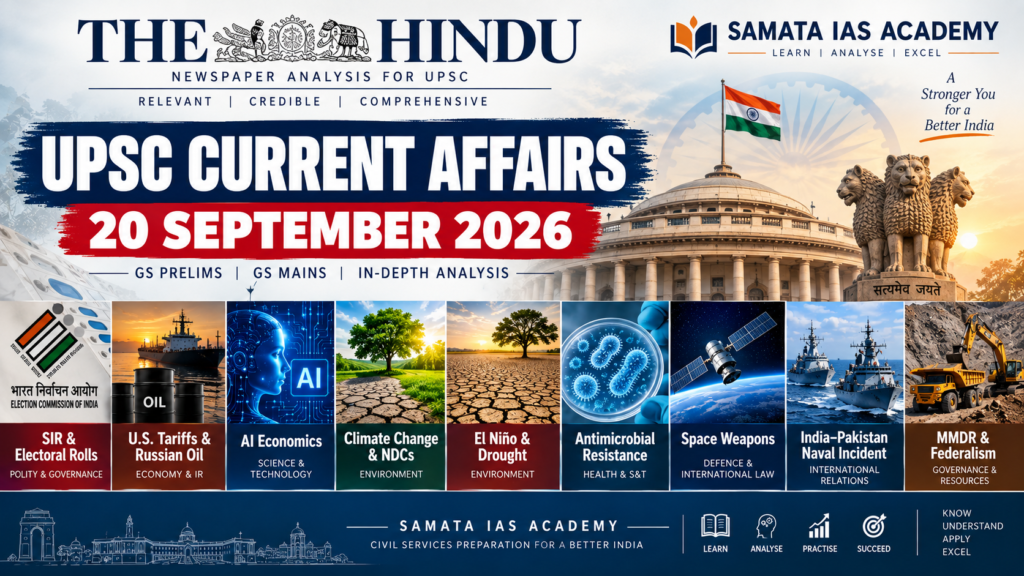
Important News Compilation for UPSC CSE
🏛️ GS-II — POLITY & GOVERNANCE
1. Special Intensive Revision: Over 22 lakh Bengal voters appeal against exclusion
The Election Commission has informed the Supreme Court that 22,21,118 voters excluded during the Special Intensive Revision (SIR) in West Bengal have filed appeals.
According to the EC’s affidavit:
- Around 27 lakh voters were excluded at the draft stage on grounds described as “logical discrepancies”.
- 16.10 lakh appeals were filed against inclusion-related issues.
- Total appeals before the 19 tribunals: 38.31 lakh.
- The tribunals had disposed of 1,26,194 appeals by September.
- More than 37 lakh appeals remained pending.
- The EC indicated that the number of appellate tribunals could be increased.
UPSC relevance:
Electoral rolls → Election Commission → Article 324 → voter eligibility → electoral registration → judicial oversight → due process.
Mains angle:
How can electoral-roll purification be balanced with the protection of universal adult suffrage and procedural fairness?
2. Delhi SIR: 33.1 lakh electors flagged for notices
The Delhi Chief Electoral Officer has published a list of 33.1 lakh electors flagged because of either:
- logical discrepancies, or
- lack of mapping with earlier electoral rolls.
The newspaper reports that around 19.3 lakh Delhi electors were flagged for logical discrepancies, while more than 13.79 lakh were marked as unmapped.
The final electoral roll is scheduled to be published on November 4, after verification and disposal of claims.
The article also highlights difficulties faced by economically vulnerable citizens in producing documentary evidence.
Important concept:
The issue raises questions concerning the relationship between electoral integrity, citizenship documentation, administrative capacity and accessibility of democratic institutions.
3. Supreme Court: Prohibition is not a complete solution to alcoholism
The Supreme Court, while examining provisions relating to alcohol regulation, observed that prohibition by itself may push liquor trade underground and increase the prevalence of unregulated and potentially lethal brews.
The Court referred to the experience of Gujarat and recent hooch tragedies.
It also discussed problems such as:
- illegal distillation,
- methanol diversion,
- corruption,
- loss of tax revenue,
- underground liquor markets,
- weak enforcement.
The Court suggested stronger monitoring of industrial units dealing with chemical solvents and better controls over methanol transportation.
UPSC relevance:
State List → public health → excise → prohibition → illicit economy → cooperative governance.
Mains question:
Is prohibition an effective public-health strategy against alcoholism? Discuss with reference to enforcement challenges and illicit markets.
4. Mines and Minerals (Development and Regulation) Amendment — Jharkhand raises federalism concerns
Jharkhand has witnessed protests against recent amendments to the MMDR Act.
The State government has argued that the amendments restrict the State’s ability to levy taxes or cess associated with mineral-bearing land.
The State Finance Minister claimed that Jharkhand could face a substantial revenue loss and sought restoration of greater State authority.
The issue is important because mineral resources and taxation involve the constitutional distribution of powers between the Union and States.
Prelims focus:
- MMDR Act
- Mineral rights
- Union–State relations
- State taxation powers
- Seventh Schedule
- Fiscal federalism
Mains angle:
Mineral-rich States often face a tension between resource sovereignty, national mineral policy and fiscal federalism.
🌍 GS-III — ENVIRONMENT
5. India and the Paris Agreement: Climate targets and carbon sink
At an international conference organised by the National Green Tribunal, Prime Minister Narendra Modi said India’s per-capita carbon emissions remain below the global average and highlighted India’s progress in renewable and non-fossil energy.
The article also provides useful technical context.
India’s first Nationally Determined Contribution (NDC) contained three quantitative targets:
- Reduction in emissions intensity.
- Increasing the share of non-fossil electricity capacity.
- Creating an additional carbon sink of 2.5–3 billion tonnes of CO₂ equivalent by 2030 through additional forest and tree cover.
The newspaper reports that India’s April 2026 submission to the UN estimated the additional carbon sink created between 2005 and 2021 at 2.29 billion tonnes.
Important distinction
India’s climate commitments must be understood through:
Paris Agreement → NDCs → mitigation → adaptation → carbon sink → non-fossil capacity → climate finance
6. Maharashtra faces a drought-like situation despite the monsoon
The Maharashtra government has asked Ministers to prepare for a possible drought-like situation in several districts.
According to the IMD data cited by The Hindu:
- India had a 15% rainfall deficit between June 4 and September 19.
- The Southern Peninsula had a deficit of around 29%.
- Maharashtra was among the affected regions.
The State government has discussed:
- crop assessment,
- farmer assistance,
- drinking water,
- fodder,
- additional electricity supply,
- preparedness for possible El Niño-related impacts.
UPSC relevance:
El Niño → monsoon variability → agricultural output → rural income → food prices → irrigation → disaster management
7. Climate justice and Himalayan disasters
The Sikkim High Court has initiated a suo motu PIL concerning climate justice after taking note of the severe impact of recent flash floods in Nepal.
The Court has issued notices to relevant authorities including:
- Railway Ministry,
- National Highways and Infrastructure Development Corporation,
- Sikkim State Disaster Management Authority,
- State Power Department.
The case is significant for understanding climate vulnerability in the Himalayan region, where disasters can cross political boundaries and affect interconnected ecosystems and infrastructure.
💰 GS-III — ECONOMY
8. U.S. Sanctioning Russia and Iran Act: implications for India
This is one of the most important articles of today’s newspaper for UPSC.
The U.S. has enacted the Lindsey O. Graham Sanctioning Russia and Iran Act, 2026.
The legislation could allow the U.S. to impose tariffs of up to 100% on goods originating from countries that continue to import Russian oil under specified conditions.
This has direct implications for India because:
- India is among the major importers of Russian crude.
- Russian oil accounted for more than 51% of India’s crude-oil imports in July 2026, according to the article.
- India is simultaneously dealing with constraints in alternative energy supplies because of the situation around the Strait of Hormuz.
Possible consequences for India
If India continues Russian oil imports:
→ possible additional U.S. tariffs
→ pressure on Indian exports
→ reduced competitiveness
→ trade uncertainty
If India reduces Russian imports:
→ need to find alternative suppliers
→ potentially higher crude prices
→ higher import bill
→ possible pressure on domestic fuel prices
The law also contains a waiver provision, subject to specified conditions.
UPSC concepts
Energy security + strategic autonomy + sanctions + secondary sanctions + trade diplomacy + export competitiveness
This topic can easily become a GS-II + GS-III integrated Mains question.
9. Artificial Intelligence is becoming cheaper — but AI spending is rising
A fascinating Business-page analysis examines the changing economics of AI.
The cost of AI inference has fallen dramatically for many tasks, partly because of:
- open-weight models
- greater competition
- improved computing efficiency
- cheaper tokens
- availability of multiple models
But companies are simultaneously spending more on AI because they are using AI for increasingly complex tasks.
The article makes an important distinction:
Lower cost per token does not necessarily mean lower cost per task.
AI agents can perform multi-step activities involving:
Reasoning → tool calls → external systems → verification → revision → additional model calls
Therefore, measuring AI economics solely through token prices can be misleading.
UPSC relevance
AI → productivity → labour markets → computing infrastructure → open-source/open-weight models → digital economy → AI governance
10. Maharashtra uses AI to detect electricity theft
The Maharashtra State Electricity Distribution Company Limited (MSEDCL) has reportedly used an AI-based system to identify electricity theft.
The system combines:
- AI,
- machine learning,
- predictive analytics,
- field inspections.
The newspaper reports that the system helped identify 27,964 instances of suspected power theft worth ₹66.28 crore over three months, with criminal cases registered in 289 cases.
Broader significance:
AI is moving beyond chatbots into public administration and utility management.
Potential applications include:
- tax administration,
- electricity distribution,
- welfare targeting,
- fraud detection,
- traffic management,
- agricultural forecasting.
🔬 GS-III — SCIENCE & TECHNOLOGY
11. Fungus develops resistance to a human immunosuppressive drug
A particularly important scientific development concerns Pneumocystis jirovecii, a fungus that can cause severe pneumonia in immunocompromised patients.
Researchers found mutations associated with resistance to mycophenolic acid (MPA).
MPA is not intended as an antifungal drug. It is an immunosuppressive medicine used in organ-transplant patients.
The scientific significance lies in the possibility that a drug aimed at human cells can nevertheless create selective pressure on a pathogen, allowing resistant variants to emerge.
UPSC concept
This connects:
Antimicrobial resistance → evolutionary selection → immunocompromised patients → transplant medicine → public health
It also expands the conventional understanding of AMR beyond antibiotic resistance in bacteria.
12. Rattlesnake proteins may contribute to next-generation antivenom
Scientists have investigated FETUA proteins found in rattlesnake blood.
Laboratory experiments reportedly showed that combinations of these proteins could neutralise certain venom components and displayed substantially greater potency than conventional antivenom in mice.
The research may have implications for developing:
- recombinant antivenoms,
- scalable venom treatments,
- alternatives to animal-derived antibody production.
Prelims concept:
Snake venom → toxin classes → antivenom → recombinant biotechnology.
13. U.S. ‘space control’ weapons and the Outer Space Treaty
The newspaper’s FAQ examines reports that the U.S. has deployed space-control weapons.
The term can include:
- kinetic systems,
- electromagnetic systems,
- cyber capabilities,
- systems designed to disrupt or degrade satellite functions.
Outer Space Treaty — important
The 1967 Outer Space Treaty prohibits States from placing:
- nuclear weapons, or
- other weapons of mass destruction
in orbit or on celestial bodies.
However, the Treaty does not comprehensively prohibit conventional weapons in orbit.
This creates an important area of contemporary space-law debate.
UPSC relevance
Outer Space Treaty + militarisation of space + weaponisation of space + space debris + satellite security + international law
🌐 GS-II — INTERNATIONAL RELATIONS
14. India–Pakistan naval collision in the North Arabian Sea
An Indian Navy vessel, INS Kolkata, and Pakistan Navy vessel PNS Hunain collided in the North Arabian Sea on September 15.
India and Pakistan have presented different accounts of the incident.
India said the Pakistani vessel carried out a dangerous overtaking manoeuvre, while Pakistan disputed India’s account.
Article 10 of the 1991 India–Pakistan Agreement
The newspaper explains that the 1991 agreement requires naval ships and submarines of the two countries to maintain a separation of three nautical miles while operating in international waters.
The provision is intended to reduce the possibility of accidents and miscalculation.
UPSC relevance:
Confidence-Building Measures (CBMs) → maritime security → India–Pakistan relations → crisis management
15. Greenland, the Arctic and U.S.–Denmark security arrangements
The U.S., Denmark and Greenland have reportedly reached an understanding concerning an expanded U.S. military presence in Greenland.
The development is important because Greenland has growing strategic significance due to:
- Arctic geopolitics
- emerging maritime routes
- proximity to North America and Europe
- military positioning
- competition among major powers
- access to strategic resources
Denmark and Greenland have stressed that any agreement must respect Greenland’s sovereignty and territorial integrity.
UPSC relevance
Arctic geopolitics → NATO → maritime routes → climate change → strategic minerals → great-power competition
16. H-1B visa fee and Indian professionals
The U.S. administration has extended an executive order imposing a $100,000 fee on H-1B non-immigrant visas for another year.
The newspaper notes that Indians constitute the largest beneficiary group of the H-1B programme.
The issue is significant for India because of the country’s large technology-services sector and the movement of skilled professionals between India and the United States.
Mains linkage:
Migration → skilled labour → services exports → technology sector → India–U.S. relations
17. AI-generated intelligence and national security
A report cited by the newspaper says that U.S. military officials came close to intercepting a Chinese vessel after intelligence produced with assistance from an AI chatbot incorrectly identified the cargo.
The report raises a much broader issue:
Can AI systems be safely incorporated into high-stakes national-security decision-making?
Important concerns include:
- hallucination,
- false positives,
- automation bias,
- lack of explainability,
- human oversight,
- accountability,
- escalation risks.
This is an excellent GS-III Science & Technology + GS-IV Ethics topic.
🧠 PRELIMS QUICK REVISION
| Topic | Remember |
|---|---|
| SIR | Special Intensive Revision of electoral rolls |
| Article 324 | Election Commission of India |
| MMDR Act | Regulation of mines and mineral development |
| NDC | Nationally Determined Contribution under Paris Agreement |
| Outer Space Treaty | 1967 |
| Space-control systems | Kinetic and non-kinetic counter-space capabilities |
| INS Kolkata | Kolkata-class guided missile destroyer |
| PNS Hunain | Pakistan Navy offshore patrol vessel |
| MPA | Mycophenolic acid, immunosuppressive drug |
| Pneumocystis jirovecii | Opportunistic fungus causing pneumonia |
| AI inference | Cost of running models to produce outputs |
| H-1B | U.S. temporary skilled-worker visa programme |
| Greenland | Autonomous territory within Kingdom of Denmark |
| El Niño | Pacific Ocean-atmosphere phenomenon affecting global climate |
🎯 MOST IMPORTANT TOPICS FOR TODAY
If we have to prioritise the day’s newspaper for serious UPSC preparation, I would structure the website article around these 10 core issues:
- West Bengal & Delhi SIR — Electoral Roll Integrity
- India’s Climate Commitments & Carbon Sink
- MMDR Amendment & Fiscal Federalism
- U.S. Sanctioning Russia and Iran Act — Impact on India
- AI Economics — Falling Costs, Rising Usage
- AI in Electricity Theft Detection
- Fungal Drug Resistance & AMR
- Space Weapons & Outer Space Treaty
- India–Pakistan Naval CBMs
- Arctic Geopolitics & Greenland
These give us a strong combination of GS-II, GS-III, International Relations, Science & Technology and Ethics, while avoiding routine crime, party statements and sports news.
The newspaper also contains several additional stories that can be used as one-line current-affairs facts, but I would not overload the main daily post with them. The attached edition itself supports the above themes across its national, business, science, FAQ and world pages.
Next, we should turn this compilation into the single publish-ready Samata IAS Academy website article, just as we did for September 19: title, introduction, detailed analysis, Prelims facts, Mains value addition, questions, SEO title, focus keyphrase, meta description, slug, category and tags.