
Introduction:
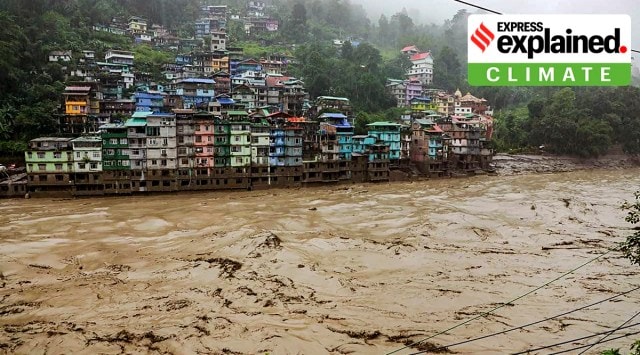
The recent glacial lake outburst flood (GLOF) in Sikkim has drawn attention to the escalating risk of climate change-induced GLOFs in the Indian Himalayan Region. With millions of people living in proximity to glacial lakes, these events pose a significant threat. The following article discusses the challenges of predicting cascading hazards in mountainous regions, the importance of early warning systems, and the need for integrated efforts to mitigate these risks.
Glacial Lake Outburst Floods (GLOFs): A Growing Climate-Induced Threat
- The GLOF in Sikkim underscores the mounting risk of climate change-induced GLOFs across the Indian Himalayan Region.
- A study in Nature reveals that approximately 90 million people in 30 countries live near 1,089 basins containing glacial lakes.
- A substantial portion of this population, around one-sixth, resides within close proximity of glacial lakes and potential GLOF runout channels.
Cascading Hazards in Mountainous Regions
- Hazard events in mountainous areas often unfold in a cascading manner, where heavy rainfall can trigger landslides, leading to GLOFs and flash floods downstream.
- Predicting this chain of events is inherently complex, and the key challenge lies in establishing systems for risk mitigation and early warning.
Early Warning Systems and Preparatory Missions
- The South Lhonak glacial lake tragedy on October 3, 2023, is still unfolding, and its exact causes are under investigation.
- In preparation for such events, the National Disaster Management Authority (NDMA) led a preparatory mission in Sikkim, installing monitoring equipment and automated cameras at high-altitude glacial lakes.
- The importance of early warning systems and timely data transmission is evident in this context.
Complex Monitoring and Risk Estimation
- The Himalayan Region confronts a range of hydro-meteorological, tectonic, climate, and human-induced mountain hazards, each requiring an extensive set of monitoring, mitigation, and early warning strategies.
- Mapping the process chain of glacial melting is challenging due to the vast number of glaciers and temporal variations in glacial recession.
Magnitude of Glacial Lakes in the Region
- The National Remote Sensing Centre’s Glacial Lake Atlas of 2023 highlights the prevalence of glacial lakes, particularly in major river basins.
- This atlas reveals that the Indus, Ganga, and Brahmaputra river basins collectively host over 28,000 glacial lakes, with 27% of them located in India.
- Catastrophic GLOF events have impacted this region in recent decades.
Challenges in Mitigation Strategies
- While various geotechnical solutions for GLOF mitigation have been explored globally, challenges are particularly daunting in high-altitude areas, including issues of accessibility, equipment transport, and power supply.
- High-risk lakes require arduous and labour-intensive measures, such as excavating channels, drainage systems, and spillways.
Increasing Risks from Natural Hazards
- Risks associated with glacial melting, landslides, intense precipitation, and heat waves, among other hydro-meteorological and geophysical hazards, are on the rise.
- The integration of disaster and climate resilience principles into government policies, private investments, and development projects is imperative.
Multi-disciplinary Efforts and GLOF Risk Mitigation
- Addressing GLOF risks necessitates a multi-disciplinary, integrated effort across institutions.
- Various data sources, including remote sensing, hydro-dynamic assessments, and national guidelines, are being utilized for monitoring and mitigating glacial lake risks.
- A comprehensive GLOF risk mitigation plan is nearing approval, incorporating early warning systems and monitoring of high-risk glacial lakes.
- Collaborative efforts among governments and scientific institutions are essential to enhance disaster risk reduction, reduce loss and damage, and provide stability for hill communities.
Conclusion:
The increasing threat of climate change-induced GLOFs in the Indian Himalayan Region requires urgent attention. Millions of people living in proximity to glacial lakes are at risk, and cascading hazards in mountainous regions present a complex challenge for prediction and mitigation. Early warning systems, along with integrated, multi-disciplinary efforts, are crucial in reducing the impact of these events. Governments, scientific institutions, and communities must work together to enhance disaster risk reduction, increase resilience, and ensure the safety of vulnerable populations in these high-risk areas.