
Dairy farming is one of the most important allied activities of agriculture in India. It plays a crucial role in rural livelihoods, nutrition security, and economic development. India is the largest producer of milk in the world, contributing significantly to the global dairy industry. The sector provides employment to over 80 million rural households, most of whom are small and marginal farmers. Given its importance, dairy farming is seen as a key driver of doubling farmers’ income and achieving sustainable agricultural growth.
Status of Dairy Farming in India
🐄 India’s Position in Global Dairy Industry
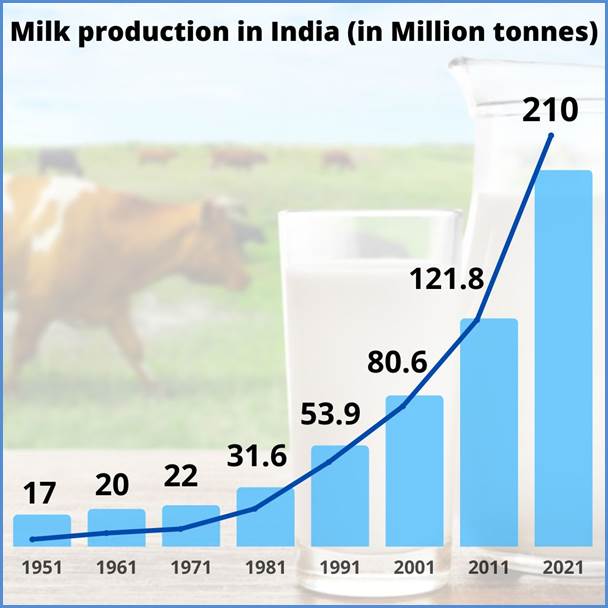
- India produces over 230 million tonnes of milk annually (2022-23), accounting for 24% of global milk production.
- The country surpassed the USA in 1998 to become the world’s largest milk producer.
📊 Key Statistics
| Indicator | Data (2022-23) |
|---|---|
| Total Milk Production | 230+ million tonnes |
| Per Capita Milk Availability | 427 grams per day |
| Dairy’s Contribution to GDP | 4.5% |
| Livelihood Dependency | 80+ million households |
Major Milk Producing States
- Uttar Pradesh – Largest producer (~16% of India’s total milk).
- Rajasthan, Gujarat, Punjab, Madhya Pradesh – Significant contributors.
- Southern States (Karnataka, Andhra Pradesh, Tamil Nadu, Telangana) – Emerging dairy hubs.
Major Dairy Breeds in India
- Indigenous Cattle Breeds 🐂
- High adaptability and disease resistance.
- Examples: Gir (Gujarat), Sahiwal (Punjab), Red Sindhi (Pakistan-India border), Tharparkar (Rajasthan), Rathi (Rajasthan).
- Exotic & Crossbred Breeds 🐄
- Higher milk yield but require better management.
- Examples: Jersey, Holstein Friesian, Brown Swiss.
- Buffalo Breeds 🐃
- Contribute more than 50% of India’s milk production.
- Examples: Murrah (Haryana), Jaffarabadi (Gujarat), Bhadawari (U.P.), Surti (Gujarat).
Challenges in Dairy Farming
1️⃣ Low Productivity of Indigenous Breeds
- Indigenous breeds have a lower milk yield (2-4 liters/day) compared to crossbred cows (10-15 liters/day).
2️⃣ Unorganized Dairy Sector
- 70% of milk production comes from small and marginal farmers, leading to fragmented production.
- Dependence on local vendors and informal markets reduces profitability.
3️⃣ Shortage of Quality Feed and Fodder 🌾
- Deficiency of green fodder (35%) and dry fodder (11%) affects milk yield.
- High cost of cattle feed reduces profit margins.
4️⃣ Poor Veterinary Services & Healthcare 🏥
- High incidence of diseases like Foot and Mouth Disease (FMD) and Mastitis affects productivity.
- Shortage of veterinarians and diagnostic facilities in rural areas.
5️⃣ Lack of Cold Chain & Storage Infrastructure ❄️
- 40% of milk is sold in the unorganized sector, leading to high spoilage and wastage.
- Inadequate chilling centers and milk processing units.
6️⃣ Environmental and Climate Challenges 🌍
- Rising temperature stress affects cattle health and milk yield.
- Scarcity of water and fodder in drought-prone regions.
7️⃣ Fluctuating Milk Prices & Market Instability 📉
- Farmers often receive low prices due to middlemen and market fluctuations.
- Inconsistent export policies impact the dairy industry.
Government Measures for Dairy Farming
🏛️ 1. National Dairy Development Board (NDDB)
- Established in 1965, played a pivotal role in India’s White Revolution.
🥛 2. Operation Flood (1970-1996)
- World’s largest dairy development program, making India self-sufficient in milk.
- Establishment of the Anand model of cooperative dairy farming (Amul success story).
🏥 3. Rashtriya Gokul Mission (RGM)
- Focuses on indigenous breed conservation and genetic improvement.
- Initiatives like E-Gopala app for farmers to access cattle management services.
❄️ 4. Dairy Infrastructure Development Fund (DIDF)
- ₹8,000 crore fund to develop chilling plants, milk processing, and cold storage facilities.
🔬 5. National Programme for Dairy Development (NPDD)
- Improves milk quality, cold chain infrastructure, and market linkages.
🚜 6. National Livestock Mission (NLM)
- Provides financial aid for dairy entrepreneurship and fodder production.
🌱 7. Fodder & Feed Development Schemes
- Subsidies for green fodder cultivation and hydroponic fodder technology.
- Introduction of Total Mixed Ration (TMR) feeding for dairy cattle.
🌍 8. Climate-Resilient Livestock Farming
- Promotion of solar-powered dairy farms.
- Research on heat-resistant cattle breeds.
Way Forward
✅ 1. Genetic Improvement & Breed Development
- Strengthen artificial insemination and embryo transfer technology (ETT).
- Encourage selective crossbreeding programs for higher milk yield.
✅ 2. Strengthening Dairy Cooperatives & FPOs
- Enhance participation in cooperative models like Amul, Nandini, Sudha.
- Support Farmer Producer Organizations (FPOs) in dairy farming.
✅ 3. Enhancing Cold Chain & Processing Infrastructure
- Investment in modern milk processing plants and refrigeration units.
- Expansion of rural milk collection centers and dairy hubs.
✅ 4. Market Reforms & Price Stability
- Implement Minimum Support Price (MSP) for milk to protect farmers.
- Strengthen e-NAM (National Agriculture Market) for dairy products.
✅ 5. Digital & Technological Integration
- Use IoT-based cattle monitoring for health tracking.
- Promote blockchain technology in milk supply chain management.
✅ 6. Sustainable & Climate-Smart Dairy Practices
- Adoption of zero-carbon footprint dairy farms.
- Encouraging organic dairy farming and A2 milk production.
Conclusion
Dairy farming is a lifeline for millions of rural families in India. The sector has grown significantly, making India the dairy powerhouse of the world. However, low productivity, market inefficiencies, and climate challenges persist. A holistic approach involving genetic improvement, infrastructure development, cooperative models, and digital transformation can ensure a resilient and profitable dairy industry. Strengthening this sector is not only crucial for food security but also for achieving the goal of doubling farmers’ income.