
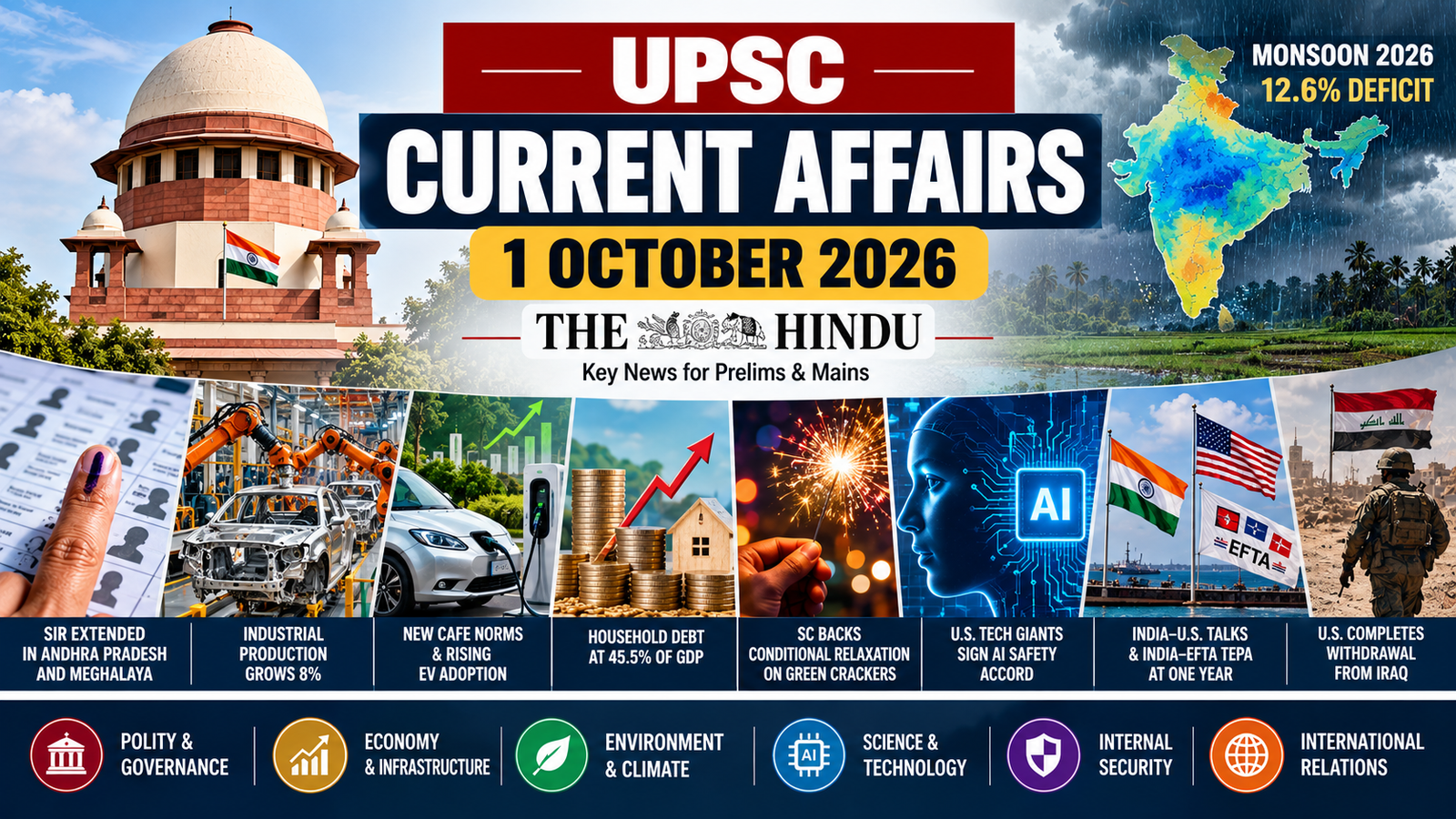
The Hindu – Delhi City Edition
Source: The Hindu, Delhi City Edition, Thursday, 1 October 2026, 18 pages. th.th_delhi.01_10_2026
1. 🌧️ Southwest Monsoon 2026 ends with 12.6% rainfall deficit
India’s 2026 southwest monsoon ended with 759.4 mm of rainfall, compared with the normal 868.6 mm, representing a 12.6% deficit.
The rainfall was equivalent to about 87% of the Long Period Average (LPA), making 2026 the driest southwest monsoon since 2015.
The East and Northeast region recorded 1,017.1 mm, its lowest southwest monsoon rainfall since systematic IMD records began in 1901. th.th_delhi.01_10_2026
The IMD had anticipated a weak monsoon in association with a strong El Niño. It had forecast 92% of LPA on April 13 and subsequently revised the forecast to 90% of LPA on May 29; the actual outcome fell within the forecast range. th.th_delhi.01_10_2026
The southwest monsoon is expected to withdraw completely during the first weeks of October. With El Niño strengthening, October rainfall is expected to be below 85% of LPA, although some parts of northwest India and southern peninsular India may receive relatively better rainfall. th.th_delhi.01_10_2026
UPSC relevance
GS-I: Indian geography, monsoon
GS-III: Agriculture, climate change, disaster management
Key concepts
- Southwest Monsoon
- LPA – Long Period Average
- El Niño
- Monsoon variability
- Regional rainfall distribution
- Northeast India’s changing rainfall pattern
Mains angle
The important issue is not merely the national rainfall deficit but the increasing spatial variability of the Indian monsoon and its implications for agriculture, water resources, food security and disaster management.
2. ⚖️ Supreme Court allows conditional relaxation on firecrackers
The Supreme Court has ruled out a nationwide total ban on firecrackers ahead of Deepavali, while accepting recommendations of CSIR-NEERI for a limited and conditional relaxation.
The court considered the use of next-generation joined green crackers subject to prescribed requirements relating to:
- Noise
- Emissions
- Safety
- Chemical composition
- Manufacturer licensing
CSIR-NEERI recommended prescribed noise limits of 125 dB(AI)/145 dB(C) peak. th.th_delhi.01_10_2026
The newspaper reports that tests on the new-generation green crackers showed approximately 30% lower emissions than conventional joined crackers, while reduction in shell size lowered solid-waste generation. The court also indicated that it may consider specified time windows for bursting crackers. th.th_delhi.01_10_2026
UPSC relevance
GS-III – Environment | Pollution | Public health
Important institutions
CSIR-NEERI
Council of Scientific and Industrial Research – National Environmental Engineering Research Institute.
Concept
The case illustrates the policy challenge of balancing:
Environmental regulation + public health + scientific standards + cultural practices
3. 🗳️ Election Commission extends SIR deadlines in Andhra Pradesh and Meghalaya
The Election Commission has extended the timelines for publication of final electoral rolls under the Special Intensive Revision (SIR) in Andhra Pradesh and Meghalaya.
Revised dates
| State | Earlier date | Revised date |
|---|---|---|
| Andhra Pradesh | October 3 | October 16 |
| Meghalaya | October 7 | October 26 |
The claims and objections period in Andhra Pradesh has been extended until October 10.
The Commission also reviewed measures announced on September 26 concerning issues such as voters flagged under “unmapped” or “logical discrepancies” categories. th.th_delhi.01_10_2026
Why important?
The SIR debate brings together:
- Electoral-roll accuracy
- Universal adult franchise
- Voter inclusion
- Voter exclusion
- Election Commission powers
- Due process
- Digital electoral databases
Constitutional connection
Article 324 – Superintendence, direction and control of elections vested in the Election Commission.
4. 🗳️ Homeless voters and electoral inclusion
A particularly important social-justice dimension of the SIR process concerns homeless voters in Delhi.
An organisation working with homeless citizens reported that only 747 applications for re-inclusion were received during special enrolment camps held in 43 Assembly constituencies.
The organisation cited:
- Weak outreach
- Language barriers
- Low literacy
- Mistrust of formal procedures
- Lack of awareness among field-level officials
The newspaper reports that under the EC’s Manual on Electoral Rolls, 2023, homeless voters do not necessarily have to provide documentary proof of address. A Booth Level Officer can verify residence, and a “zero” house number may be used for a homeless voter. th.th_delhi.01_10_2026
UPSC relevance
This is an excellent example of the intersection of:
Democracy → social exclusion → administrative capacity → last-mile governance
Mains question
“Universal adult franchise requires not merely the formal right to vote but effective administrative mechanisms enabling vulnerable groups to exercise that right.” Discuss.
5. 🏗️ Delhi Jal Board announces ₹17,969-crore sewer overhaul
The Delhi Jal Board (DJB) has given in-principle approval to a 10-year, ₹17,969.93-crore programme for sewer maintenance.
The proposed “One Zone, One Operator” model will divide Delhi into eight zones, with one operator responsible for the sewer network in each zone.
The programme envisages:
- Planned preventive maintenance
- Geotagged inspections
- Real-time monitoring
- Central command centre
- Mechanical and robotic sewer cleaning
- Performance-linked payments
The DJB currently maintains approximately 11,212 km of sewer lines, 6.68 lakh manholes and 145 pumping stations. th.th_delhi.01_10_2026
It has also approved a ₹6,044.05-crore project for refurbishment of South Delhi’s water-supply infrastructure, including smart meters, bulk-flow meters and sensors for chlorine and pressure monitoring. th.th_delhi.01_10_2026
UPSC relevance
GS-II – Urban governance
Key themes:
- Urban infrastructure
- Municipal governance
- Outcome-based public service delivery
- Technology-enabled governance
- Water and sanitation
6. 🏭 Industrial production grows 8% in August
The Index of Industrial Production (IIP) recorded 8% growth in August 2026.
This was the second-fastest monthly growth recorded since the beginning of the new IIP series in April 2024.
For April–August 2026, IIP growth stood at 6.8%. th.th_delhi.01_10_2026
Sector-wise highlights
| Indicator | August 2026 |
|---|---|
| Overall IIP | 8% |
| Electricity | 12.3% |
| Construction goods | 6.4% |
| Manufacturing | ~9% |
| Consumer durables | 11.1% |
Manufacturing averaged 7.6% growth during April–August 2026.
The newspaper notes that earlier growth had been driven substantially by exports, while August data indicate that domestic consumption is also recovering. th.th_delhi.01_10_2026
UPSC relevance
GS-III – Indian economy
Prelims
IIP is compiled by the National Statistical Office (NSO) and measures changes in the volume of industrial production.
Major sectors:
Mining + Manufacturing + Electricity
7. 🚗 New CAFE norms tighten automobile fuel-efficiency requirements
The Centre has notified the third phase of Corporate Average Fuel Efficiency (CAFE) norms for passenger vehicles.
The new norms will apply from 1 April 2027 to 31 March 2032.
Under the new framework:
Each battery electric vehicle (EV) will count as three vehicles for a manufacturer’s fleet-efficiency calculation.
Cleaner technologies and biofuel-based vehicles will also receive specified credits. th.th_delhi.01_10_2026
The fuel-consumption benchmark will become progressively tighter:
3.996 litres/100 km in 2027–28 → 3.3273 litres/100 km in 2031–32
This represents an improvement of approximately 16.7% over the five-year period.
The norms apply to new passenger vehicles manufactured or imported for sale in India.
UPSC relevance
GS-III – Environment | Energy | Automobile sector
Policy objective
CAFE norms seek to improve vehicle fleet efficiency and reduce fuel consumption and associated CO₂ emissions.
8. 🔋 EV adoption crosses 12% of vehicle registrations
Data cited by The Hindu show continued growth in India’s EV and hybrid-vehicle registrations.
During the first five months of 2026–27, EVs and hybrids constituted approximately 12.7%, or 16.5 lakh, of roughly 1.29 crore vehicle registrations.
Among major States/UTs, Kerala, Delhi, Karnataka, Odisha and Telangana recorded shares of at least 15%. th.th_delhi.01_10_2026
However, the newspaper highlights an important qualification: when three-wheelers are excluded, the EV/hybrid share falls to below 5% in 2026–27.
Why important?
EV adoption is affected by:
Vehicle price + charging infrastructure + electricity availability + state incentives + commercial three-wheelers + battery technology
This is particularly relevant to India’s transition towards low-carbon mobility.
9. 💳 Household debt rises to 45.5% of GDP
An important economic analysis in the newspaper examines India’s changing household borrowing pattern.
According to RBI data cited in the article, household debt stood at 45.5% of GDP in September 2025, compared with:
- 39.2% in March 2021
- ~42% in June 2023
Household net financial savings, meanwhile, increased to approximately 6% of GDP in 2024–25, from 5.2% in 2023–24. th.th_delhi.01_10_2026
The composition of debt is particularly significant.
Increasing borrowing through:
- Credit cards
- Personal loans
- Digital lending
- Consumer-durable loans
- Buy-now-pay-later arrangements
raises questions about household financial vulnerability.
Important distinction
Housing loan → potentially creates an asset
whereas
Unsecured consumption loan → creates future repayment obligations without necessarily creating an asset
UPSC relevance
GS-III – Economy
This can be linked to:
Household savings → consumption → credit → financial stability → monetary policy
10. 🤖 Six major technology companies sign voluntary AI safety accord
U.S. President Donald Trump and heads of six major technology companies have signed a voluntary framework titled the “White House Accord on Super Intelligence: Joint Commitment on Frontier Responsibilities.”
The agreement proposes a four-layer system of AI safety controls, including:
- Internal monitoring
- Independent external evaluation
- Board-level oversight
- Controls over model capabilities and alignment
Companies named in the accord include Google, Anthropic, Meta, OpenAI, xAI and Nvidia. th.th_delhi.01_10_2026
UPSC relevance
GS-III – Science & Technology
Emerging concept
Frontier AI governance
The central challenge is moving from:
AI innovation → AI capability
towards:
AI capability → AI safety → accountability → responsible deployment
11. 🔬 Indian school students win CERN’s Beamline for Schools competition
Five Indian school students are among the winning teams of the 13th Beamline for Schools competition organised by CERN.
Their team, “attoPION”, includes students from institutions in:
- Nizamabad
- Bengaluru
- Greater Noida
- Durgapur
Their project studied pion charge exchange — specifically, how frequently a charged pion becomes neutral when interacting with light atoms such as lithium and beryllium. th.th_delhi.01_10_2026
The measurements have relevance to the Deep Underground Neutrino Experiment (DUNE) because pion production and charge exchange can affect neutrino-interaction modelling.
UPSC Prelims concepts
Pion
→ Subatomic particle
→ Can be positively, negatively or neutrally charged
Neutrino
→ Electrically neutral elementary particle
→ Extremely weak interaction with matter
CERN
→ European Organization for Nuclear Research
→ Located near Geneva, Switzerland
12. 🚀 Starship engine failure creates implications for NASA’s Moon programme
A malfunction of one of the Raptor engines during SpaceX’s latest uncrewed Starship test could have implications for NASA’s timetable for human lunar missions.
Starship is one of the systems being considered for transporting astronauts to the lunar surface under NASA’s Artemis-era lunar exploration programme.
The test nevertheless achieved several objectives, including orbital operations and commercial satellite deployment, before being cut short following the propulsion-system malfunction. th.th_delhi.01_10_2026
UPSC relevance
GS-III – Space Technology
Important concepts:
- Reusable launch vehicles
- Heavy-lift launch systems
- Human spaceflight
- Lunar exploration
- Commercial space sector
- Public-private space cooperation
13. 🌐 India–U.S. relations: Modi–Trump discuss trade, defence and critical technologies
Prime Minister Narendra Modi and U.S. President Donald Trump held a telephone conversation covering trade, defence, energy and critical technologies.
The conversation came amid concerns regarding:
- Tariff issues
- India–U.S. FTA negotiations
- Treatment of Indian migrants
- Pakistan
- U.S. sanctions relating to countries importing Russian oil
Indian officials had raised concerns regarding the Lindsey O. Graham Sanctions Against Russia and Iran Act (SRIA), which the newspaper reports could provide for tariffs of up to 100% on imports from countries importing Russian oil. th.th_delhi.01_10_2026
UPSC relevance
GS-II – International Relations
Key themes:
India–U.S. relations → Trade → Energy security → Russia → Strategic autonomy → Critical technologies
14. 🇮🇳🇪🇺 India–EFTA TEPA completes one year
The Trade and Economic Partnership Agreement (TEPA) between India and the four European Free Trade Association (EFTA) countries entered into force on 1 October 2025.
EFTA comprises:
- Iceland
- Liechtenstein
- Norway
- Switzerland
The agreement is notable because it includes commitments relating not only to trade but also investment and employment generation.
The article notes that EFTA states have offered concessions on 92.2% of their tariff lines, covering 99.6% of India’s exports to them, while India has offered concessions on 82.7% of its tariff lines, covering 95.3% of EFTA exports. th.th_delhi.01_10_2026
The agreement also contains an investment ambition of $100 billion over 15 years and facilitation of one million direct jobs. th.th_delhi.01_10_2026
UPSC relevance
GS-II – International Relations
GS-III – Economy and Trade
Additional angle
The article highlights India’s relationship with Iceland in:
- Geothermal energy
- Fisheries
- Cold-chain technology
- Arctic research
- Sustainable resource utilisation
India has been an Observer in the Arctic Council since 2013 and operates the Himadri research station in Svalbard. th.th_delhi.01_10_2026
15. 🇺🇸 U.S. completes withdrawal from Iraq
The United States has withdrawn its combat forces from its last military base in Iraq, more than two decades after the 2003 invasion.
The newspaper’s analysis highlights the transformation of the regional balance following the U.S. intervention.
The U.S. had spent approximately $1.7 trillion over the 23-year period and lost around 4,500 troops, according to the article. th.th_delhi.01_10_2026
The withdrawal occurs in a complex environment involving:
- Iraqi political fragmentation
- Iran-backed Shia militias
- Kurdish autonomy
- Islamic State remnants
- U.S.–Iran strategic rivalry
The article argues that the departure could alter the balance between U.S. and Iranian influence in Iraq. th.th_delhi.01_10_2026
UPSC relevance
GS-II – International Relations
Historical linkage
2003 invasion → Saddam Hussein removed → sectarian conflict → rise of AQI/ISIS → Iranian influence → U.S. withdrawal
This is useful for understanding the long-term consequences of external military intervention and state fragility.
16. 🌍 U.K. debate over closer relationship with the European Union
The British Prime Minister Andy Burnham said that rejoining the European Union could be one of the options for the United Kingdom, while also discussing alternatives such as a customs union or Single Market relationship.
The debate follows continuing discussion about Britain’s post-Brexit relationship with the EU, its largest trading partner. th.th_delhi.01_10_2026
UPSC relevance
Useful for understanding:
- European integration
- Brexit
- Customs union
- Single Market
- Free movement
- Regional economic integration
Prelims distinction
Customs Union
→ Common external tariff + removal of internal customs barriers
Single Market
→ Wider integration involving free movement of goods, services, capital and people.
17. 🏭 Export-support schemes extended
The Union government has extended two export-support schemes until 31 December 2026:
RoDTEP
Remission of Duties and Taxes on Exported Products
RoSCTL
Rebate of State and Central Taxes and Levies
The extension has been made without changes in the existing rates and structure. th.th_delhi.01_10_2026
UPSC relevance
GS-III – Indian Economy
These schemes address the problem of taxes and duties embedded in exported products, helping maintain export competitiveness.
📌 Prelims Quick Revision
| Topic | Key fact |
|---|---|
| 2026 Southwest Monsoon | 759.4 mm; 12.6% below normal |
| LPA | Long Period Average |
| El Niño | Associated with subdued monsoon conditions |
| SIR | Special Intensive Revision of electoral rolls |
| Form 7 | Objection/deletion from electoral roll |
| IIP August 2026 | 8% growth |
| Manufacturing growth | Nearly 9% |
| CAFE norms | Corporate Average Fuel Efficiency |
| EV credit under new CAFE norms | 1 EV counts as 3 vehicles |
| TEPA | India–EFTA Trade and Economic Partnership Agreement |
| EFTA | Iceland, Liechtenstein, Norway, Switzerland |
| CERN | European particle physics research organisation |
| DUNE | Deep Underground Neutrino Experiment |
| RoDTEP | Remission of Duties and Taxes on Exported Products |
| RoSCTL | Rebate of State and Central Taxes and Levies |
| CSIR-NEERI | Environmental engineering research institute under CSIR |
| Green crackers | Lower emissions/noise compared with conventional varieties |
| Household debt | 45.5% of GDP in September 2025 |
🧠 Mains Practice Questions
GS-II – Polity
1. Electoral-roll revision must balance the objectives of electoral integrity and universal voter inclusion. Discuss with reference to the challenges emerging from intensive revision exercises.
GS-II – International Relations
2. The withdrawal of a major external power from a conflict zone does not necessarily end its geopolitical consequences. Examine with reference to Iraq.
3. Discuss the strategic significance of India–EFTA economic relations beyond conventional tariff reduction.
GS-III – Economy
4. The recent rise in industrial production indicates an important role for domestic consumption in India’s growth cycle. Examine the significance and limitations of IIP as an indicator of economic activity.
5. Rising household indebtedness can simultaneously support consumption and create macroeconomic vulnerabilities. Discuss.
GS-III – Environment
6. Examine the role of Corporate Average Fuel Efficiency norms in India’s transition towards low-carbon mobility.
7. How can scientific standards be incorporated into environmental regulation while balancing economic and social considerations? Discuss with reference to green crackers.
GS-III – Science & Technology
8. What are the major challenges associated with the governance of frontier artificial intelligence? Discuss the significance of internal monitoring, external evaluation and board-level oversight.
🔗 Today’s Conceptual Map
                    1 OCTOBER 2026
                          │
       ┌──────────────────┼──────────────────┐
       │                  │                  │
     POLITY             ECONOMY           ENVIRONMENT
       │                  │                  │
   SIR / ECI             IIP              MONSOON
   Electoral             CAFE             El Niño
   Inclusion             EVs              Green crackers
       │                  │                  │
       └──────────────┬───┴──────────────────┘
                      │
                 TECHNOLOGY
                      │
             ┌────────┼─────────┐
             │        │         │
            AI      CERN     Starship
                      │
                      │
              INTERNATIONAL
                      │
        ┌─────────────┼─────────────┐
        │             │             │
     India–US      India–EFTA     Iraq
🎯 Today’s highest-value UPSC themes
1. Monsoon 2026 and El Niño
2. Electoral-roll revision and voter inclusion
3. IIP and industrial recovery
4. CAFE norms and EV transition
5. Household indebtedness
6. AI safety governance
7. India–EFTA TEPA
8. U.S. withdrawal from Iraq
9. Green crackers and air pollution
10. India–U.S. strategic relationship