
The Hindu | Delhi Edition
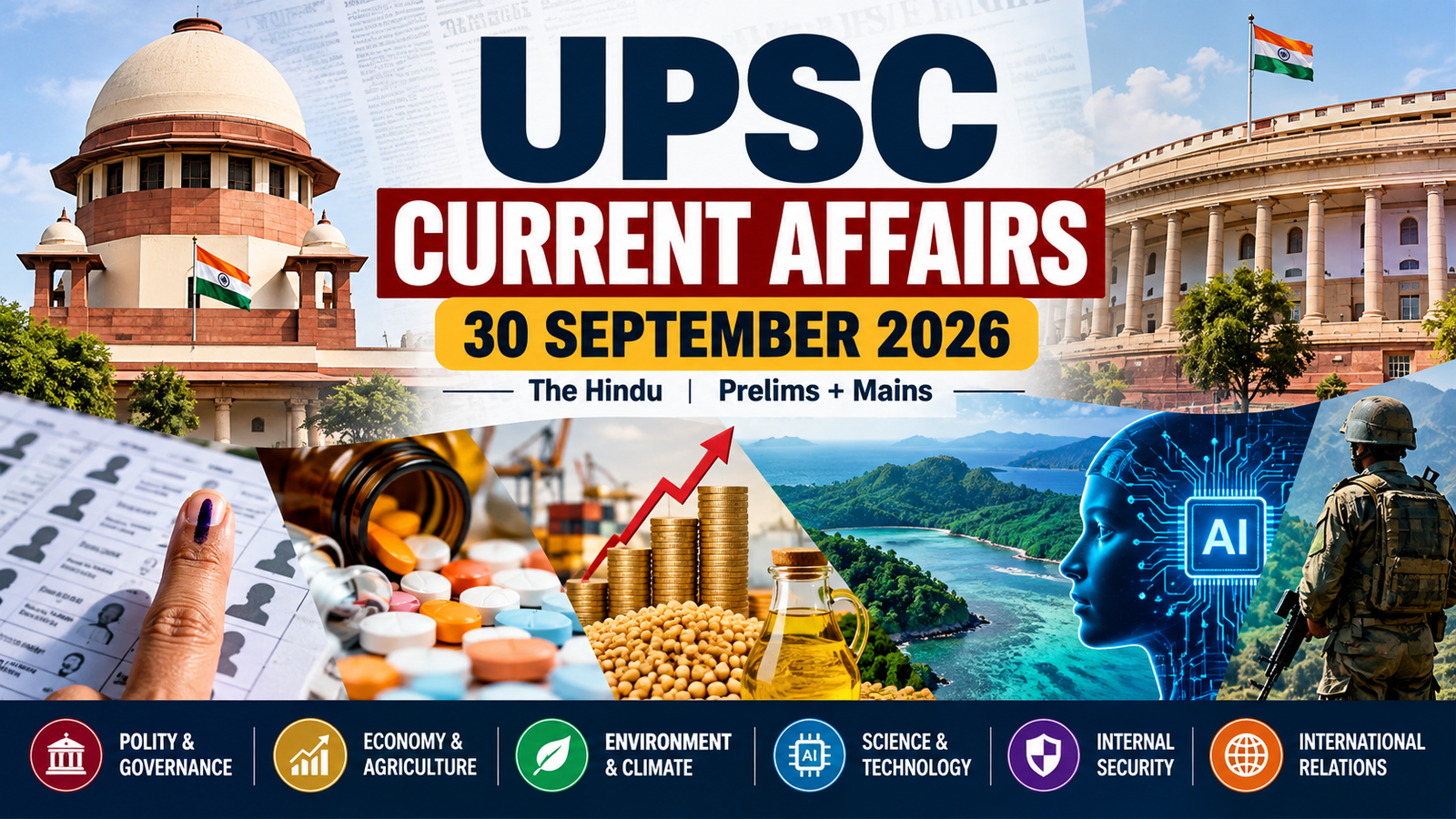
Source: The Hindu, Delhi City Edition, Wednesday, 30 September 2026. The front page prominently carries developments concerning essential-drug pricing, electoral-roll revision, the new NCERT Social Science textbook, the Great Nicobar project and artificial intelligence.
1. ⚖️ Supreme Court flags steep mark-ups on essential medicines
The Supreme Court has raised concerns over the large difference between the price at which essential medicines are supplied to retailers and the price ultimately paid by consumers.
The Court was hearing petitions seeking regulation of prices of medicines, medical equipment and generic drugs. The Bench questioned why the 16% retailer margin prescribed under the Drugs (Prices Control) Order (DPCO), 2013 should not be applied more uniformly to essential medicines.
A particularly striking example discussed before the Court was an essential cancer drug supplied to retailers for around ₹3,000 but reportedly sold to consumers for approximately ₹27,000.
The Court also highlighted the implications for public expenditure because medicines purchased through government-funded health schemes ultimately involve taxpayer money. The matter has been posted for further hearing on 12 October 2026.
UPSC relevance
GS-II – Health | Governance | Welfare schemes
Key concepts
- Drugs (Prices Control) Order, 2013
- National Pharmaceutical Pricing Authority (NPPA)
- Price to Retailer (PTR)
- Maximum Retail Price (MRP)
- Scheduled and non-scheduled formulations
- Generic medicines
- Ayushman Bharat and public health expenditure
Mains perspective
The issue highlights the tension between:
Affordable medicines → consumer welfare → universal healthcare
and
Market-based pricing → pharmaceutical margins → availability and innovation
The larger question is how India can ensure affordability without weakening incentives for pharmaceutical research, production and distribution.
2. 🗳️ Electoral Rolls: Problems emerge in Special Intensive Revision
The ongoing Special Intensive Revision (SIR) of electoral rolls continues to generate questions relating to electoral administration and voter verification.
In Delhi, The Hindu reports that some Booth-Level Agents (BLAs) were able to submit more than the Election Commission’s prescribed limit of 10 applications per day by using the ECINET online portal, which did not technically enforce the same restriction.
Between September 21 and 27, 1,095 Form 7 objections were reportedly filed in Delhi. Form 7 is used to object to the inclusion of a name in the electoral roll or seek deletion of a name. The newspaper also reports that the deadline for claims and objections has been extended to 30 October, while publication of the final electoral roll is scheduled for 4 December.
Why important?
This raises broader questions about:
- Electoral integrity
- Voter inclusion and exclusion
- Digital governance
- Role of BLAs
- Transparency of electoral-roll revision
- Institutional safeguards against wrongful deletion
Important Forms
| Form | Purpose |
|---|---|
| Form 6 | Application for inclusion of name in electoral roll |
| Form 7 | Objection/deletion of a name |
| Form 8 | Modification/correction of electoral-roll entries |
UPSC connection
GS-II: Election Commission, electoral reforms, representation, constitutional institutions.
Potential Mains question:
“Electoral-roll revision is necessary for maintaining accurate electoral databases, but procedural safeguards are equally important to prevent wrongful exclusion.” Discuss.
3. 🗳️ Bulk objections reported in Karnataka SIR
The newspaper reports that more than 4,000 Form 7 applications seeking deletion of names were filed across several Karnataka Assembly constituencies, with a large proportion reportedly targeting Muslim voters.
In Babaleshwar, for instance, 1,373 Form 7 applications were received on September 22, of which 1,363 were reportedly filed by 10 individuals.
Similar patterns were reported from Bhalki, Basavakalyan and Belthangady. The newspaper also raises questions about applications in which portions of voter details appeared to have already been printed while objector information was handwritten.
Issues for UPSC
This story can be studied through the broader framework of:
Universal adult franchise → electoral-roll accuracy → voter inclusion → due process → democratic legitimacy
The important distinction for students is between legitimate correction of electoral rolls and procedural mechanisms that may inadvertently or deliberately exclude eligible voters.
4. ⚖️ Supreme Court quashes NSA detention in Sambhal case
The Supreme Court has quashed the preventive detention of a person under the National Security Act, 1980, in connection with the 2024 Sambhal violence.
The Court held that the required connection between the material relied upon and the detention order was absent and imposed ₹10 lakh in costs on the Uttar Pradesh government.
The Court also observed that a confessional statement made before a police officer cannot, by itself, constitute the basis for preventive detention under the NSA.
UPSC Concept: Preventive vs Punitive Detention
| Preventive Detention | Punitive Detention |
|---|---|
| Prevents anticipated future acts | Punishes an offence already committed |
| Based on apprehension of threat | Based on adjudicated criminal liability |
| Exceptional constitutional mechanism | Part of ordinary criminal justice |
| Subject to constitutional safeguards | Follows criminal trial and conviction |
Constitutional connection
Article 22 contains safeguards relating to arrest and detention.
The case also connects with:
- Personal liberty
- Habeas corpus
- Due process
- Judicial review
- Protection against self-incrimination
- Rule of law
5. 🌳 Great Nicobar Project: Centre approaches Supreme Court
The Union government has approached the Supreme Court seeking a stay on proceedings before the Calcutta High Court concerning petitions challenging aspects of the proposed ₹92,000-crore Great Nicobar Island project.
The petitions allege violations of provisions of the Forest Rights Act (FRA), 2006, particularly in relation to obtaining consent for diversion of forest land.
The controversy involves questions concerning:
- Forest rights
- Tribal communities
- Gram Sabha consent
- Diversion of forest land
- Environmental clearance
- Development versus ecological protection
- Judicial review of large infrastructure projects
UPSC relevance
GS-III – Environment
GS-II – Tribal rights and governance
The case is particularly useful for understanding the interaction among:
Forest Rights Act + Gram Sabha + Scheduled Tribes + Protected Areas + Environmental clearance + Infrastructure development
Important legislation
Forest Rights Act, 2006
It recognises certain rights of forest-dwelling Scheduled Tribes and other traditional forest dwellers.
The Gram Sabha has an important role in determining and recognising community and individual forest rights.
6. 🌾 Old grasslands may not recover their original ecological character
A new global study reported in the newspaper has significant implications for ecosystem restoration.
The study examined 742 plant species from grassland ecosystems in India, Australia and Brazil and compared old-growth grasslands with secondary grasslands.
The finding is important:
Destruction of ancient grasslands can result in ecological changes that persist for more than a century, even when vegetation subsequently returns.
Secondary grasslands may have:
- Different plant species
- Fewer species overall
- Greater prevalence of non-native annual plants
- Different soil conditions
- Different ecological functions
Why is this important for India?
Grasslands are often incorrectly treated as “wastelands”.
They provide:
- Livestock grazing
- Carbon storage
- Wildlife habitat
- Livelihood support
- Ecosystem services
- Habitat for threatened species
The article highlights restoration examples involving species such as the Great Indian Bustard, lesser florican and pygmy hog.
UPSC connection
GS-III – Environment
Important conceptual distinction:
Afforestation ≠ ecological restoration
A grassland converted into a plantation may increase tree cover while simultaneously destroying a naturally evolved grassland ecosystem.
7. 🧪 Sulphur prices and India’s fertiliser vulnerability
International sulphur prices have risen sharply, according to the newspaper’s data analysis.
The price reportedly increased from approximately $280 per tonne in July 2025 to $1,050 per tonne in July 2026.
This matters because sulphur is an important input for the production of sulphuric acid and fertilisers.
India’s vulnerability
India produced around 3.7 million tonnes of sulphur but remains dependent on imports.
In 2025:
- India’s sulphur imports: approximately 2.25 million tonnes
- Imports from West Asia: approximately 2.02 million tonnes
Thus, roughly 90% of India’s sulphur imports came from West Asian producers.
Why prices are rising
The newspaper links the supply situation to:
Russia-Ukraine conflict + West Asian conflict + supply restrictions + rising demand
Demand is also increasing because sulphuric acid is used in metals processing, including processes connected with nickel production and EV battery supply chains.
UPSC significance
This is an excellent example of:
Geopolitics → commodity prices → import dependence → fertiliser costs → agricultural economy
It also illustrates India’s exposure to global supply-chain disruptions.
8. 🛢️ Edible oil import duty reduced
The Union government has reduced the Basic Customs Duty (BCD) on several imported edible oils.
The changes are aimed at moderating domestic edible-oil prices ahead of the festival season.
Important changes
| Oil | Earlier BCD | New BCD |
|---|---|---|
| Crude soybean oil | 10% | 5% |
| Crude palm oil | 10% | 5% |
| Crude sunflower oil | 10% | 0% |
| Refined palm oil | 32.5% | 27.5% |
| Edible-grade sunflower oil | 32.5% | 22.5% |
| Peanut/olive oil | 32.5% | 27.5% |
The government argues that lower import duties should reduce landed costs and moderate consumer prices.
Policy dilemma
The issue illustrates a classic economic-policy trade-off:
Lower import duty
→ cheaper imported edible oil
→ lower consumer prices
→ lower food inflation
But potentially:
→ greater import competition
→ lower domestic prices for oilseeds
→ concerns regarding farmers’ incentives
→ challenges to edible-oil self-sufficiency
UPSC connection
GS-III – Agriculture | Inflation | Trade policy
Key term: India’s edible oil import dependence
9. 🧑💻 Cybercrime rises amid expansion of digital transactions
The newspaper highlights findings from the Status of Policing in India Report 2026, based on a survey of 8,306 citizens across 16 States.
According to NCRB data cited in the report, registered cybercrime cases increased from 86,420 in 2023 to 1,01,928 in 2024, an increase of 17.9%, even as overall registered crime declined.
Frequently encountered scams included:
- Fake delivery calls
- High-return investment scams
- Fake bank officials
- Fake police/authority calls
- Emergency calls pretending to be friends or relatives
The survey also indicates that digital exposure is associated with greater exposure to scams.
Major governance issue
Cybercrime is no longer merely a technological problem.
It involves:
Technology + policing + financial regulation + digital literacy + data protection + consumer protection
UPSC connection
GS-II: Police reforms, governance
GS-III: Cybersecurity, digital economy
Essay: Technology and vulnerability
10. 🛡️ AFSPA extended in parts of Northeast
The Union Home Ministry has extended the Armed Forces (Special Powers) Act, 1958 (AFSPA) in parts of Manipur, Nagaland and Arunachal Pradesh for another six months from 1 October 2026.
In Manipur, the entire State continues to be declared a disturbed area except the jurisdictions of 13 police stations in five Valley districts.
What is AFSPA?
AFSPA is applicable in areas declared “disturbed areas”.
It gives armed forces certain special powers, including:
- Use of force under specified circumstances
- Arrest without warrant
- Search of premises without warrant
- Certain legal protections for personnel operating under the Act
Why controversial?
The central constitutional debate concerns the balance between:
National security and internal security
versus
Fundamental rights, accountability and civilian oversight
UPSC connection
GS-II: Internal security, fundamental rights, federalism
GS-III: Insurgency and border management
11. 🇮🇳🇯🇵 India–Japan defence cooperation and UNICORN radar
Japan has urged India to expedite its internal processing of the agreement concerning the UNICORN (Unified Complex Radio Antenna) naval radar system.
The agreement concerns technology transfer between Japan and India.
The newspaper also reports that the next naval exercise involving the Quad countries is expected to be held near the Sea of Japan before the end of the year.
Strategic significance
India-Japan defence cooperation is expanding beyond traditional exercises towards:
- Defence technology
- Maritime security
- Naval systems
- Technology transfer
- Indo-Pacific security
- Supply-chain resilience
UPSC connection
GS-II – International Relations
India-Japan → Quad → Indo-Pacific → Maritime security
12. 🇪🇺 India–EU trade relationship
An interview carried by the newspaper discusses the expected implications of the India–EU Free Trade Agreement.
The assessment cited in the article is that the agreement could significantly expand bilateral trade, with a substantial share of the increase potentially coming from services.
Areas of potential significance include:
- IT and digital services
- Technology
- Start-ups
- Research and innovation
- Human capital
- Market access
- Regulatory cooperation
UPSC angle
The India-EU relationship can be studied through:
Trade + technology + investment + strategic autonomy + supply-chain diversification
For India, the EU is simultaneously:
- A major trading partner
- A large consumer market
- A source of technology and investment
- An important regulatory power
- A strategic partner in the Indo-Pacific and global governance
13. 🤖 AI agents raise new questions about digital agency
The newspaper discusses a legal dispute involving Amazon and Perplexity AI concerning AI agents that can perform actions on behalf of users.
Unlike conventional AI systems that merely generate information, agentic AI systems can potentially:
search → compare → log in → select → purchase → complete transactions
The case therefore raises a deeper legal question:
Who is legally responsible when an AI agent acts on behalf of a user?
Possible actors include:
User → AI agent → platform → developer
The article connects this debate with India’s Information Technology Act, 2000, including Sections 43(a) and 66.
UPSC significance
This is a highly relevant Science & Technology + Governance issue.
Emerging questions include:
- AI agency
- Algorithmic accountability
- Platform governance
- Intermediary liability
- Data protection
- Cybersecurity
- Human oversight of autonomous systems
14. 📚 New NCERT Class 9 Social Science textbook
NCERT has released a new Class 9 Social Science textbook titled:
Understanding Society: India and Beyond – Part Two
The new textbook gives greater space to medieval Indian history, regional resistance movements and Indian sovereignty, while removing or reducing treatment of some European revolutionary history found in the earlier edition.
The development is relevant to discussions on:
- Curriculum design
- Historical interpretation
- National identity
- Education policy
- Textbook writing
- Representation of Indian and global history
UPSC connection
GS-I: Indian history and culture
GS-II: Education and governance
Essay: Education, history and nation-building
15. 🌾 Agriculture: El Niño and foodgrain production
The Union Agriculture Minister has stated that India’s rainfall deficit is around 12%, while ruling out a major national crop-production crisis due to El Niño.
For 2026–27, the Centre has set a foodgrain production target of 373.93 million tonnes, compared with actual production of 376.56 million tonnes in 2025–26.
The Rabi production target has been set at approximately 177.72 million tonnes.
UPSC relevance
This is useful for understanding:
Monsoon → El Niño → agricultural output → food prices → food security
It also highlights the importance of:
- Climate-resilient agriculture
- Crop diversification
- Irrigation
- Weather forecasting
- Agricultural insurance
- Strategic foodgrain stocks
📌 Prelims Quick Revision
| Topic | Key Fact |
|---|---|
| DPCO, 2013 | Regulates prices of specified medicines |
| Form 6 | Inclusion of name in electoral roll |
| Form 7 | Objection/deletion of name |
| Form 8 | Modification of electoral-roll particulars |
| NSA, 1980 | Preventive detention law |
| AFSPA, 1958 | Special powers in disturbed areas |
| FRA, 2006 | Recognises forest rights |
| UNICORN | Unified Complex Radio Antenna |
| BCD | Basic Customs Duty |
| NCRB | National Crime Records Bureau |
| SIR | Special Intensive Revision |
| NPPA | National Pharmaceutical Pricing Authority |
| Gram Sabha | Important institution under FRA and PESA-related governance |
| AI agents | Systems capable of performing multi-step tasks autonomously/on behalf of users |
🧠 Mains Practice Questions
GS-II
1. Electoral-roll revision is essential for electoral integrity, but the process must simultaneously protect the right to vote and procedural fairness. Discuss.
2. Preventive detention represents a difficult balance between national security and individual liberty. Examine with reference to constitutional safeguards.
3. Discuss the emerging governance challenges created by AI agents that can act autonomously on behalf of users.
GS-III
4. India’s dependence on imported industrial commodities can convert geopolitical disruptions into domestic inflationary pressures. Discuss with reference to sulphur.
5. Examine the implications of reducing import duties on edible oils for consumers, farmers and India’s objective of edible-oil self-sufficiency.
6. Why are natural grasslands ecologically different from areas that merely acquire vegetation after degradation? Discuss the implications for ecological restoration.
Essay
“Development is sustainable only when ecological systems and institutional safeguards are treated as assets rather than obstacles.”