
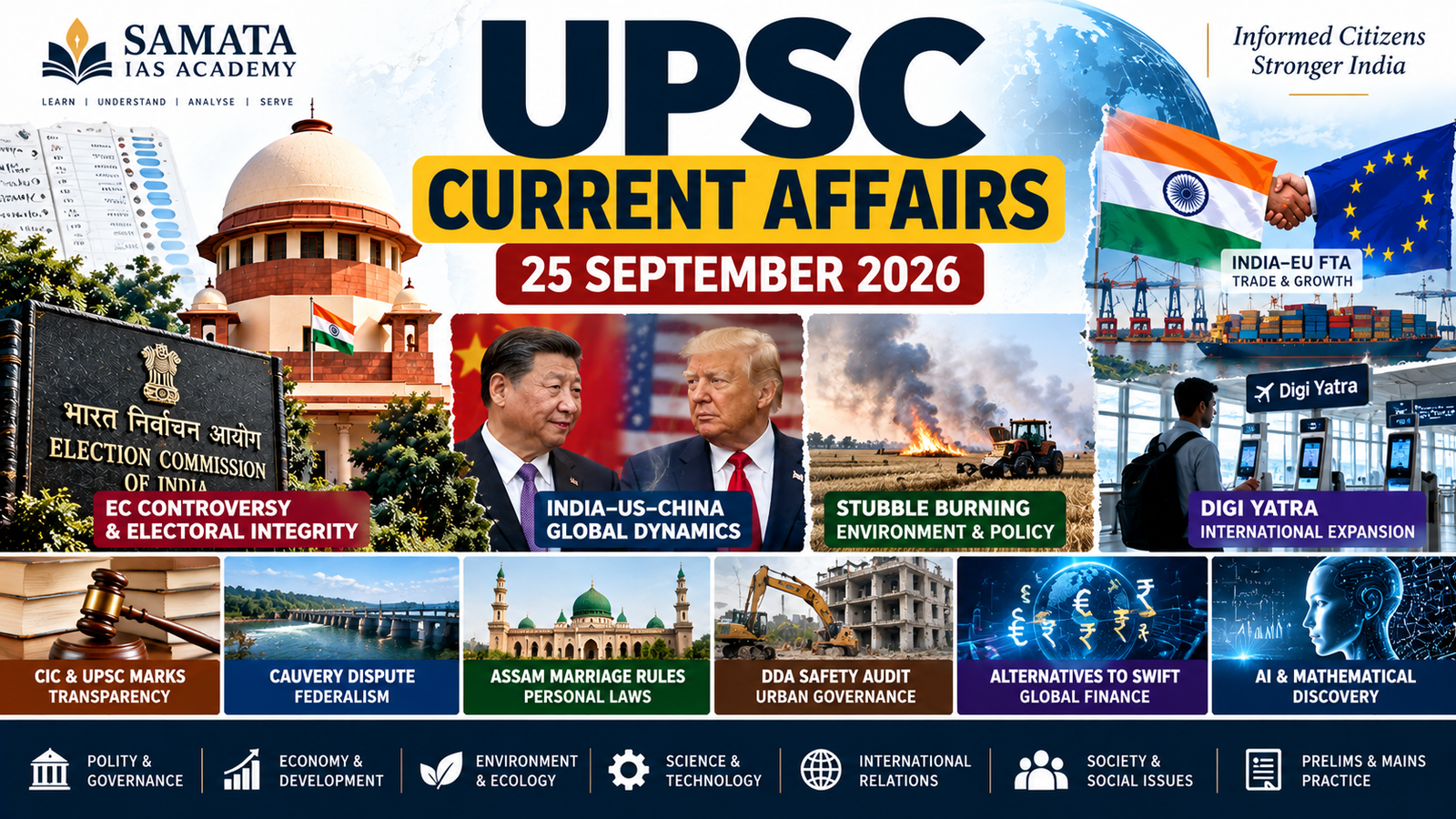
Source: The Hindu, Delhi City Edition, Friday, 25 September 2026. The uploaded newspaper is a 20-page Delhi City Edition dated September 25, 2026.
1. POLITY & GOVERNANCE
1. Election Commission, SIR and institutional independence
The controversy surrounding the Election Commission of India (ECI) and the Special Intensive Revision (SIR) of electoral rolls continues.
The newspaper reports political allegations concerning the conduct of elections and demands for the resignation of the Chief Election Commissioner. These are political allegations and should not be treated as established findings.
Of greater institutional significance is the reported disclosure that two Election Commissioners had formally recorded objections on several occasions concerning decisions taken during the period under review.
The issue connects with:
- Article 324 — superintendence, direction and control of elections.
- Independence of constitutional authorities.
- Electoral-roll management.
- Internal decision-making within the ECI.
- Transparency and institutional accountability.
- Relationship between electoral integrity and public confidence.
UPSC angle:
“Institutional independence requires not only formal autonomy but also transparent procedures that sustain public confidence.”
The newspaper also reports that the ECI has defended its functioning, stating that focusing selectively on internal notes does not provide the complete picture.
2. CIC recommends publication of paper-wise UPSC marks
A particularly relevant development for civil-services aspirants concerns the Central Information Commission (CIC).
The CIC has recommended restoration of the practice of publishing paper-wise marks of candidates selected in the Civil Services Examination.
According to the report:
- Detailed marks were publicly disclosed until CSE 2017.
- From 2018, aggregate marks rather than detailed paper-wise marks were being made available.
- An RTI applicant sought comparative data covering General Studies papers, optional subjects and Personality Test marks.
- The CIC noted that the Department of Personnel and Training could not produce a formal record explaining the discontinuation of detailed marks.
- The CIC recommended disclosure in the interests of transparency and fairness.
UPSC relevance:
This raises broader questions regarding:
RTI → transparency → public accountability → competitive examinations → institutional disclosure.
It can also be linked with the principles of natural justice, transparency in public institutions and the right to information.
3. Assam: compulsory registration of Muslim marriages
The Assam Cabinet has approved the Assam Muslim Marriage Registration (Compulsory) Rules, 2026.
The rules operationalise the framework created under the Assam Compulsory Registration of Muslim Marriages and Divorces Act, 2024, which replaced the earlier 1935 legislation.
Important features reported:
- Registration of Muslim marriages becomes a formal government process.
- The registration process is shifted from licensed Muslim registrars/qazis to government registration officials.
- The woman must be at least 18 and the man 21 at the time of marriage.
- Applications require proof of identity, age and residence.
- A 30-day objection period is provided.
- The stated objectives include documentation of marriages and protection of rights.
UPSC connection
This provides a useful case study for:
- Uniform Civil Code — Article 44
- Personal laws
- Marriage registration
- Legal pluralism
- Gender rights
- State regulation of religious practices
- Constitutional balance between religious freedom and secular legal regulation
The distinction between registration of marriage and regulation of religious ceremony is important for conceptual clarity.
4. J&K court orders reopening of institution shut under UAPA
A court in Shopian, Jammu & Kashmir, has ordered the reopening of Darul Uloom Jamia Siraj-ul-Uloom, an educational institution earlier declared an unlawful entity under the Unlawful Activities (Prevention) Act (UAPA).
The court permitted reopening pending adjudication of the main case.
The case raises important questions concerning:
- UAPA
- Judicial review of executive action
- Due process
- Educational rights
- Preventive/security legislation
- Proportionality of restrictions
Mains angle:
How should the State balance national security concerns with constitutional protections and procedural safeguards?
5. ECONOMY
5. India–China–US economic and strategic competition
The newspaper reports Chinese President Xi Jinping’s meeting with U.S. President Donald Trump, with emphasis on managing rivalry without conflict.
Issues discussed include:
- AI
- Taiwan
- Iran
- U.S.–China strategic competition
- Avoidance of confrontation
Xi reportedly stressed that AI development should remain under human control.
UPSC significance
The issue should be studied through the broader framework of:
US–China rivalry → technology competition → semiconductor/AI competition → Taiwan → trade → global supply chains → strategic autonomy for India.
For India, this has implications for:
- Technology access
- Supply-chain diversification
- Indo-Pacific geopolitics
- Strategic autonomy
- India–US relations
- India–China relations
6. Alternatives to SWIFT and the changing international payments system
A significant economic/geopolitical theme in the newspaper concerns efforts to develop alternatives to the SWIFT international financial messaging system.
The discussion covers systems including:
- China’s CIPS
- Russia’s SPFS
- Iran’s SEPAM
- BIS-linked mBridge
- Increasing use of national currencies in cross-border transactions
Why this matters
SWIFT is primarily a financial messaging system facilitating communication between financial institutions. It is not itself a conventional payment settlement system.
The increasing use of alternative systems reflects:
sanctions → financial fragmentation → payment-system diversification → de-dollarisation debate → greater use of national currencies.
UPSC relevance
This intersects with:
- BRICS
- Financial sanctions
- International monetary system
- Digital currencies
- CBDCs
- Cross-border payments
- India’s strategic autonomy
7. AGRICULTURE & ENVIRONMENT
7. Haryana’s ‘Parali Protection Force’
Haryana plans to establish a Parali Protection Force to tackle paddy-stubble burning.
The proposed enforcement mechanism includes:
- Police personnel
- Agriculture Department officials
- Administrative officials
- District/block-level monitoring
- Late-evening patrolling
- Drones to monitor farm fires
The State also proposes:
- ₹1,200 per acre incentive for optimal utilisation of crop-residue-management machinery.
- Greater availability of balers, rakers and other machines.
- FIRs and penalties in verified cases.
- Environmental compensation in specified cases.
- Movement of machinery between districts according to harvesting requirements.
UPSC linkage
This is a classic environment–agriculture–governance issue.
Crop residue burning → PM2.5 → Delhi-NCR air pollution → farm economics → mechanisation → incentives vs enforcement → cooperative federalism.
The important analytical point is that stubble burning cannot be approached solely as a law-and-order problem; economic incentives, machinery availability, cropping patterns and the rice-wheat cycle also matter.
8. Cauvery Water Dispute
The Supreme Court has sought Karnataka’s response to a plea by Tamil Nadu concerning the Cauvery water dispute.
The report highlights disagreement between the States over water availability and release obligations.
Tamil Nadu has claimed a substantial shortfall affecting the kharif crop, while Karnataka has pointed to drought conditions and its efforts to meet its responsibilities.
UPSC relevance
This is important for:
- Inter-State river-water disputes
- Article 262
- Inter-State River Water Disputes Act
- Cauvery Water Management Authority
- Cauvery Water Regulation Committee
- Federalism
- Water security
- Climate variability and river-basin management
Mains concept
India’s water disputes increasingly require a shift from state-centric allocation towards basin-level water management, especially when rainfall variability and drought conditions complicate historical sharing arrangements.
9. URBAN GOVERNANCE & DISASTER MANAGEMENT
9. DDA orders structural safety audits of pre-2001 buildings
The Delhi Development Authority has ordered structural safety audits of high-rise buildings and high-footfall structures constructed or sanctioned before March 21, 2001.
The audit is to be completed within three months.
The measure follows the September 6 Satya Niketan building collapse, in which seven people died.
The audit will cover structures including:
- Malls
- Hospitals
- Educational institutions
- Cinema halls
- Group housing societies
- Other high-footfall buildings
The newspaper also notes Delhi’s classification as Seismic Zone IV, highlighting the earthquake-risk dimension.
UPSC relevance
Urbanisation + ageing infrastructure + seismic vulnerability + building regulation + disaster preparedness
This can be linked with:
- Disaster Management Act
- National Disaster Management Authority
- Building codes
- Retrofitting
- Urban local governance
- Risk-sensitive urban planning
10. INTERNATIONAL TRADE
10. India–EU Free Trade Agreement
The India–EU FTA remains a major development in India’s trade policy.
The newspaper reports a proposed December 16 signing.
According to the report:
- The EU would eliminate tariffs on 99.5% of items exported by India.
- India has provided tariff concessions covering 97.5% of traded value.
- Negotiations restarted in June 2022 after a prolonged hiatus.
- Negotiations concluded in January 2026.
The agreement is important for:
- Export diversification
- Market access
- Manufacturing
- Services
- MSMEs
- Supply-chain integration
- India’s trade strategy amid tariff uncertainty elsewhere
The procedural point is important: conclusion of negotiations is not identical to the agreement becoming legally operative; internal approval, signing and ratification/implementation procedures remain relevant.
11. Digi Yatra expands internationally
Digi Yatra is preparing to expand its biometric airport-access ecosystem to international departures.
The proposed expansion involves:
- Facial-recognition-based airport access.
- Digital travel credentials.
- Cross-border sharing of travel credentials.
- A trial involving selected airports/passengers.
- Wider rollout subsequently.
UPSC angle
This is relevant to:
Digital Public Infrastructure + biometrics + privacy + data protection + seamless travel + cross-border digital identity.
A possible Mains question:
How can India balance the convenience offered by biometric digital infrastructure with privacy, consent and data-protection requirements?
12. FSSAI and ‘analogue paneer’
The Food Safety and Standards Authority of India (FSSAI) is considering restrictions concerning the manufacture and sale of products marketed as analogue paneer.
The issue is relevant to:
- Food safety
- Food standards
- Consumer information
- Labelling
- Regulation of food substitutes
- Role of FSSAI
Prelims: Remember that FSSAI operates under the Food Safety and Standards Act, 2006.
13. Financial Markets — SEBI reforms
The business pages report changes concerning settlement processes and Portfolio Management Services (PMS).
The broader significance is the continuing effort to:
- streamline securities-market settlement,
- improve investor protection,
- strengthen market conduct,
- reduce compliance friction,
- improve regulatory oversight of intermediaries.
For UPSC, connect this with the role of SEBI as India’s capital-market regulator and the evolution of securities-market regulation.
14. Manufacturing and investment
The newspaper’s business analysis examines India’s manufacturing performance and Gross Fixed Capital Formation (GFCF).
A key issue is whether the rise in manufacturing’s share under the revised national-account series represents a sufficiently strong structural transformation.
This connects with:
Manufacturing → investment → productivity → employment → exports → structural transformation.
The issue is particularly relevant to the debate over India’s transition from an economy dominated by services towards a more diversified manufacturing-and-services growth model.
15. Andhra Pradesh shipbuilding push
The newspaper reports that Andhra Pradesh’s shipbuilding plans are receiving a major boost through partnerships involving the Mumbai-based shipbuilding ecosystem.
UPSC relevance
Shipbuilding has implications for:
- Blue economy
- Maritime security
- Coastal industrialisation
- Employment
- Defence manufacturing
- Logistics
- Port-led development
- Atmanirbhar Bharat
16. West Asia crisis and crude oil
The business pages continue to track the West Asia crisis and crude-oil prices, with Brent crude reported above the $100-per-barrel level.
For India, sustained high crude prices have implications for:
- Current account balance
- Inflation
- Fiscal pressures
- Import bill
- Rupee
- Transport costs
- Petroleum subsidies/tax revenues
- Energy security
This is an important example of how a geopolitical shock becomes a domestic macroeconomic issue.
17. AI: Mathematical discovery and scientific verification
The newspaper’s Science coverage continues the discussion of AI systems producing solutions to difficult mathematical problems.
The central issue is not simply whether AI can generate mathematical proofs, but whether those proofs can be independently verified, attributed correctly and reproduced.
This provides a useful conceptual distinction:
AI-generated result ≠ automatically validated scientific knowledge.
UPSC Science & Technology angle
- Generative AI
- AI reasoning systems
- Scientific reproducibility
- Peer review
- Research integrity
- Attribution
- Human oversight
- AI governance
This is particularly useful for GS-III and Essay.
18. AI safety and independent evaluation
The newspaper also discusses the debate over whether frontier AI companies should allow independent third-party evaluation of increasingly capable systems.
The larger issue is:
AI capability → competitive race → safety risks → independent evaluation → governance.
This can be connected with India’s emerging approach to responsible AI, algorithmic accountability and technology governance.
PRELIMS QUICK REVISION
| Topic | What to Remember |
|---|---|
| ECI | Article 324; electoral supervision |
| SIR | Special Intensive Revision of electoral rolls |
| CIC | Central Information Commission; RTI framework |
| UPSC marks | CIC recommended restoration of paper-wise disclosure |
| Assam marriage rules | Compulsory registration framework for Muslim marriages |
| UAPA | Unlawful Activities (Prevention) Act |
| Cauvery | Inter-State river-water dispute |
| CWRC | Cauvery Water Regulation Committee |
| Parali | Crop residue/stubble |
| Delhi | Seismic Zone IV |
| Digi Yatra | Biometric/facial-recognition-enabled passenger processing |
| FSSAI | Food Safety and Standards Authority of India |
| CIPS | China’s Cross-Border Interbank Payment System |
| SPFS | Russia’s alternative financial messaging system |
| SEPAM | Iran’s interbank messaging/payment infrastructure |
| mBridge | Multi-CBDC cross-border payment infrastructure |
| SEBI | Securities-market regulator |
HIGH-VALUE MAINS THEMES
GS-II
- Electoral institutions derive legitimacy not only from constitutional autonomy but also from transparent and accountable functioning. Discuss.
- Examine the constitutional and federal dimensions of inter-State river-water disputes in India.
- Discuss the balance between national security legislation and procedural safeguards in a constitutional democracy.
GS-III
- Stubble burning is simultaneously an agricultural, economic, environmental and governance problem. Examine.
- How can digital public infrastructure improve international travel while safeguarding privacy and data protection?
- The international financial system is witnessing greater diversification of payment mechanisms. Examine its implications for India’s strategic autonomy.
Essay
- “Technology can accelerate discovery, but institutions determine whether discovery becomes knowledge.”
- “Environmental problems often require economic solutions before they can be solved through enforcement.”
Today’s Most Important Conceptual Linkages
Election Commission → Electoral integrity → Constitutional institutions → Public trust
Cauvery → Federalism → Water scarcity → Climate variability → Cooperative federalism
Stubble burning → Agriculture → Incentives → Air pollution → Environmental governance
SWIFT alternatives → Sanctions → Financial fragmentation → BRICS → Strategic autonomy
Digi Yatra → Digital identity → Biometrics → Privacy → Data governance
AI mathematics → Generative AI → Scientific verification → Research integrity → AI governance
India–EU FTA → Trade diversification → Market access → Manufacturing → Export competitiveness
Overall UPSC Takeaway
The strongest themes from the 25 September newspaper are not isolated news events but the larger structural questions behind them:
institutional credibility, cooperative federalism, environmental governance, trade diversification, financial-system fragmentation, digital public infrastructure and responsible AI.
These are the areas worth converting into Mains-ready analytical notes, rather than merely memorising the day’s headlines.